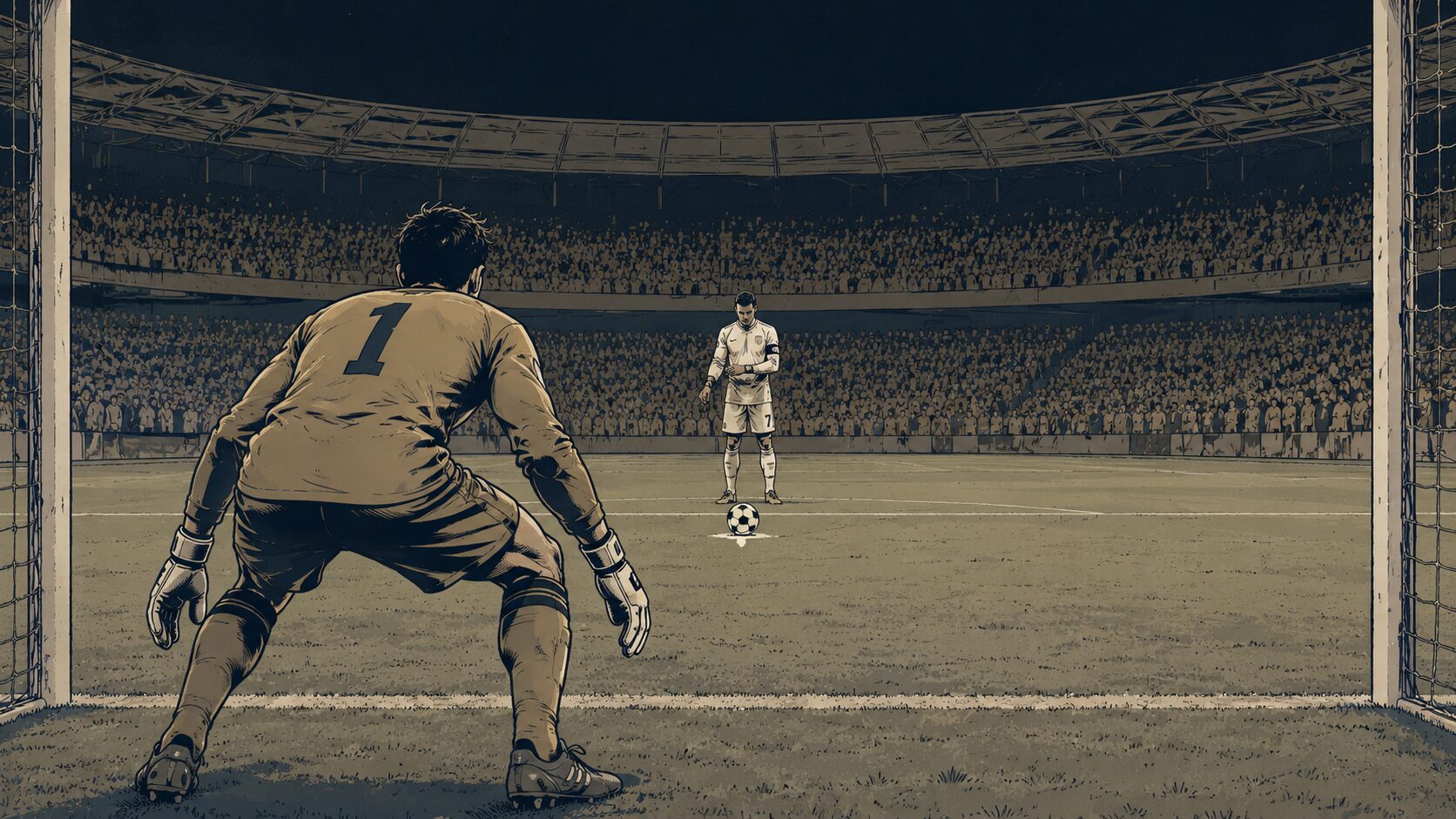
The penalty spot at Estadio Monumental in Buenos Aires is a white circle the size of a dinner plate, and Tomás Reyes had been staring at it for eleven years. Not always at this stadium, not always in Argentina — but always that circle, always that distance, always that silence that falls over a crowd of fifty thousand people in the exact same way every time a football penalty kick is about to happen. A silence that is not truly silence at all, but something else. A held breath that a whole city takes at once.
Tomás was thirty-one years old, and he had been a goalkeeper since he was nine. He was not the best goalkeeper in the Argentine national team’s history, and he knew it. He was not spectacular. He did not make the saves that became statues outside stadiums. What he had — and what he knew he had, though he never said it aloud — was patience. The kind of patience that looked like stillness from the outside and felt, from the inside, like everything moving at once.
The Weight of Watching
His father had told him once that a goalkeeper’s job was the loneliest job in football. Tomás had disagreed even at nine years old. He said the job was about watching. His father laughed. Tomás didn’t explain further, because he couldn’t yet, but the feeling stayed. He spent his childhood watching — not just the ball, not just the striker, but the whole scene. The way a player adjusted his socks before a corner kick. The way a forward looked at his own feet for half a second before a through ball. Small things. Unnecessary things, maybe. But Tomás collected them the way other boys collected stickers.
By the time he was nineteen and playing for Racing Club in Avellaneda, he had so many observations stored in a private part of his mind that sometimes he forgot which of them mattered. He saved penalties he should not have saved. He conceded penalties he thought he had read perfectly. The pattern was never perfect. But the watching — the watching never stopped.
It was in his second season as a professional that he first noticed what he would spend the next decade trying to understand. It happened during a football penalty kick in a cup semifinal, late in the season, in a stadium whose floodlights buzzed faintly at a pitch slightly too high to ignore.
What a Football Penalty Kick Leaves Behind
It was a league cup semifinal. Racing were away, in Córdoba, at Estadio Mario Alberto Kempes. The match had ended one-one after extra time, and Tomás found himself standing on the goal line at the far end of the pitch while the referee arranged the shootout. The floodlights made the grass look almost blue. The crowd from the home side was louder, but it was the kind of loudness that has already decided an outcome, already started celebrating — and that kind of loudness has always bothered Tomás less than the other kind.
The first three penalties were scored. Two for Córdoba, one for Racing. The fourth was a Racing player named Benítez, and he scored comfortably, low to the right. Then came Córdoba’s third taker, a midfielder named Galván who played with the slightly too-confident energy of someone who had trained for this specifically.
Galván walked to the spot and placed the ball. He stepped back, aligned himself, then — just before he began his run — he pressed the knuckle of his right index finger very briefly against his lower lip.
Tomás noticed it. He didn’t know what it meant. He dove to his left, Galván shot to his right, and the ball hit the back of the net. Nothing unusual. A football penalty kick is scored more often than not. Tomás picked himself up off the ground and tried to remember if he’d seen the gesture before.
He had. Two seasons ago. A different player, in a different city. The same knuckle, the same lip, the same brief and private touch. That player had also scored.
The Gesture He Kept Seeing
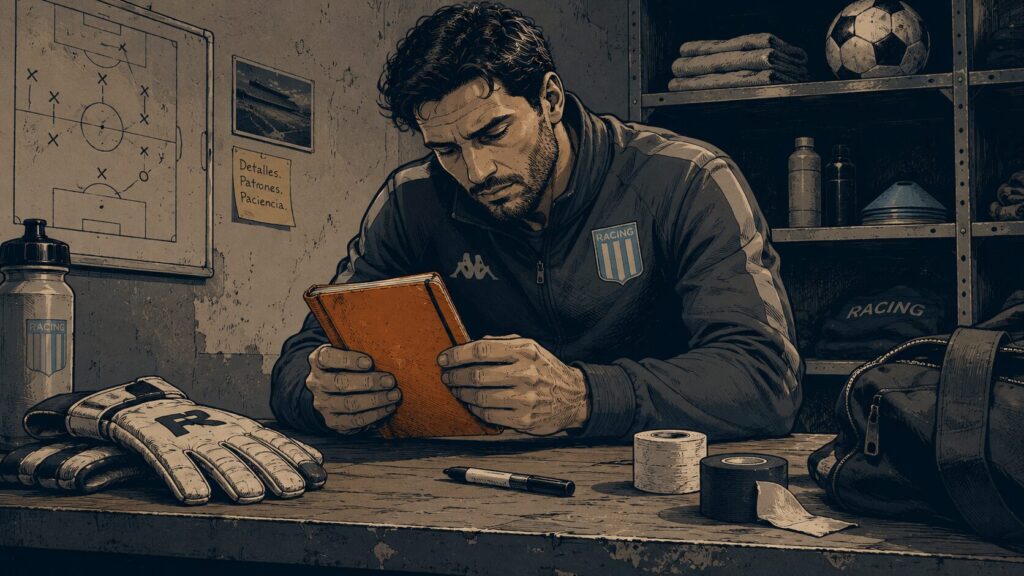
Over the next three seasons, Tomás kept a notebook. He did not tell anyone about the notebook. It was a small, orange-covered thing that he bought from a stationery shop in Buenos Aires near the Plaza de Mayo, and he kept it in his training bag under a spare pair of gloves. After every match involving a penalty kick — in training, in leagues, in friendlies, in cups — he would write down what he had seen. Not just whether the kick was scored or missed. He wrote down everything before it: posture, eye movement, where the taker looked, what their hands did, whether their head turned toward the goalkeeper at the last moment, and — most importantly — any gesture they made in the final seconds before beginning the run-up.
What emerged over three years was not clean. It was messy and contradictory in most places. But in one area it was almost uncomfortably consistent.
Players who made small self-directed gestures — a touch to the lip, a press of two fingers to the sternum, a thumb run briefly across the opposite palm — before a football penalty kick tended to miss more often than those who made no gesture at all. The sample was not enormous. Forty-one observed instances over three years. Twenty-two gestures. Of those twenty-two, fourteen ended in a miss.
Fourteen out of twenty-two was not a law. But it was not nothing, either.
Everything a Football Penalty Kick Tells You Before It Happens
Tomás shared his notebook with exactly one person: a physical therapist at Racing named Mauro Delgado, who had a minor degree in sports science and a major interest in anything that could not be fully explained. Mauro sat in the equipment room one evening after training, turning the orange notebook over in his hands the way you hold something you are not sure is real.
“Fourteen out of twenty-two,” he said.
“Yes.”
“That’s sixty-three percent.”
“I know.”
Mauro looked at the entries again. He read them slowly, not skimming. “What do you think the gesture means?”
Tomás had thought about this for three years. “Fear,” he said. “I think it’s a fear response. Something involuntary. The body betrays the mind at the last second.”
Mauro set the notebook down on the equipment table between a roll of sports tape and a water bottle. “Fear,” he repeated, but not agreeing — more like tasting the word.
“Or nerves,” Tomás added. “The same thing, really. The body knows what’s at stake. The gesture is like a tick, a self-soothing mechanism. And it leaks information.”
“And you’ve been reading it.”
“I’ve been trying to.”
Mauro picked the notebook up again and went back to the beginning. He stayed quiet for a long time, which Tomás had learned to respect. Mauro was not a man who filled silence with noise. Eventually he looked up and said, “I want to think about this.”