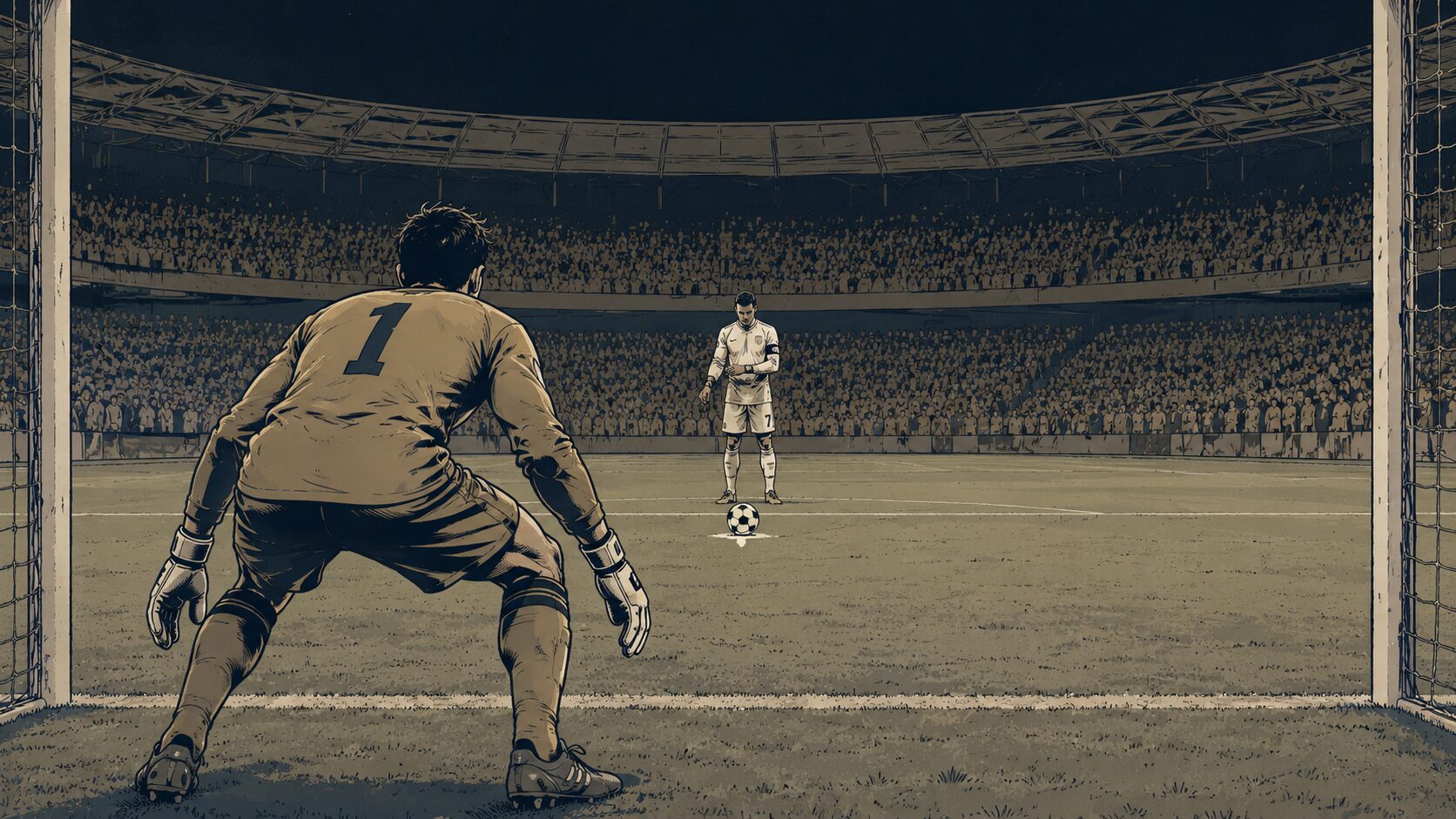
A Theory Built From Loss
That conversation happened in March. The following November, Tomás was called up to the Argentine national team squad for the first time — not as a starter, but as third-choice goalkeeper, which meant training daily with the best players in the country and standing on the sideline with a jacket on during matches. He brought the orange notebook. He kept watching.
Two friendlies, one competitive qualifier. He saw four football penalty kick attempts across those three matches. He noted three gestures. One resulted in a miss. The other two were scored.
The pattern was holding, but barely. He was starting to feel that he had built a theory from a coincidence, that fourteen out of twenty-two was a number with no real architecture beneath it. He almost stopped writing in the notebook. He almost convinced himself that the gesture was nothing — a random human habit with no signal in it whatsoever.
Then came the qualifier against Bolivia, in La Paz, in altitude that made every player move as if the air had doubled in weight. Argentina were awarded a penalty kick in the sixty-seventh minute. Their taker was a forward named Espinoza who Tomás had seen take penalties in training but never in a competitive match. Espinoza walked to the spot with the calm, measured pace of someone who had never once in his life doubted a decision, and he placed the ball without ceremony.
Then, just as he stepped back to begin his run, Espinoza pressed two fingers briefly against his collar bone — left side, very quick, barely perceptible.
Tomás, in his jacket on the sideline, felt something go very still in his chest.
Espinoza shot. The ball hit the left post and came back into play. Espinoza stood for a moment looking at the goal as if trying to understand what had happened, and Tomás wrote two words in his notebook: collar bone.
The Football Penalty Kick That Fooled Everyone, Including Him
The following April, in Rosario, Argentina played a home qualifier in which the opposition was awarded a football penalty kick in the eighty-ninth minute of a match that Argentina were winning one-nil. The taker was a player Tomás had never seen in a penalty situation before. No data. No prior observation. He was in goal that day — the first-choice keeper had a hamstring strain — and the weight of the whole situation had compressed itself into that single moment.
The player walked up. He placed the ball. He stood back. He pressed his thumb, quickly, across the top of his wrist.
Tomás’s heart did something unusual. It did not race. It slowed down. He had the notebook entry in his mind without needing to check it — he had memorised most of them by now. Thumb to wrist. He had seen it twice before. Both misses.
He did not dive early. He waited, he watched, and he went to his right just as the ball was struck. The ball went to his right as well. He got a hand to it. It went over the bar.
The crowd made a sound that was not a cheer and not a scream but something in between — relief converted into noise. Tomás stood in his goal and looked at the white circle of the penalty spot at the far end of the pitch, and felt the full, strange weight of what had just happened.
After the final whistle, two reporters asked him about the save. He said he read the player well. He said nothing about thumb to wrist. He said nothing about the fact that every football penalty kick in his orange notebook now felt like a door he had only partially opened.
What Mauro Did Not Say
That evening Tomás called Mauro from his hotel room in Rosario. It was late. Mauro answered on the second ring, which meant he was still awake and had been waiting.
“I saved it,” Tomás said.
“I know. I watched.”
There was a pause. Tomás was sitting on the edge of the bed with his boots still on, which was something he never did.
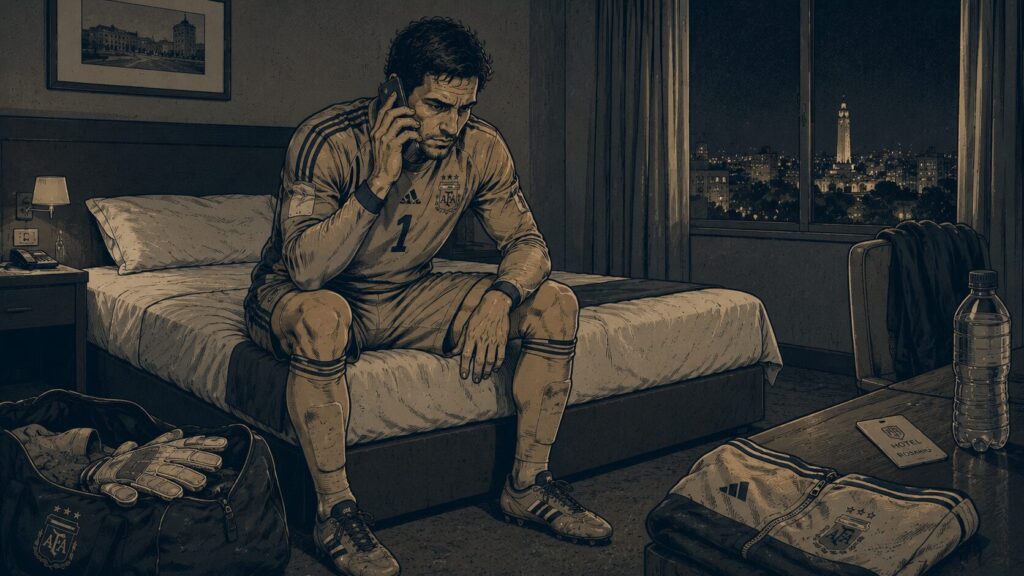
“Thumb to wrist,” he said.
“I saw,” said Mauro. “Left to right, you went.”
“Yes.”
Another pause. Then Mauro said, “I’ve been reading things.”
Tomás waited.
“About pre-commitment. About how penalty takers decide where to shoot and when they make that decision. There’s a strategy split — some players decide where they’re going before they even begin the run. They commit early. Others wait until the goalkeeper moves and then redirect. The early commiters, the ones who decide before the run — apparently they tend to go to a fixed spot no matter what happens around them. The decision is already made and locked by the time they start walking.”
“And the gesture?” Tomás said.
“That’s what I haven’t been able to work out yet,” Mauro said. “But I’m starting to think it’s not about fear.”
Tomás lay back on the hotel bed with his boots still on. Outside the window, Rosario was doing what mid-sized Argentine cities do at eleven in the evening — existing quietly with the occasional sound of a motorcycle or someone laughing from a balcony above the street. He had just saved a football penalty kick in front of forty thousand people by reading a gesture he had been cataloguing for four years, and he felt less like celebrating than like thinking.
“Not fear,” he repeated.
“Maybe not,” Mauro said. “I want to see more. I want to look at your notebook again when you’re back.”
How a Football Penalty Kick Gets Decided Too Early
They met two weeks later in the same equipment room at Racing. Mauro had printed several pages of research and placed them in a folder that he pushed toward Tomás with both hands, the way you hand someone something you are unsure will be welcome.
Tomás read. Mauro watched him read. Neither spoke for close to twenty minutes.
What the research described was a concept Tomás had no name for before seeing it in print: the keeper-independent strategy, as opposed to the keeper-dependent one. A penalty taker using a keeper-dependent strategy waited until the goalkeeper committed to a direction and then shot to the opposite side. Technically demanding. High execution risk. But theoretically sound.
The keeper-independent strategy was simpler. The taker chose a corner before beginning the run, committed to it fully, and shot there regardless of where the goalkeeper moved. No adjustment, no reading of the dive. Just the pre-decided direction and the execution of sending the ball there.
And the problem, Tomás read, was this: the keeper-independent taker was not less confident. He was not more nervous. He was simply fixed. He had made the decision so far in advance that by the time he stood at the spot and looked at the goal, there was no decision left to make. The mind had already left the body there alone with a completed plan.
“The gesture,” Tomás said finally, without looking up from the pages. “It’s the seam point. The exact moment a football penalty kick stops being a decision and becomes only an execution.”
“Yes,” said Mauro.
“It’s not fear.”
“No.”
“It’s the mind finishing before the body has even started.” He looked up. “The gesture is the seam. Where the decision closed.”
Mauro nodded slowly.
Tomás thought about Galván in Córdoba, about the knuckle against the lip. About Espinoza and the collar bone. About the thumb across the wrist in Rosario. He thought about all fourteen misses and the eight scores. He thought about what was different between them.
“The ones who scored,” he said, more quietly.
“The ball still went where they planned,” Mauro said. “They missed the goalkeeper. The gesture doesn’t always mean a miss. It means the direction is fixed. If you know the direction and go there—”
“Then it becomes a question of execution,” Tomás said. “Whether the shot is accurate enough.”
“Exactly.”
Tomás set the pages down. Outside the equipment room a sprinkler was running on the training pitch, and the sound of it came faintly through the closed door. “So I’ve been reading it right for four years,” he said. “But I had the wrong reason.”