Sand is expected to behave in certain ways. It shifts under pressure, absorbs heat, and settles back into stillness. In deserts, this expectation becomes even stronger, which is why the idea of singing sand feels almost wrong at first mention. These landscapes are often described as quiet not because they are peaceful, but because they appear inactive. The ground moves, but nothing seems to answer. For that reason, sound feels misplaced there—something meant for weather, animals, or machines, not for the land itself.
Yet in a small number of deserts, silence does not hold. When the surface of certain dunes slides, a low tone emerges. It doesn’t burst outward or scatter. Instead, it stays close to the ground, steady and contained. The sound can last briefly or continue as long as the sand keeps moving. Nothing about the dune’s appearance explains it. The slope looks ordinary, even while it resonates.
That mismatch is difficult to ignore. Sound usually follows motion we can see. Here, the movement remains familiar while the result does not. The dune doesn’t suggest force or activity, yet it refuses to stay mute. Without warning or display, it responds in a way that feels precise rather than accidental.
When Singing Sand First Drew Attention
The earliest written mentions of singing sand appear in travel records rather than scientific texts. Ancient Chinese documents describe dunes that produced deep, drum-like sounds when disturbed. Marco Polo wrote about deserts that hummed loudly enough to startle travelers at night. In North Africa, explorers recorded hills that released sound when their surfaces shifted.
What is striking about these accounts is their restraint. The observers did not exaggerate or mythologize what they heard. They did not frame it as a miracle or a warning. Instead, the sound was noted the same way terrain or distance would be noted. It was a property of the place, not a story demanding interpretation.
Over time, that matter-of-fact awareness faded. Routes changed, travel accelerated, and attention narrowed. The dunes did not stop singing. The sound did not disappear. What disappeared was the habit of noticing something that did not insist on being noticed.
Where Singing Sand Still Exists Today
Singing sand has not gathered in one region. It appears in scattered locations across the world. In parts of the Gobi Desert, large dunes produce low, booming tones when sand slides in volume. In Morocco, certain dunes emit a sustained hum that can last for minutes. Smaller dunes in California’s Mojave Desert create softer, almost murmured sounds.
These places share no culture or climate that explains the phenomenon on its own. What they share is fragility. The sound depends on conditions that are easy to disrupt. Moisture, uneven grains, repeated disturbance — any of these can silence a dune permanently. The land remains, but its voice does not return easily.
Because of this, singing sand feels temporary even where it still exists. It is not something that can be scheduled or guaranteed. A person can stand on the right dune at the wrong moment and hear nothing. The experience belongs to alignment, not location.
What Makes Singing Sand Possible
The sound of singing sand does not come from impact or collision. It emerges when countless grains move together in a coordinated way. As the sand slides, vibration builds and travels upward through the dune. The volume does not come from force, but from unity. The sound grows only while that coordination holds.
This explains why a small movement can produce a sound that feels much larger than the action that caused it. The dune is not reacting to pressure. It is responding to balance. When that balance breaks, the sound stops immediately. Nothing collapses. Nothing marks the end. Silence simply returns.
Knowing this does not make the sound feel mechanical. Instead, it makes it feel conditional. The sound exists only when circumstances align precisely, and disappears the moment they do not. It is less like noise and more like a brief state the land passes through.
Why Singing Sand Feels Aware
People who hear singing sand often struggle to describe it without implying intention. The sound does not scatter or echo unpredictably. It holds its place. It feels contained, almost directed. That quality makes it difficult to dismiss as random.
At the same time, nothing visible appears responsible. There is no structure opening or closing, no movement beyond sand doing what sand normally does. The absence of a visible cause creates tension between what is seen and what is heard. The mind searches for something to assign responsibility to.
As a result, perception shifts. The dune does not feel alive, yet it no longer feels passive. The sound suggests response without expression. Not communication, but acknowledgment. The land feels capable of more than weight and stillness, even if it never reveals how.
What the Sound Refuses to Give Away
Modern tools can record frequencies and describe conditions, yet none of that captures the experience itself. Recordings flatten the sound. Descriptions reduce it. The phenomenon resists being turned into something portable or repeatable.
Part of that resistance comes from scale. Singing sand is too broad to feel intimate, yet too restrained to feel overwhelming. It occupies a narrow space that does not translate well. Any attempt to exaggerate it distorts it. Any attempt to simplify it empties it.
Because of this, the sound remains tied to presence. It exists fully only in the moment it happens. Understanding how it occurs does not dissolve its effect. It emphasizes how easily it can vanish without explanation.
When the Surface Remembers
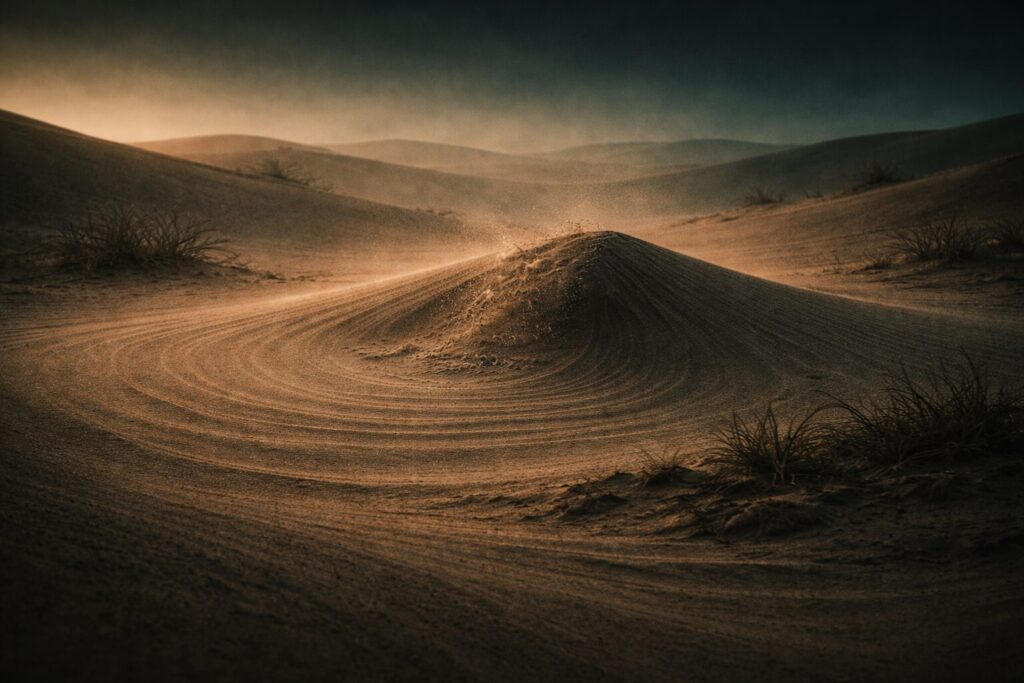
After the sound fades, the dune does not return exactly to its earlier state. The surface settles differently. Ripples soften, lines realign, and slopes carry faint signs of recent movement. Nothing announces itself as proof. The changes are subtle and temporary.
Wind begins erasing those traces almost immediately. Given enough time, the surface becomes indistinguishable from any other dune nearby. Still, for a brief period, the sand holds the memory of coordination. The sound is gone, but its conditions remain visible.
This is where form quietly becomes relevant. Certain shapes seem to hold stillness the way the dune held sound — without excess, without emphasis. An object shaped by singing sand does not explain the phenomenon; it exists because that precise alignment mattered. Like the surface after movement, it carries evidence without demanding attention.
After the Dune Falls Silent
When the sound ends, nothing dramatic follows. The dune does not collapse or change shape in a visible way. The sand settles, the air clears, and the place returns to the stillness it held before. Anyone arriving afterward would see nothing unusual. Without having heard it, there would be no sign that the dune ever produced sound at all.
What changes is not the landscape, but the way it is understood. A desert that once seemed permanently quiet is now known to be conditionally so. Silence stops feeling like a fixed trait and starts feeling like a state that can shift. The land does not promise response, yet it has already shown that response is possible.
That knowledge stays subtle. It does not demand attention or explanation. It simply sits there, altering how stillness is perceived. The dune looks the same, but it no longer feels empty. It feels capable—only under the right conditions, only briefly, and without needing to announce itself again.