The Captain’s Walk
Brazil’s captain came fourth in the shootout. His name was Edson. He was thirty-three years old, he had been playing international football for eleven years, and he had taken penalty kicks in every type of match — leagues, cups, qualifiers, knockout rounds. Tomás had watched footage. He had a strong preference for the bottom right from his right foot, but he had scored to the left as well, twice. He was not a creature of fixed habit. He was, if Tomás had to characterize him based on the video, a thinker.
The first three kicks of the shootout had gone: Argentina scored, Brazil scored, Argentina scored. Then Brazil’s second taker — a young midfielder playing only his second major tournament — had stepped up, made no gesture, and smashed the ball against the crossbar. His run-up had been too fast. His weight had been wrong. Nothing about the football penalty kick had felt settled in that moment. Tomás had gone early to his left, guessed wrong, and it hadn’t mattered because the execution had failed without his involvement.
Argentina’s fourth taker scored. Now it was Edson.
The crowd’s sound changed when Edson walked to the spot. Not louder — altered. Fifty-two thousand people who all knew who he was doing the same thing at once: paying a different quality of attention.
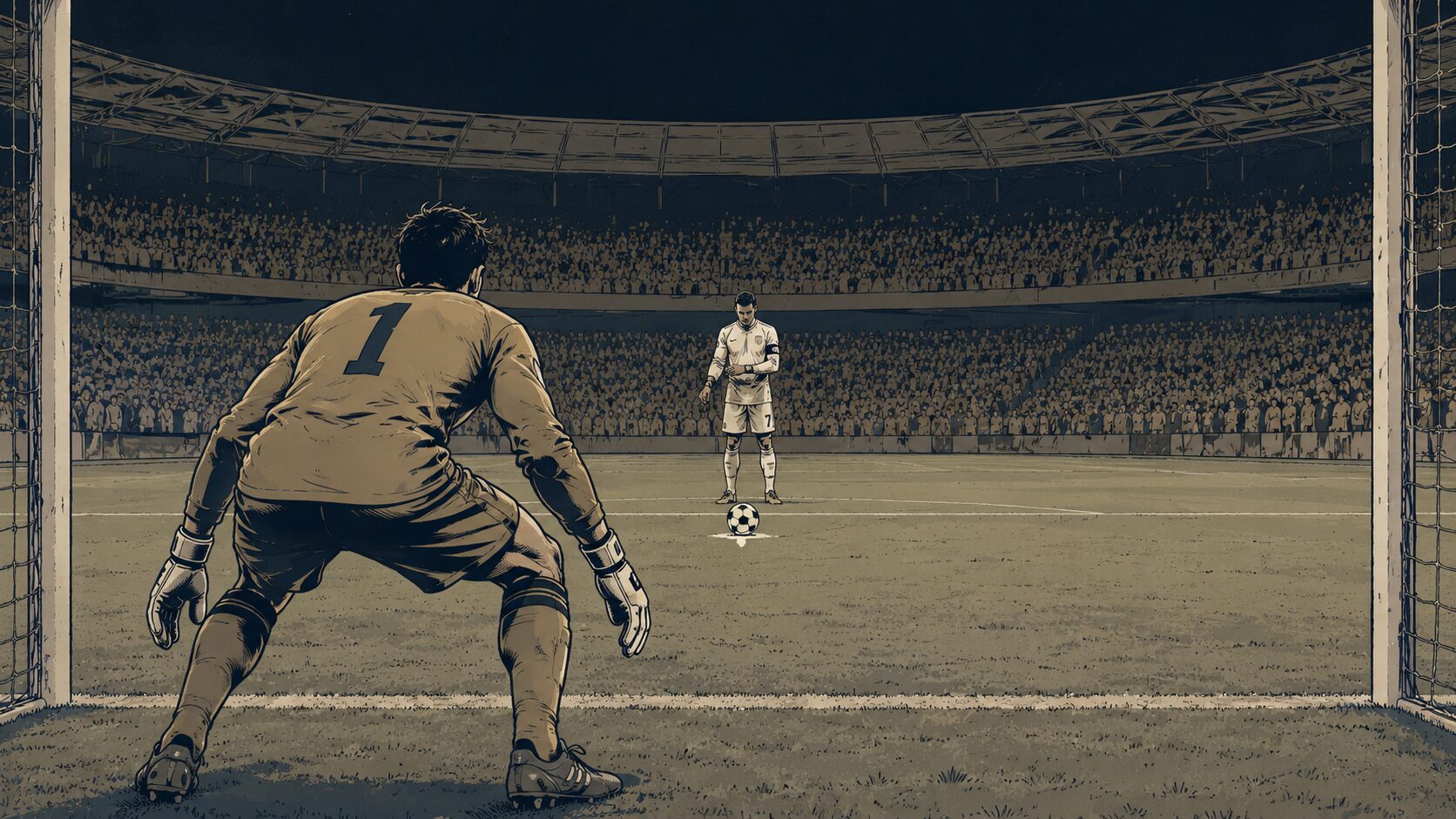
Edson placed the ball. He stepped back. His posture was even. His face showed nothing Tomás could read at distance. He made a small half-turn to align his run, and then he was still.
And then, very briefly, almost imperceptibly — he raised his right hand and pressed two fingers flat against the back of his left wrist. It was the gesture of a man checking a watch that was not there.
One Football Penalty Kick Left
Tomás felt the thing in his chest that he had felt in Rosario six years ago. The slowing-down feeling. Not calm, not relief — something more precise than either. The feeling of a conversation becoming clear.
He had the notebook in his mind. He ran through Edson’s video, which he had watched twelve times. Right-foot taker. Strong preference bottom right. The gesture had appeared, which meant the decision was already made and locked. The mind had finished. The corner was chosen.
But which corner?
A keeper-independent taker did not change because of you. He went where he had decided. The gesture confirmed pre-commitment; it did not confirm direction. Tomás had to use what he had. Video: eight out of eleven kicks, in the footage he had found, were bottom right. Three were left, and all three had come in low-pressure training situations. In a football penalty kick of this weight, in a World Cup quarterfinal, in Buenos Aires, at this moment—
Tomás made his decision. He did not allow himself to un-make it.
His decision was: right.
He stood on his line and looked at Edson and did not think about fear. He thought about a fixed point. He thought about a mind that had already finished and a body that was now simply executing. He thought about the thumb against the wrist and the collar bone and the knuckle against the lip, and the fourteen misses and the eight scores, and the orange notebook on the shelf above his kitchen table, and the twenty years of watching — not just the ball, not just the striker, but the whole scene.
Before the Whistle
Edson began his run-up.
It was not a long run. Five steps. Measured. Even. The run-up of someone who had done this thousands of times and was not trying to fool anyone because he did not need to.
Tomás watched the trunk, the plant foot, the angle of the body as it moved through its approach. Everything was consistent with the pre-committed taker. Nothing changed in the last two steps. No adjustment, no hesitation, no last-second reading of the goalkeeper’s body. Edson was not looking at Tomás anymore. He was looking at a point that was not in the goal but somewhere behind it, some fixed target that only he could see.
The crowd held its breath.
The whole of Buenos Aires, Tomás thought in the fraction of a second before — the whole city was doing what it always did. That held breath that was not silence. The Estadio Monumental trembling very slightly with the contained force of fifty-two thousand people all wanting the same thing at once.
He thought about the notebook. Not the specific entries, not the numbers — just the object itself. The orange cover, the slight warping of the spine from being carried in a bag for years, the way the pages near the back had dried differently from the pages near the front because he’d once left it too close to a water bottle that had leaked. He thought about his daughter reaching for it from the shelf and not knowing what it was — a child’s hand on the cover of a record of every football penalty kick he had ever watched with the specific attention of someone trying to understand something that was not yet understood. He thought about Mauro in Mendoza, who was probably not watching — Mauro rarely watched the big matches, he’d said once, because they made him nervous in a way that had nothing to do with the football and everything to do with knowing too much about the people involved.
Tomás pressed his heels against the goal line. The white paint was cool through the thin rubber of his gloves where he briefly touched the post on his right side — an old habit, one he’d had since Racing, a gesture of his own he’d never thought to analyse.
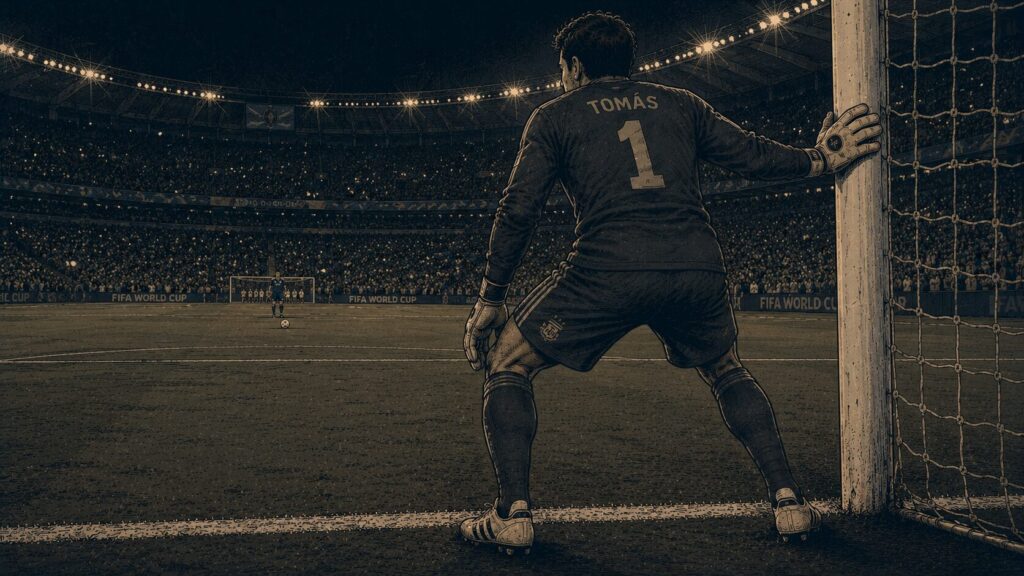
Edson’s plant foot landed.
The angle of the body was right. Not a metaphor, not a feeling — the geometry of it matched what he’d seen in twelve replays and what his body had absorbed from two decades of standing in goals while men ran toward him with the same intent and different execution. Right. The decision, already made three steps into the run-up, was aimed right. The body was simply completing what the mind had finished minutes ago, or hours, or the night before in some hotel room with a tactics board and a memory of the goalkeeper who would be standing here.
Tomás had already moved.
Not much. Not the full dive — that came a half-second later, in the full commitment of muscle and weight and the particular tilt of the body that meant there was no going back. But the initial shift, the small lean, the rebalancing of weight onto the left foot that would drive him rightward — that had already happened. It had happened before Edson’s foot touched the ball, and that was not instinct. That was the orange notebook. That was fourteen misses and eight scores and a quiet evening in an equipment room in Avellaneda with a sprinkler running outside and a man who had said I want to think about this and then actually thought about it.
That was everything a football penalty kick had ever taught him, absorbed so deeply now that it no longer felt like knowledge — it felt like gravity.
The ball left Edson’s foot.
The Estadio Monumental exhaled.
And Tomás, already in motion, had no more thoughts at all — only the direction he had chosen, and the air rushing past his ears, and the white circle of the penalty spot at the far end of the pitch shrinking behind him as he went.
The smallest moment often carries the greatest decision. This artifact preserves the silence before a football penalty kick, when the game has already begun inside the mind.