The lighthouse keeper was not supposed to be here. That was the first thing Karim Hossain thought when the speedboat pulled away from Mognama Ghat and left him standing on the narrow concrete jetty with a duffel bag and a handover sheet and nothing else — not supposed to be here, and yet here, undeniably, the Bay of Bengal spread out before him in every direction like a sentence that had forgotten how to end. He was twenty-three. He had passed his Department of Shipping certification on the second attempt. The man who was supposed to take this posting — a senior keeper named Rafiq with fifteen years of coastal stations behind him — had broken two fingers on his left hand unloading cargo in Chittagong three days before his start date, and Karim had been the only certified name available on short notice, which was the sort of logic that moves a person’s life in directions they hadn’t agreed to.
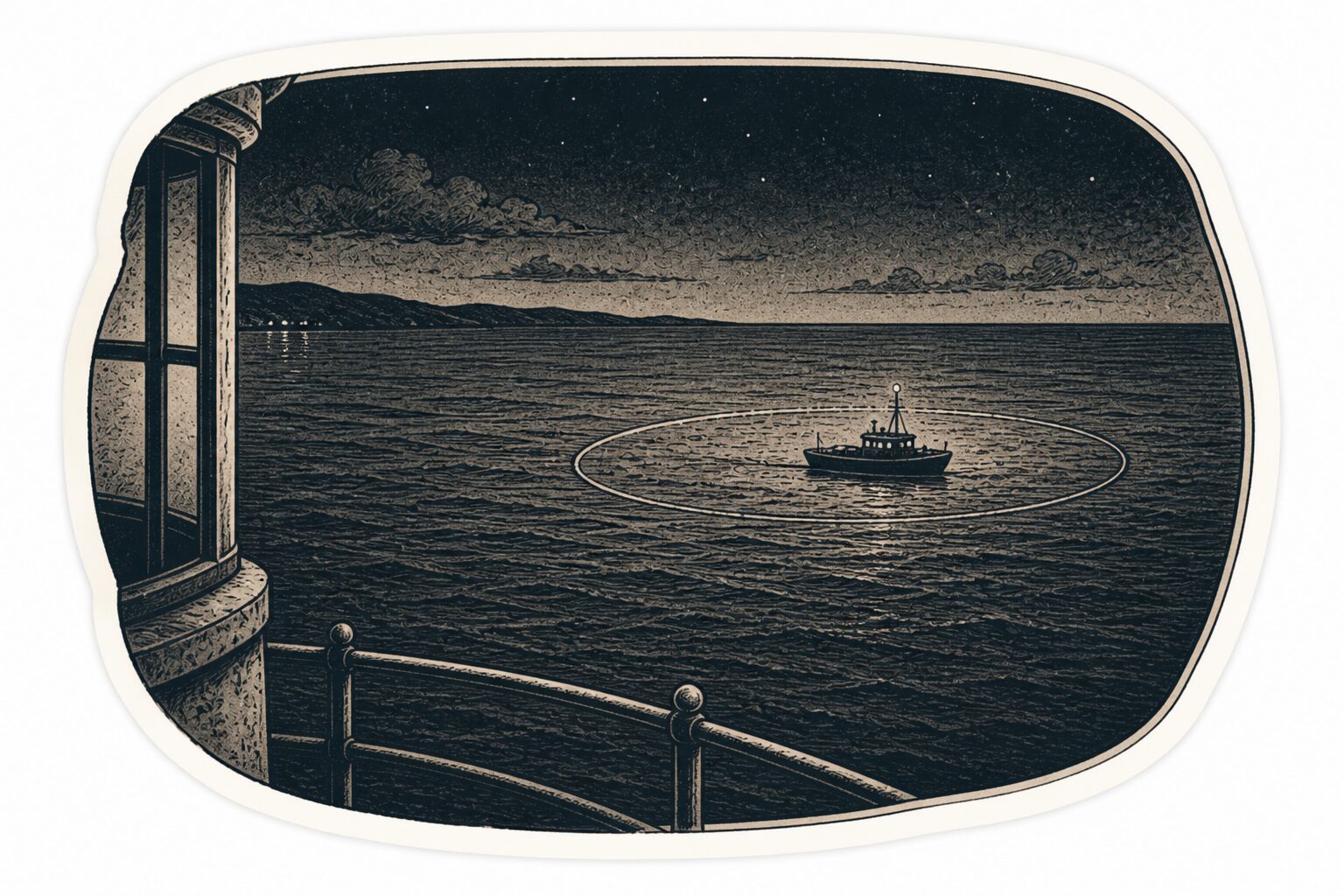
He stood on the jetty for longer than he needed to. The lighthouse keeper’s station rose behind him — the skeletal steel tower in its red and white horizontal bands, thirty-five metres of it catching the late afternoon light in a way that made it look briefly alive. The Bay stretched west and south, brown at the shore and darkening fast, the kind of water that doesn’t reflect the sky so much as swallow it. At the base of the tower, close to the waterline, a concrete marker sat in the sand. He had read about it in the handover file on the bus from Chittagong: the original batighar, established here in 1846, forty metres of stone built on six chambered floors with wooden stairs and a lamp of eight wicks burning coconut oil, which had guided ships away from this coast through every monsoon and cyclone the Bay produced for over a century, until a tidal bore in 1960 took the beach from under it and the whole structure went into the water. The stone crown was still there on the seabed. On the clearest low-tide mornings it broke the surface — still present, still occupying the coordinates it had always occupied, surrounded by a bay that had completely rearranged itself in the sixty years since the tower fell.
He picked up his bag. He went inside.
The outgoing keeper, Jalal, had left that morning. He’d left the handover sheet on the desk, the logbook open to a clean page, and a note that said: Log everything. Don’t assume anything is routine until you’ve seen it three times. Good luck. Karim read the note twice, decided the advice was either very wise or very ominous, and put it in his pocket.
The First Thing the Lighthouse Keeper Got Wrong
He thought the hardest part would be the solitude.
He had been told this by everyone who knew he was taking the posting — his mother in Dhaka, who called it loneliness duty; his friend Nasir, who said he’d last a week before going mad; his certification instructor, who said the psychological component of solo posting was underestimated by every candidate without exception. Karim had prepared for loneliness the way you prepare for a difficult exam: systematically, a little arrogantly, with more confidence in his preparation than the situation warranted.
The solitude, it turned out, was fine. The island was not empty — it was dense with movement and sound, fishing trawlers working the inner channel before dawn, cargo ships staging at the outer anchorage in the afternoon, egrets standing in the shallows with the absolute stillness of creatures that had decided patience was the only intelligent response to existence. The lighthouse keeper’s job, he discovered, was not to endure silence but to pay attention inside noise — to separate the significant from the ambient, to know which sound meant something and which was just the Bay talking to itself.
What he hadn’t prepared for was the logbook.

The logbook was a blue hardcover ledger, the current volume in a series going back eleven years. He had been told in training that log-keeping was mechanical — date, time, vessel type, heading, speed, any radio contact. What the training had not conveyed was that a logbook written with care becomes a kind of argument. Every entry was a claim: this happened, at this time, and I was paying attention. Every blank space was its own kind of statement. Karim understood, by the third day, that the logbook was not a record of the Bay. It was a record of the lighthouse keeper’s relationship to the Bay. The accuracy of one depended entirely on the quality of the other.
He started keeping a second notebook. Personal. Unofficial. The kind of thing that had no format.