The Language Underneath the Grass
What shifted after that meeting was not dramatic. Tomás did not suddenly become a different goalkeeper. He did not dive more decisively or save more penalties. What changed was subtler: he stopped thinking of the gesture as a symptom of something broken in a player and started thinking of it as information about something already completed.
He went back through the notebook and reread every entry with different eyes. The fourteen misses did not un-miss themselves. But they changed meaning. Those players had not missed because their bodies betrayed a secret fear. They had missed because their minds had sent them to one specific corner and the ball had not gone there precisely enough. The goalkeeper’s presence, Tomás now understood, had almost been irrelevant to those kicks. The shooter’s fate was written before the run began.
This was either more useful or less useful than fear, depending on what you did with it. A football penalty kick decided before the run began was not something you could disrupt — you could only position yourself ahead of the decision that had already been made.
The Football Penalty Kick as a Fixed Point in Time
Tomás spent the next two years working on a specific skill: reading the gesture, estimating the probable corner — based on player stance, preferred foot, historical data from his notebook and from video — and then moving not on instinct but on inference. Not waiting for the ball to begin moving and reacting, which is what goalkeepers are trained to do. Moving earlier, just slightly, but on the strength of a conclusion rather than a reflex.
It did not always work. He still conceded penalties when no gesture appeared. He still conceded some when a gesture did appear, because the execution was clean and the ball landed in the corner he’d predicted and he simply couldn’t reach it. A football penalty kick hit accurately into a corner is often just not saveable. That was something the research confirmed, and Tomás had known it from years of practice without needing the confirmation.
But against certain types of players — the fixed ones, the committed-early ones, the ones who made the small involuntary gesture of a mind that had already closed — he now had something that felt less like a guess and more like a conversation he was listening to from another room.
He shared the updated version of his thinking with Mauro, and Mauro shared it with no one else, as agreed. It was the kind of knowledge that only worked if it was private. The moment it became common — the moment players started training to suppress the gesture — the whole system would collapse. Tomás knew this without needing to say it. Mauro knew it too.
What Fear Looks Like Versus What Fixation Looks Like
Two more years passed. A World Cup qualifying campaign. A continental championship. Tomás became the starting goalkeeper for Argentina. He was not celebrated the way the forwards and midfielders were celebrated — a goalkeeper’s work is most visible when it fails, and Tomás’s great skill was making his work invisible. Saves that looked easy because he was already where the ball was going.
He gave one interview about penalty saving. A journalist from a Buenos Aires sports magazine came to the training ground at Ezeiza and sat across from him with a recorder running, and asked him what he thought made the difference in a football penalty kick situation.
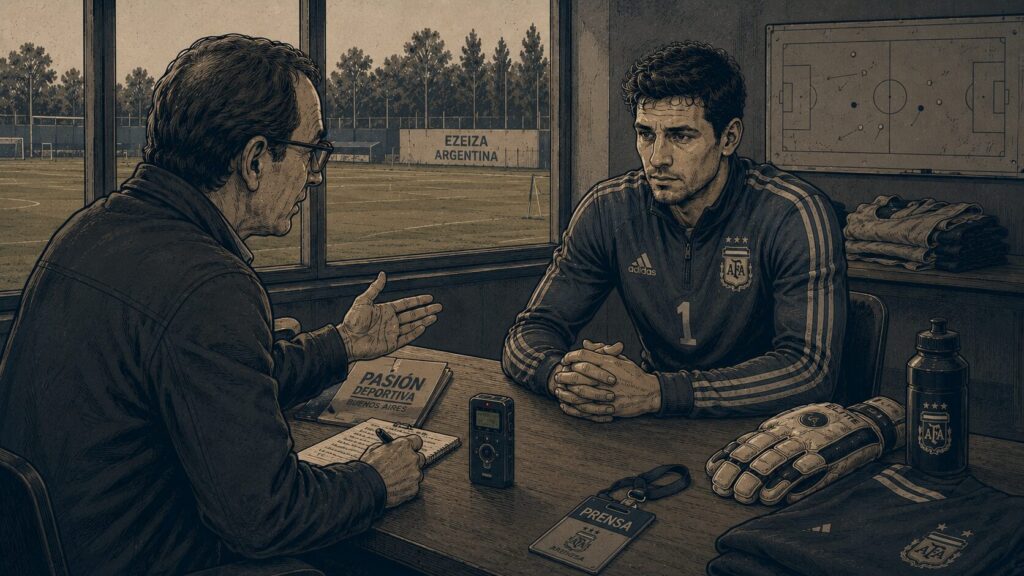
Tomás gave a long, considered answer about positioning, about staying balanced, about trying to gather whatever information was available from the player’s approach. He said nothing about the notebook. He said nothing about the gesture. He said nothing about fixed minds and early decisions.
The journalist seemed slightly disappointed, as if hoping for something dramatic. Tomás smiled in what he hoped was a reassuring way and offered to show the journalist the training pitch. The journalist declined politely. They shook hands and the recorder went into a bag.
What fear looks like and what fixation looks like from the outside — Tomás had learned — are almost identical. Both produce a stillness in the eyes. Both produce a slight rigidity through the shoulders. The difference is interior: fear is a moving thing, shifting and uncertain; fixation is a completed thing, a conclusion already reached. You cannot tell them apart without knowing what to look for. And even knowing, you can be wrong.
Reading a Football Penalty Kick From the Inside
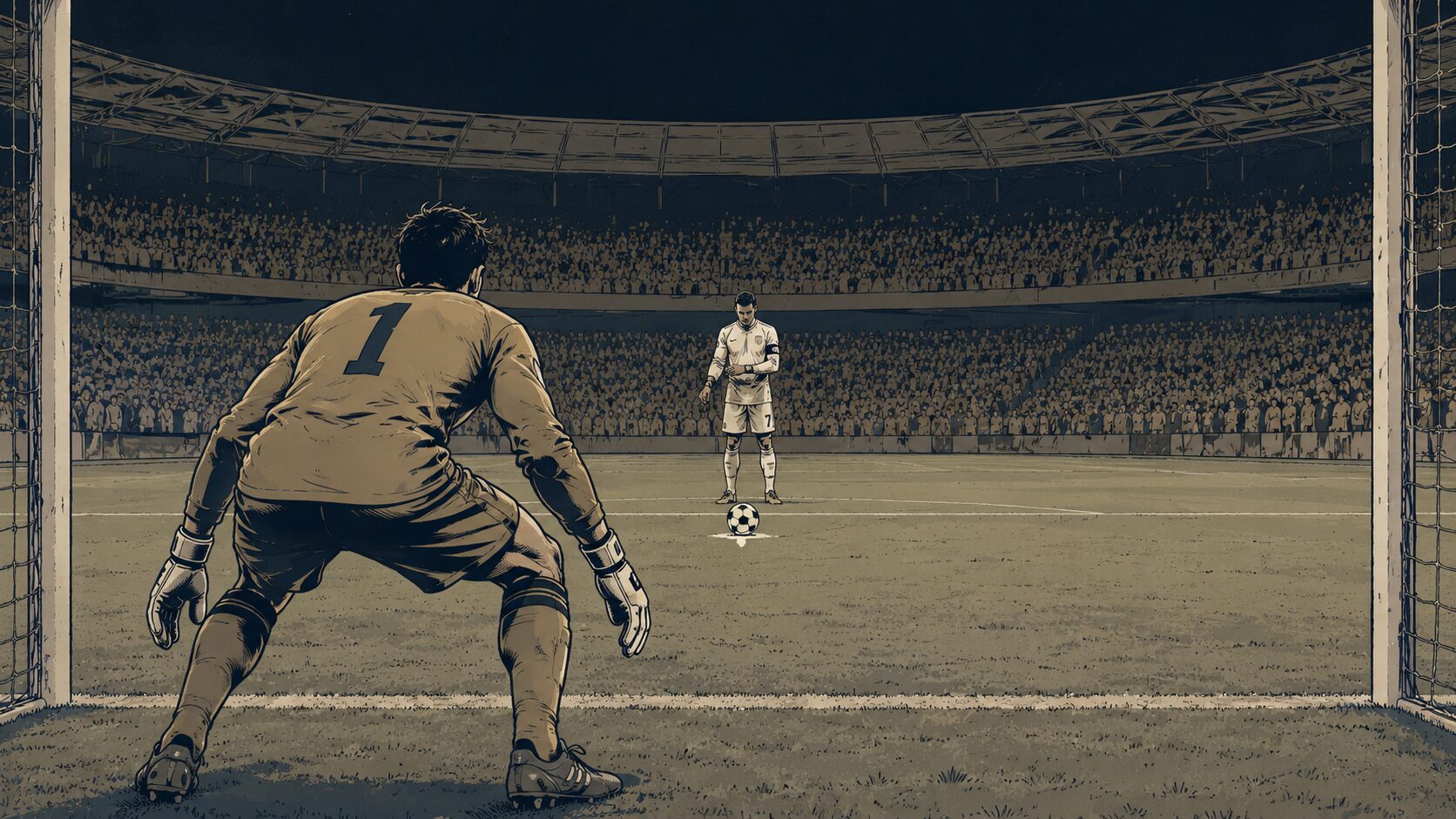
Before a World Cup football penalty kick shootout, Tomás sat in the dressing room at the Estadio Monumental — the same stadium, the same pitch, the same white circle he had been standing in front of since he was twenty — and did not speak. The other players were various: some talking loudly to release pressure, some very quiet, some listening to music, one of the defenders pacing from one wall to the other at a measured, involuntary rhythm. The coach spoke briefly. The goalkeeper coach spoke briefly. Then there was nothing left to say and they went back out through the tunnel.
It was a World Cup quarterfinal. Argentina and Brazil, in Buenos Aires. Fifty-two thousand people inside the stadium and the kind of night air that makes everything feel slightly unreal — warm, very still, with the smell of cut grass and the distant suggestion of the Río de la Plata. It had gone to extra time at two-all. The football penalty kick shootout was the only resolution left.
Tomás took his position on the goal line and looked at the spot. He thought, briefly, about the orange notebook, which was at home on the shelf above his kitchen table where his daughter sometimes reached up and tried to pull it down. He thought about Mauro, who was not here tonight — Mauro had left Racing three years ago and now worked in youth development in Mendoza. They still called each other sometimes. They had never spoken publicly about any of it.