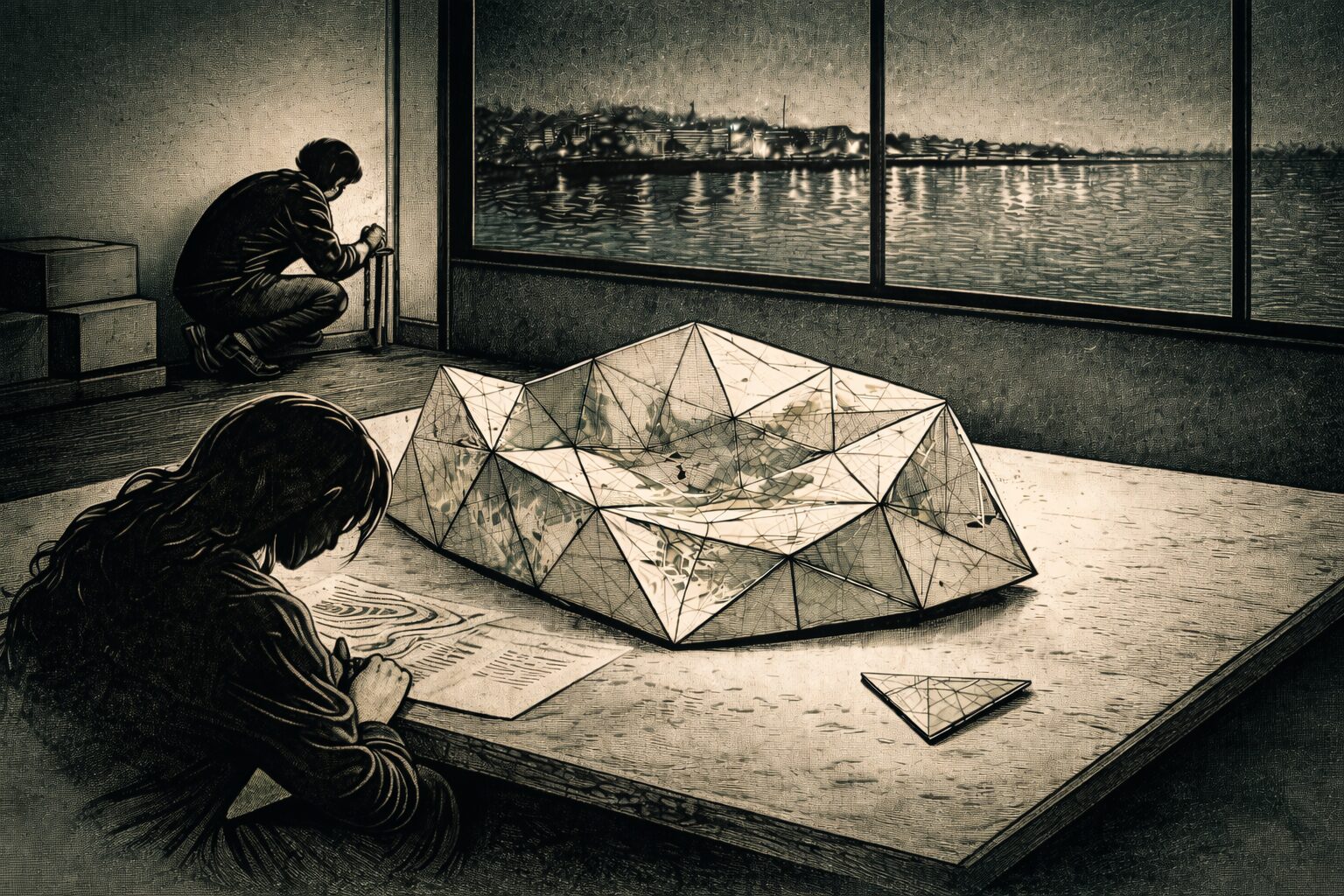
Inside MAAT — Museum of Art, Architecture and Technology in Belém, Lisbon, the air carried river salt and the dry smell of old metal. The lights were set to late-hours brightness, the kind that makes concrete look clean even when it isn’t. On a worktable that should have been empty sat a folded object with sharp seams, and Asha couldn’t stop looking at it: a Dymaxion Map that hadn’t been scheduled, logged, or explained.
Leo crouched by a wall panel with a small screwdriver, moving like the building could hear him. Asha kept her thumb on the edge of her lanyard, rolling the plastic clip back and forth—her quiet tell when something didn’t match the list. The museum was closed, yet the place still had rules: no loud voices, no wandering without a badge, no touching anything that might turn into tomorrow’s incident report.
The folded map clicked.
Not a paper rustle. A precise little sound, like a latch testing itself.
Asha placed two fingers on a triangle edge. The surface felt like coated paper that wanted to last, with seams pressed so many times they’d learned the memory of being folded. She didn’t open it. She waited, the way you wait when a streetlight flickers and you want to see if it will do it again.
It clicked a second time, as if annoyed by her patience.
The river kept tapping the glass like it had a question.
Behind the gallery windows, the Tagus moved in broken ribbons of light. Outside, a few late walkers drifted along the riverfront, phones glowing in their hands, stepping slower near the museum as if the building asked for it. Inside, the quiet had layers: the low hush of vents, the distant murmur of the old power station side, and—beneath it all—a hum that was almost too steady to notice.
Leo straightened and slid his tool back into a pouch. The zipper sounded too loud in the empty room.
“Is that yours?” Asha asked, not looking up from the folded object.
Leo gave the map a long glance, then her. “If it were mine, I wouldn’t leave it like a confession on a table.”
Asha’s mouth moved as if she might smile, but she didn’t. She leaned closer. The map smelled faintly like a book kept away from sunlight, not like fresh ink. That smell didn’t belong to anything delivered this week.
The folded object clicked again, and a thin line of pale light ran along one seam, then disappeared.
Leo’s eyes tightened. “Okay. That’s new.”
Asha kept her fingers still. “It wants to be unfolded.”
“It wants?” Leo repeated, half amused, half not.
“It’s acting like it wants,” Asha said. “And the building is acting like it noticed.”
As if the museum had been waiting for someone to say it out loud, the hum in the walls shifted a fraction, then settled again.
The Dymaxion Map lay folded like a quiet dare.
Asha opened it carefully, not all at once, but like you’d open a letter that might carry powder. The triangles spread outward in a net that refused the comfort of a rectangle. Edges interrupted, tabs and cuts placed with intention. It was a world laid out in sharp faces, as if the Earth had agreed to be understood only in pieces.
Leo leaned in. “That’s not Mercator.”
Asha traced a seam with her nail. “Good.”
He looked offended on Mercator’s behalf. “Mercator isn’t evil. It does what it was meant to do.”
“It does,” Asha agreed. “But it also makes certain places look like they own the page.”
Leo’s lips pressed together, like he wanted to argue but couldn’t deny the feeling. He pointed at a landmass that looked familiar but not in its usual posture. “This is Fuller’s projection.”
“Dymaxion,” Asha said, and the name felt oddly correct in her mouth, like she’d seen it before in a dream and forgot until now.
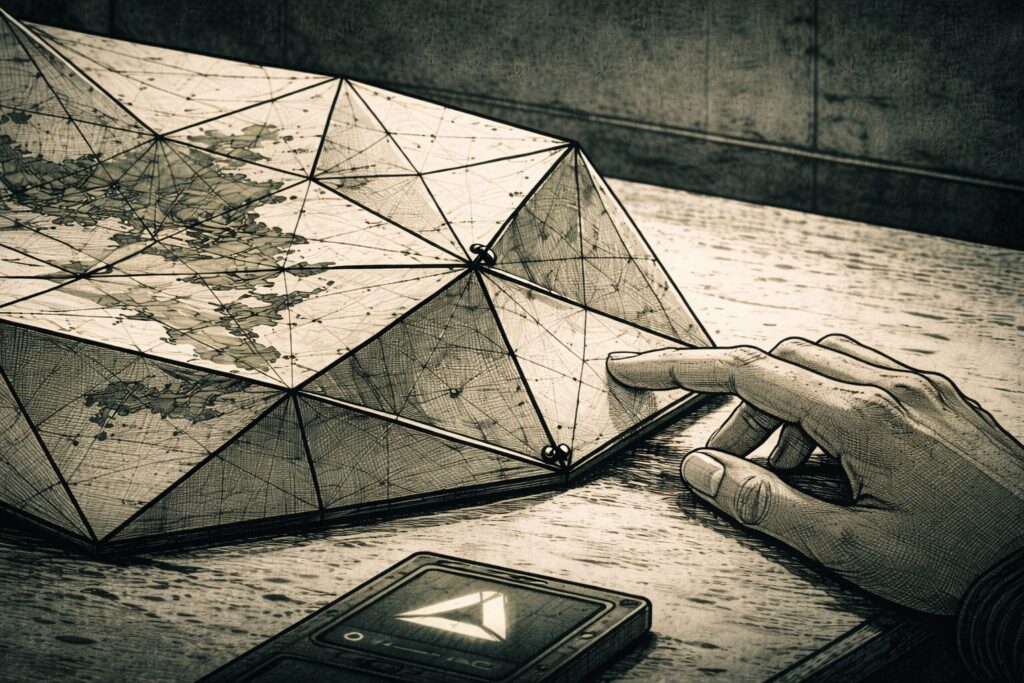
The map clicked. One triangle face shifted slightly, not tearing, not bending—just adjusting, as if the seam were a hinge in something more than paper.
Leo’s badge beeped once, sharp. The tiny display flashed an icon he’d never seen: a triangle.
Asha found faint writing forming along an ocean cut, like a message appearing on fogged glass.
FACE 12. FOLD TO HINGE.
Leo read it twice. “Face twelve like it’s a die.”
Asha’s fingers tightened. “Like it’s an icosahedron.”
Leo blinked. “Twenty faces.”
Asha nodded. “And this net can fold into it.”
The museum lights held steady, but the air felt charged, like the building had turned its head toward them.