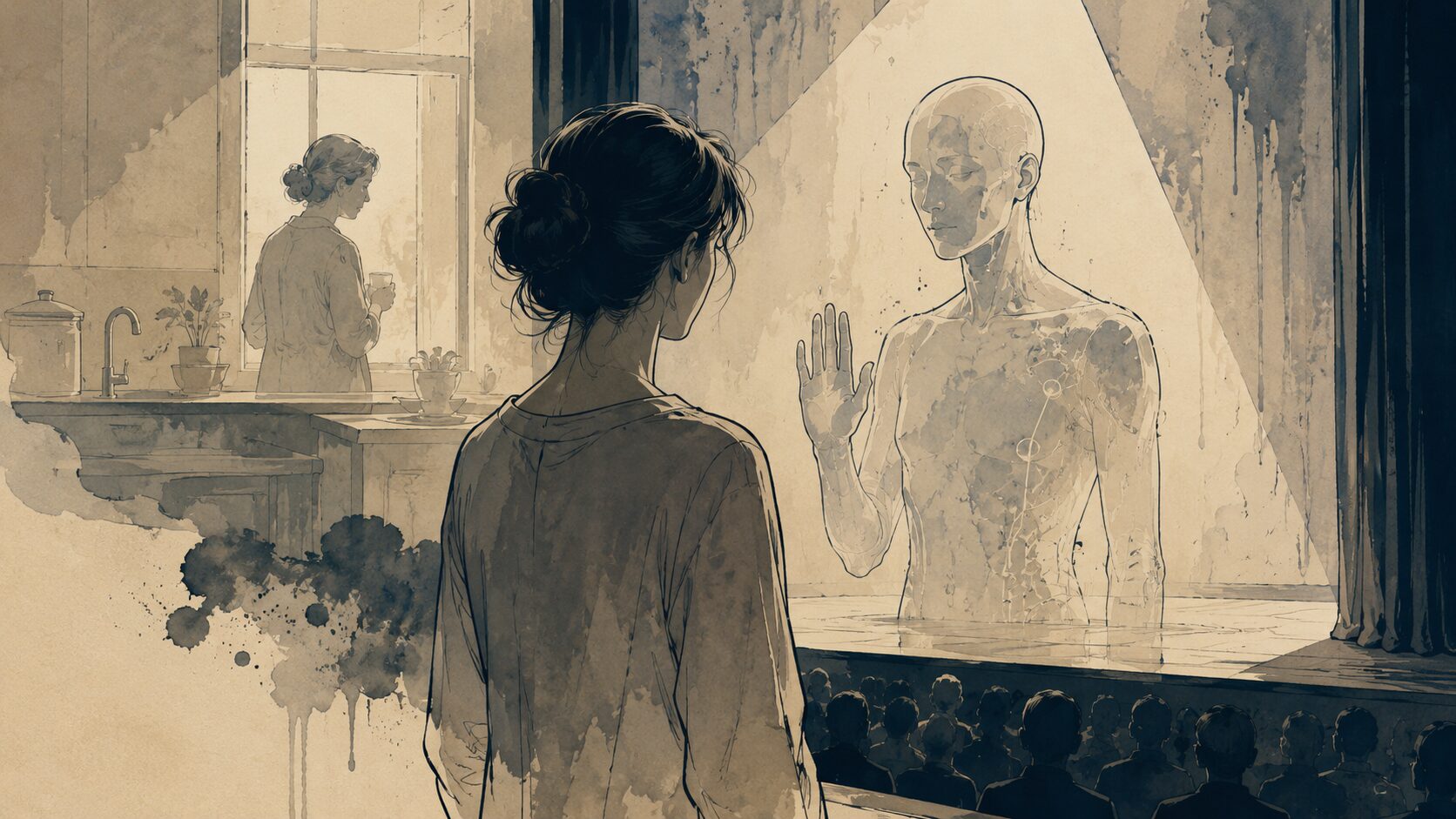
The call came on a Wednesday morning, which was already a bad sign. Nora Vass had learned over fourteen years of auditioning that good news arrived on Fridays, when casting directors were in the mood to end the week cleanly. Wednesday calls were complications. Wednesday calls were we need to discuss something. This one was from her agent, a compact and efficient woman named Bridget who had represented her since Nora was twenty-two and had developed, over that time, a particular way of beginning bad news — a single breath, audible, before the first word. Nora heard the breath and sat down on the edge of her bed. Bridget told her that the Edinburgh production of The Interval — a two-hander she had been cast in six weeks ago, rehearsals already underway, opening in eleven days — had just lost its co-lead. The male lead had pulled out overnight, citing a contractual conflict that Bridget described as almost certainly invented. The director, a man named Gideon Hale, was flying up from London that afternoon and wanted to meet with the remaining cast. There would be decisions. Bridget used that word specifically: decisions. Nora thanked her and sat with the phone in her hand after the call ended and thought about the particular mathematics of theatrical collapse — how fast a production could go from certain to uncertain, how quickly the ground moved. Then she noticed the email that had arrived while she was on the phone, and the mathematics became something else entirely. The email was from a company called Ariel Systems. It concerned a dream recording that, according to Ariel’s records, bore her name.
She read the email twice. It was written in the careful language of legal proximity — not quite an apology, not quite an explanation, but something engineered to occupy the space between them. It informed her that Ariel Systems had recently completed an audit of data sourced through a third-party research partnership, that certain recordings had been identified as requiring additional consent verification, and that her file was among them. It asked her to contact their data compliance team at her earliest convenience. It provided a number and a name: a woman called Dr. Iris Foley.
Nora put the phone down on the bed beside her. She looked at the email again. She had spent six weeks the previous autumn sleeping three nights a week in a neuroscience lab called Somnis on Quartermile, wearing a neural band at her temples, contributing what she understood to be anonymized emotional data to a sleep study. The consent forms had been long. She had read most of them. The phrase third-party research partnership had not appeared — or if it had, it had been inside a clause inside a clause, in the particular location where things are put when the intention is that they not be found.
She picked the phone back up and dialed Bridget again.
Gideon Hale and the Dream Recording He Knew Nothing About
Gideon Hale arrived at the rehearsal space on Jamaica Street at two in the afternoon with the specific energy of a man who had decided, somewhere between London and Edinburgh, that the production was not going to collapse and was prepared to hold that decision against whatever the afternoon produced. He was fifty-one, had directed seventeen productions in twenty years, and had the kind of authority that did not require volume — the authority of someone who had sat in enough rooms during enough crises to have stopped being surprised by them.
There were four people waiting for him: Nora, the stage manager, the set designer, and the movement coach. They sat around a folding table in a room that smelled of coffee and old wood, and Gideon sat at the head of it without taking off his coat and looked at each of them in turn before he spoke.

The production was not collapsing, he said. The male lead’s departure was a problem that had a solution, and the solution was already in motion. He had spoken that morning with the artistic director of the Barbican in London — Interior, the AI performance piece that had opened there in January and run to full houses for three months, had just concluded its London run. Ariel Systems, the company behind it, had agreed to loan the system for a two-week Edinburgh engagement. The Interval would be restaged as a human-AI production: Nora’s character opposite an AI performer trained on human emotional data.
Nora looked at him.
“The Ariel system,” she said.
“You’ve heard of it,” Gideon said. He took it as confirmation.
“I’ve heard of it,” she said. “I have some questions about it.”
“Good,” Gideon said. “So do I. Their technical team is arriving Thursday. We have eleven days.”
After the meeting she stood outside on Jamaica Street in the February cold and called the number from Ariel’s email. It rang four times and went to voicemail. She left a message with her name and number and said she needed to speak with Dr. Foley as soon as possible regarding a data compliance matter. She kept her voice level. She had learned to do this in auditions — to perform a version of calm that was not entirely separate from actual calm but was more reliable under pressure.
Then she went back inside and picked up her script and started work, because the production was in eleven days and falling apart was not something she was prepared to do.