What the Postcard Said
It arrived on a Saturday, eleven days after the correction letter.
No message. No return address. Postmarked from a small city in upstate New York. On the picture side, an unremarkable street scene — the kind of image that appears on postcards from dozens of cities without identifying any of them specifically.
On the message side, his address. And below it, in the same controlled even handwriting as his name on the brown paper package, one sentence:
The route works in both directions.
He read it twice. Set it on the kitchen table beside the ledger. Sat with both of them.
Then he understood.
Ruben’s name appeared nowhere in the ledger. Not in the double columns, not on the list. A man who had spent five years documenting nineteen other people’s situations had never put himself in the document. He’d maintained the discipline of it — kept himself outside the record so the record could remain purely what it was, a document with a purpose, not a personal accounting.
But the route he’d built for eleven composers, the route that used the official debt record as a disguise and moved people out through the gap between the official version and the real one — that route had no reason to work in only one direction.
The most complete disappearance was the one that left no record at all. Not in the official ledger. Not in the parallel one. Not anywhere. A man whose departure generated no documentation was a man whose location could not be found in any document, because the location existed in no document.
Ruben had built the door. At the end, he’d walked through it himself. And the blank space where his name would have gone in the list — the blank that Gil had been looking at for two weeks without knowing how to read it — was not an absence.
It was the point.
The Last Morning on the Block
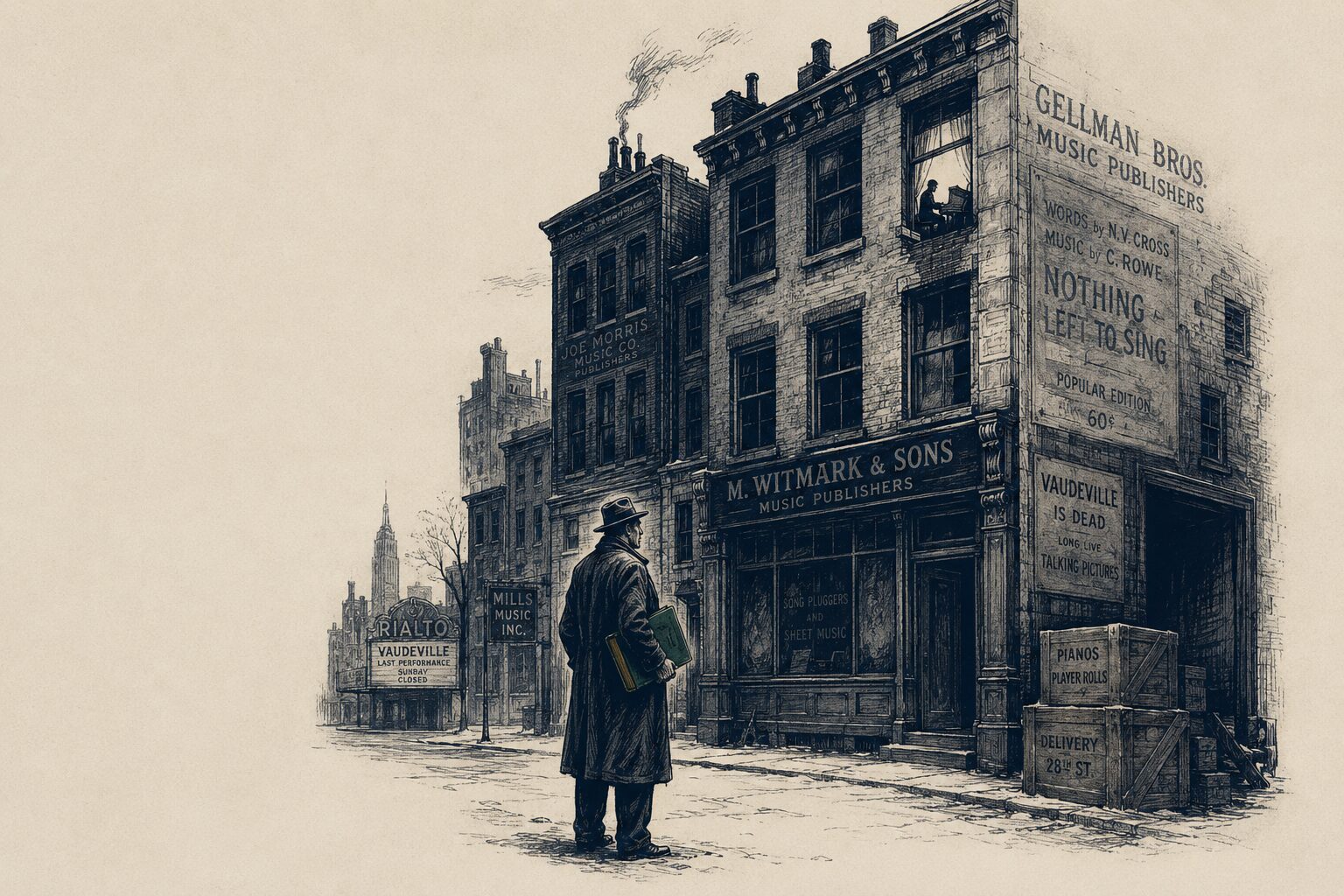
He went back to West 28th Street on a Friday in December, one final time.
The cold had settled in properly — the kind that stripped the block of everything decorative and left only the structures underneath. The buildings. The pavement. The grey sky sitting low over the rooftops. Tin Pan Alley in December, in the year the industry was finishing its long retreat to other parts of the city, looked like a street that had completed something and was waiting to find out what came next.
The two men who’d stood outside the Gellman Brothers building were gone. The car with its engine off and its windows dark was gone. The block was quieter than it had been in November, and the quality of the quiet was different — less like a held breath, more like something that had been under pressure and had recently been allowed to release.
Gil walked the full length of 28th Street once, slowly, in the way he’d walked it for eleven years of plugging, letting the geography tell him what it knew.
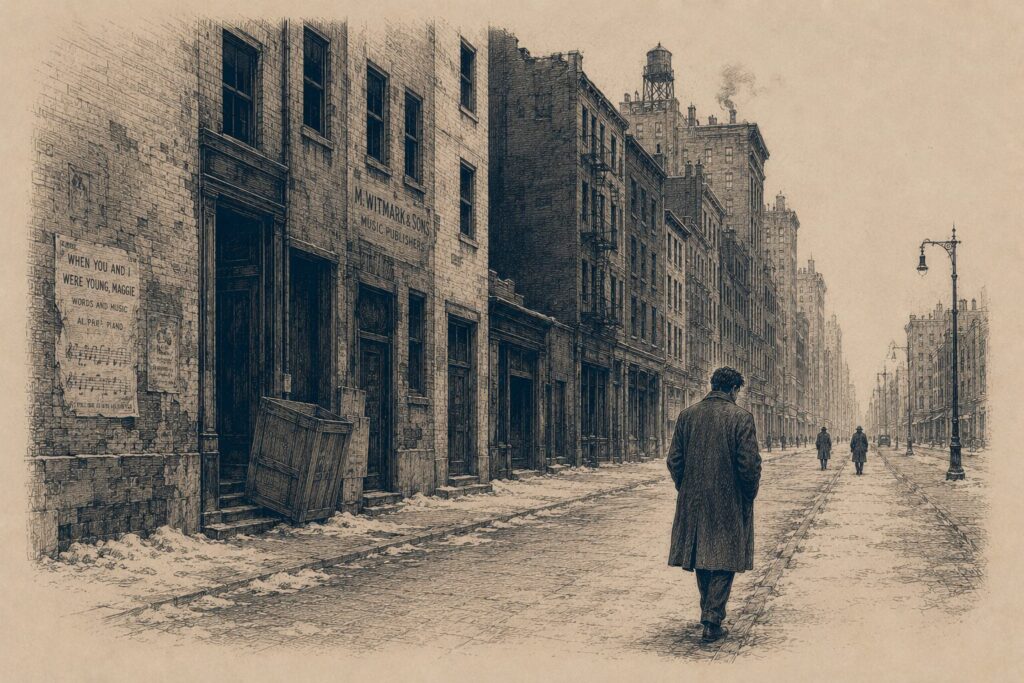
What it knew now was this: the professional parlors were empty, the sheet music business was contracting toward irrelevance, the vaudeville circuit that had been the block’s distribution engine was gone beyond recovery, and the publishing houses that remained were running on the catalog value of songs already written by composers who had seen almost nothing from those songs because the royalty structure had been designed, from the beginning, to ensure they saw almost nothing.
This had not changed. The correction letters had addressed the inflated debt records, not the underlying structure that had made them possible. ASCAP had been fighting that structure since 1914 and would keep fighting it. The block’s composers would keep working inside it because there was no other system available to them, and the music they made inside it would keep being worth far more to the people who owned the paper than to the people who made the music.
What had changed was smaller and more specific. Nineteen people had their real debt figures on the official record. Eleven people were alive in other cities under adjacent names, free, with their official records functioning as the cover Ruben had designed them to provide. One man had dissolved into the gap between the official version of the truth and the real one, which was the most complete freedom available to someone who had built a system for other people and finally used it on himself.
Gil stopped on the corner of 28th and Sixth.
He took the ledger out of his coat pocket and held it in both hands. The green cloth cover. The pale corners. The cedar smell almost entirely replaced now by the smell of his own coat, his own life, the accumulated weeks of carrying it everywhere until its weight was indistinguishable from his own.
He thought about Chet Rowe, who had refused the route and chosen to fight and was in the ground at thirty-four years old. He thought about Walt Foss, who was somewhere on the other side of a train journey right now, in a room in a city he had never lived in, with a piano he didn’t own yet and a name he was still learning to answer to. He thought about eleven other composers in eleven other cities, alive, invisible inside Pitch’s own paperwork, protected by the very system that had tried to trap them.
He thought about the postcard in his coat pocket.
Above him a window opened on the third floor of the building across the street. The sound of a piano came through it — something slow, unresolved, a phrase returning again and again to the same note as though the note meant something the rest of the melody was still working out how to say.
The sound lasted maybe thirty seconds.
Then the window closed, and the block went quiet again, and Gil stood on the corner of 28th and Sixth in the December cold with the ledger in his hands.
He put it back in his coat pocket.
He thought about leaving it somewhere — on the corner, on the stoop of the Gellman Brothers building, in a drawer somewhere it would never be found. But a ledger left behind was a ledger that could be found by the wrong person, and the copies he’d distributed were already doing what copies were supposed to do, and the original was safest where it had been for six weeks.
With him.
He turned north on Sixth Avenue and started walking, with the ledger in his coat and the postcard beside it and the December cold making no accommodations for any of it, and he walked without stopping until the block was behind him and the city was doing what the city always did — moving, indifferent, enormous, full of rooms where people were making things that other people would own, and full of other rooms where people were figuring out quietly, carefully, at some cost, how to make that arrangement slightly less permanent than it was designed to be.
He kept walking.
An archival souvenir from the final years of Tin Pan Alley, when disappearing musicians remained alive only through the paperwork attached to them.