Tin Pan Alley’s Ledger and the Name That Shouldn’t Have Been In It
He found the package the next morning on his kitchen table.
He hadn’t left anything on his kitchen table when he went out. He was certain of this in the way you’re certain of the small arrangements of your own home. The brown paper package sat precisely in the center of the table with his name on the outside in a handwriting he didn’t recognize — controlled and even, the kind of penmanship that doesn’t vary regardless of what it’s recording.
He checked the apartment first. Every room. The bathroom. The fire escape window. Empty.
His door had been locked. He was certain of that too.
He sat down and opened the package.
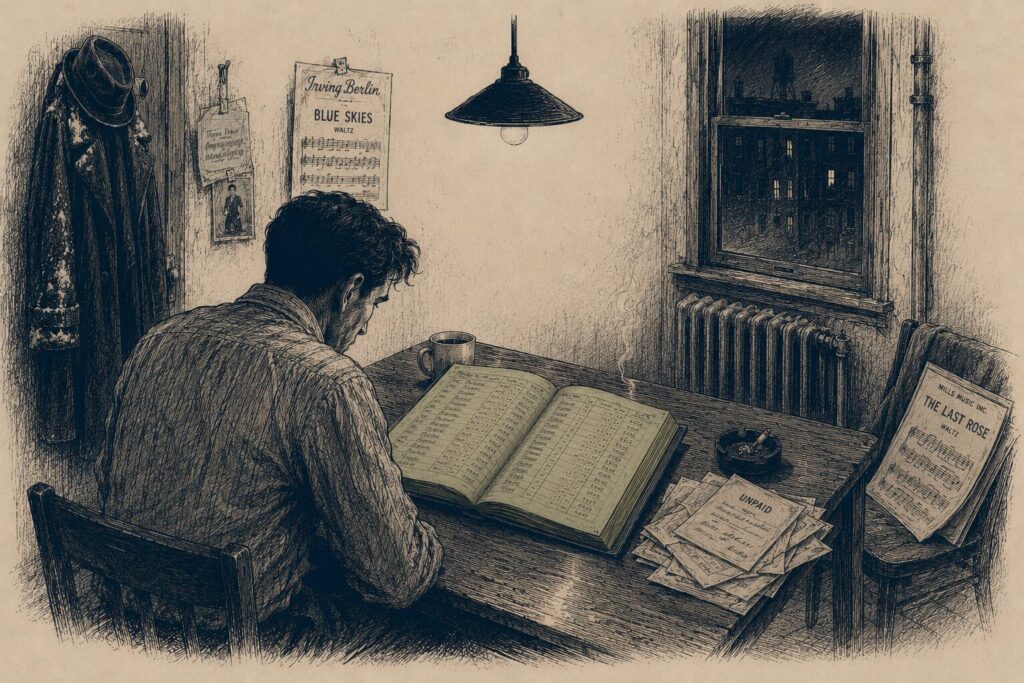
The ledger was green cloth, half an inch thick, the corners worn pale from years of handling. It smelled of cedar and old paper and the staleness of something kept hidden for a long time. There was no note. No explanation. Just the notebook, placed on his table by someone who had not wanted to be there when he opened it.
He opened it.
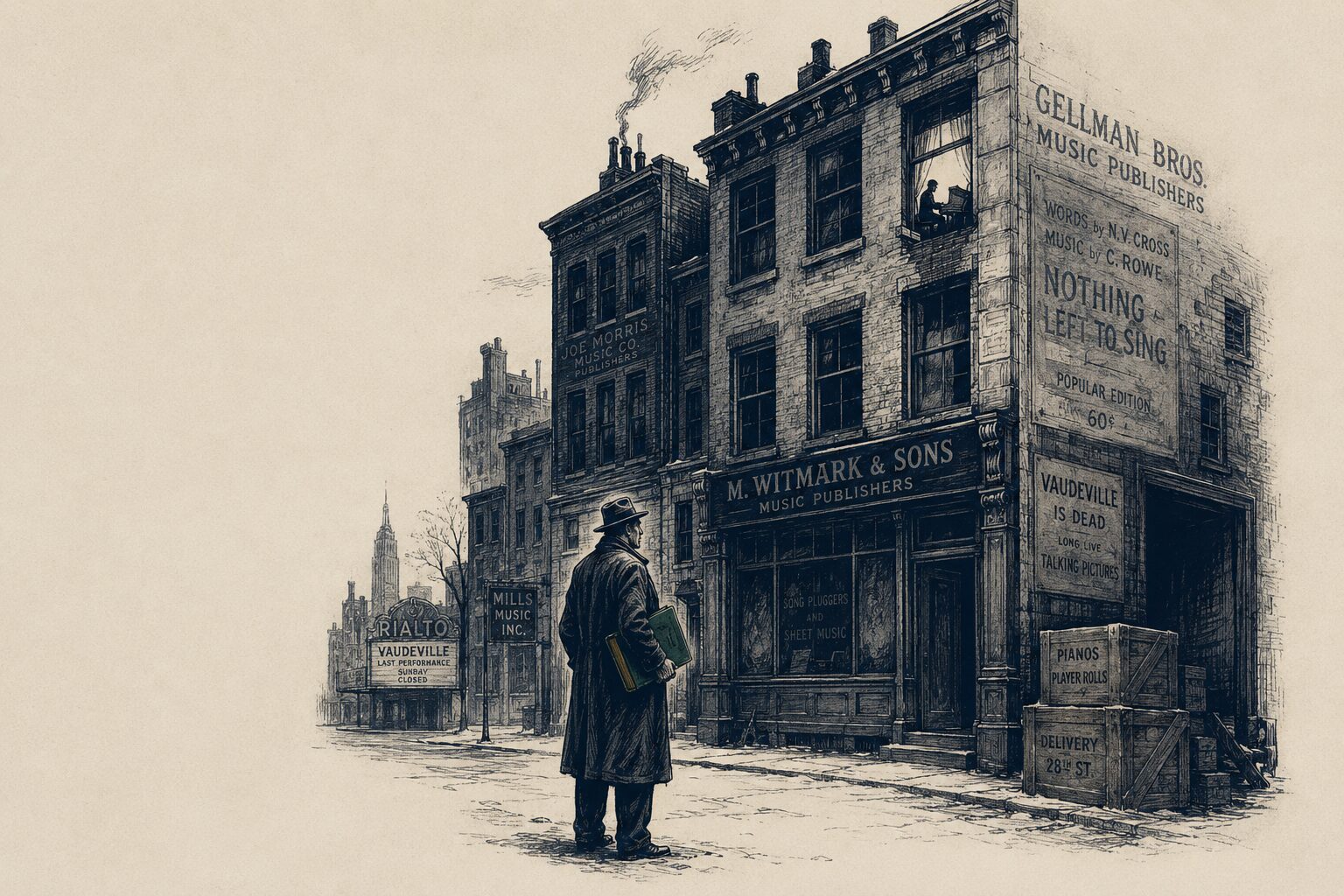
Two columns on every page. Left column — the official figures. The numbers that lived in the records at Gellman Brothers. The numbers that showed composers owing money they could never fully repay. Right column — the real figures. What had actually been borrowed. What had actually been repaid. The true balance in almost every case: zero. The word discharged in small clean letters beside a date.
The distance between the two columns, entry by entry, was the distance between what Harlan Pitch had built and what the truth actually was.
Gil read without stopping for ninety minutes.
Then he turned to page twenty-four and found his own name.
Left column: advance of two hundred dollars from Gellman Brothers, dated 1934, outstanding balance three hundred and twenty, still active, still accumulating.
Right column: advance of seventy dollars, repaid in full by August 1934. Balance zero. Discharged.
He sat with this for a long time.
He’d had no idea. No idea his name was in any ledger except the official one. No idea that someone had been maintaining a record of his real situation for four years while the official paperwork told a different story to anyone who looked.
He turned to the back of the ledger.
A list of names. Twelve of them. Most had a small mark beside them — a horizontal line with a single downward tick. Beside most marks, a city or a date. Beside two of the names — no mark at all. Just the name and a blank space.
One of the two unmarked names was Chet Rowe.
Beside Chet’s name, written in slightly different ink than the surrounding entries — newer, added later — five words: would not take the route.
Gil stared at those five words for a long time.
The route.
Chet had been offered something and had refused it. Whatever the route was — wherever it led — Chet had said no. Had chosen to fight instead. And three weeks after making that choice, he was dead.
Which meant the composers who had disappeared from the block — the ones whose names appeared on the list with marks and cities beside them — had not been killed.
They had gone somewhere.
What the Route Actually Was
He went back to Nora the same afternoon, to the same coffee counter, and told her what he’d found.
She listened without interrupting. When he finished she was quiet for a moment, turning it over, assembling it the way she assembled a lyric — looking for the logic underneath the surface until it became visible.
“The official debt record was the trap,” she said. “Pitch controlled the official record. As long as it showed a composer still owing money, they were bound to the house. They couldn’t leave. Couldn’t go anywhere else. The debt kept them.” She paused. “But Ruben understood something. He understood that the official record could also be a disguise.”
“If it still showed someone as an active debtor—”
“Pitch would have no reason to look for them,” Nora said. “Why chase a man you think you already have? Why look for someone whose paperwork shows them still bound to your house, still working off their debt, still present in the system?” She looked at Gil steadily. “So Ruben would approach a composer whose situation had become dangerous. He’d say: leave quietly. Go to another city. Start over. I’ll keep your official record exactly as it is — still showing you as an active debtor, still accumulating, still here. Pitch’s people will see a name in the books and have no reason to go looking for the person behind the name.”
“And the composers who took the route—”
“Are alive somewhere,” Nora said. “Hidden in plain sight inside Pitch’s own paperwork.”
Gil thought about the marks in the ledger. The cities beside them. The careful record of a man who had built an escape mechanism out of the very trap that was meant to hold people.
“Chet refused,” he said.
“Chet wanted to make it public. Wanted to force it into the open.” Nora’s voice was steady and sad in equal measure. “Ruben told him the ledger wasn’t ready. That going public without complete documentation would give Pitch time to destroy the evidence and disappear. Chet didn’t want to wait.” She looked at the counter. “So Ruben built the route for eleven other composers and couldn’t save the one who wouldn’t use it.”
“And then Ruben disappeared.”
“Yes.”
“Used the route himself,” Gil said.
“That’s what I believe.” Nora looked at him. “He built the door. At the end, he walked through it.”