The Second Unmarked Name
He went home and opened the ledger to the list again.
Twelve names. Ten with marks and cities. Two without.
Chet Rowe — dead.
The second unmarked name was a composer named Walt Foss. No mark. No city. No notation of any kind. Just the name and a blank space that could mean Ruben hadn’t reached him yet, or had reached him and been refused, or had reached him and the route was still pending when Ruben disappeared.
Gil spent two days finding Walt Foss.
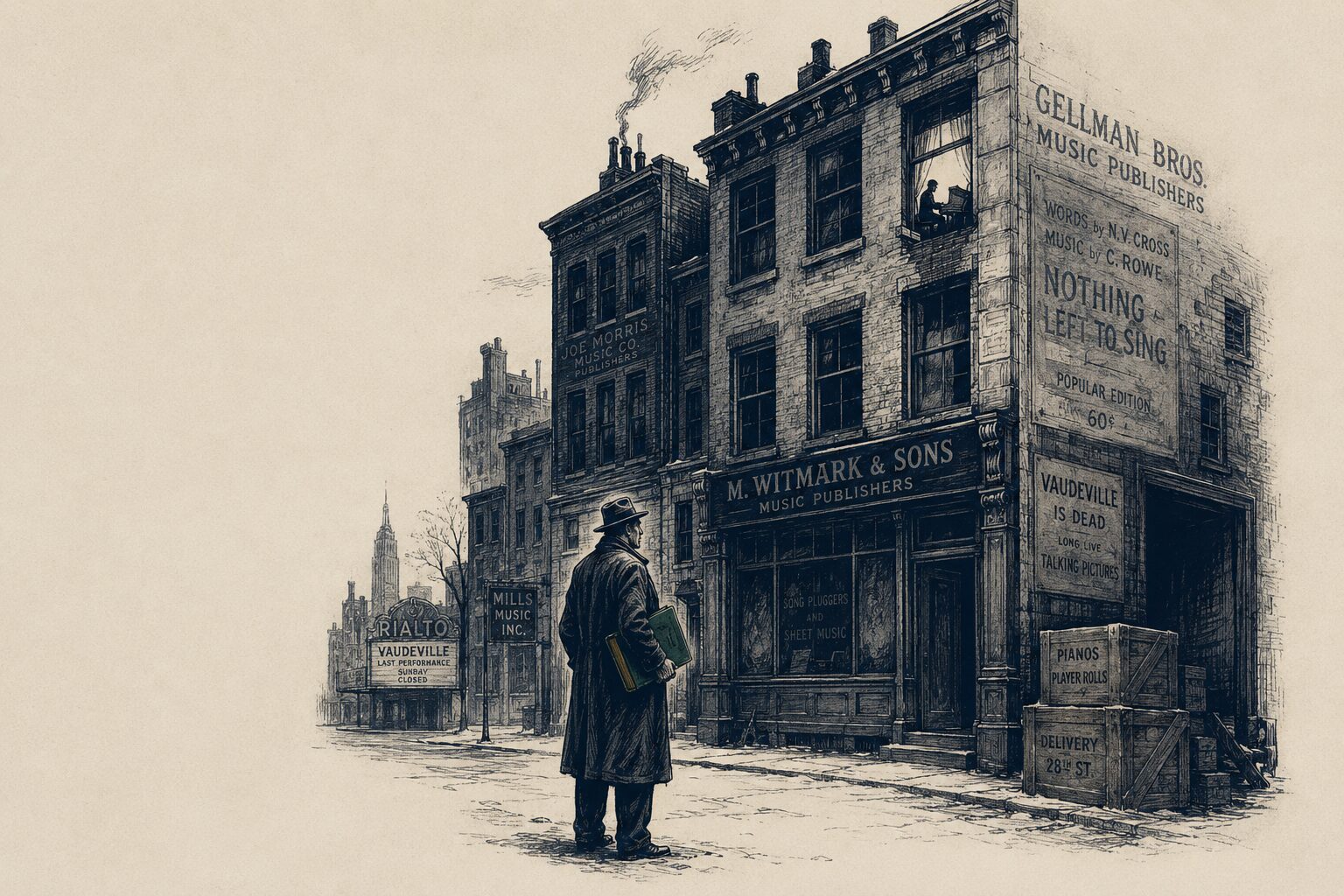
He was still in the city. Still at Gellman Brothers. Sixty-seven years old, lived alone in a rooming house on West 70th Street, had been at the house since 1912. Gil found him through a retired performer who knew the block’s population the way cartographers know coastlines — comprehensively, from years of close attention.
He went on a Thursday afternoon and knocked twice.
The man who opened the door was old in the way of someone who had been frightened for long enough that the fear had reorganized itself into a kind of patient endurance. He was wearing his coat inside the apartment, which meant he’d been thinking about leaving.
He looked at Gil for a moment. Then he stepped back and let him in.
The room was sparse. A bed, a table, two chairs. Against the far wall, an upright piano covered with a bedsheet.
“Ruben sent you,” Walt said. It wasn’t a question.
“Ruben sent the ledger. I don’t know if he’s alive.”
Walt sat down slowly. “A man came to see me last week. Very polite. Said there had been errors in my advance account and he wanted to discuss the details of my original transactions.” He looked at his hands. “I had heard about Chet by then. I knew what that kind of conversation meant.”
“Did you move here after his visit?”
“The next morning.”
“Does he know where you are?”
“Not yet.” Walt looked at the covered piano. “Ruben came to me in the spring. He explained the route. What it offered, how it worked. I told him I couldn’t go — I’m sixty-seven years old, my daughter lives four blocks from where I used to live, my whole life is in this part of the city.” He paused. “He said the route would stay open. That if the situation changed around me, the offer stood.”
“The situation has changed,” Gil said.
Walt was quiet for a long moment. He looked at the covered piano. Then he stood up and crossed the room and pulled the bedsheet off it.
The piano sat exposed in the thin afternoon light. Old wood. Worn keys. The look of an instrument that had been played for forty years by the same pair of hands.
Walt sat down on the bench. He didn’t play anything. He just rested his hands on the keys and looked at them.
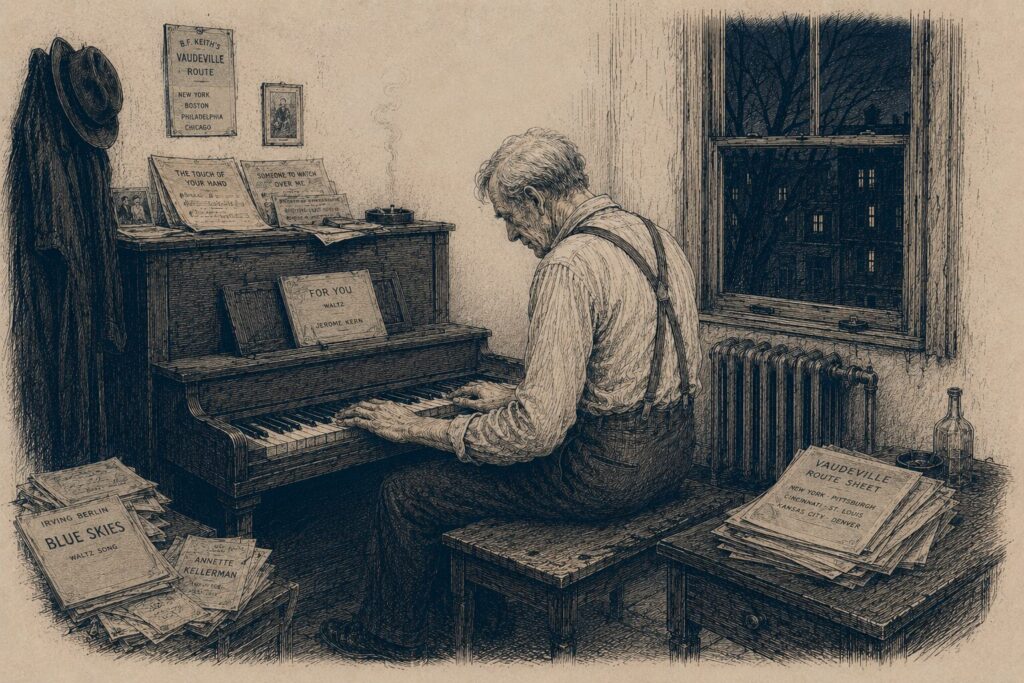
“Where would I go?” he said.
“Wherever the route leads. Ruben had contacts. People in other cities who could set something up — a teaching position, a room, a new professional context with no connection to this block or anyone on it.” Gil paused. “You’d be a name in Pitch’s books who still appeared to owe money. He’d have no reason to look for you.”
Walt pressed a single key. The note rang softly in the small room and faded.
“Will the route still work?” he said. “Without Ruben to maintain the official record?”
Gil had thought about this. “I’ll maintain it. I know the structure from the ledger. I know which figures need to stay active in the official record and which need to stay buried. Ruben documented everything clearly enough that someone else can run it.”
Walt played a slow chord. Then another. Something with no name yet, feeling for a shape.
“All right,” he said quietly. “All right.”
Tin Pan Alley Has a Man Named Cord
He knew he was being followed by the end of that week.
Not a feeling — a fact. The same figure appearing at the edges of his movement across three different days, in three different locations, maintaining a distance that didn’t vary. A man in a dark overcoat with a face Gil couldn’t hold clearly in his memory afterward, which he suspected was not accidental.
On Saturday morning he came home to an apartment that had been searched.
Nothing broken. Nothing dramatically displaced. But the brown paper from the ledger’s packaging had moved by an inch, and a chair had been angled slightly from where he’d left it, and these small displacements had the quality of things that happen when someone careful goes through a space quickly and covers the large details while missing the small ones.
They’d been looking for the ledger.
They hadn’t found it, because Gil had been carrying it in his coat pocket since the morning after it arrived, a decision he’d made without fully examining why, and standing in his searched kitchen he understood the decision had been correct.
He made three copies of the ledger’s most important pages that night — the dual columns showing the real figures against the inflated ones, the list with its marks and cities, the full pattern of the fraud across multiple years. He sent one copy to a lawyer named Felix he trusted. One to a journalist who had been trying to write about publishing house financial practices for two years and had told Gil once that she lacked the documentary precision to make the piece publishable. One to a former plugger in Chicago who owed Gil a favor with no expiration date.
Three cities. Three people with no connection to each other. Three copies of the ledger’s core evidence, in the mail, beyond reach.
Then he went to find Cord.