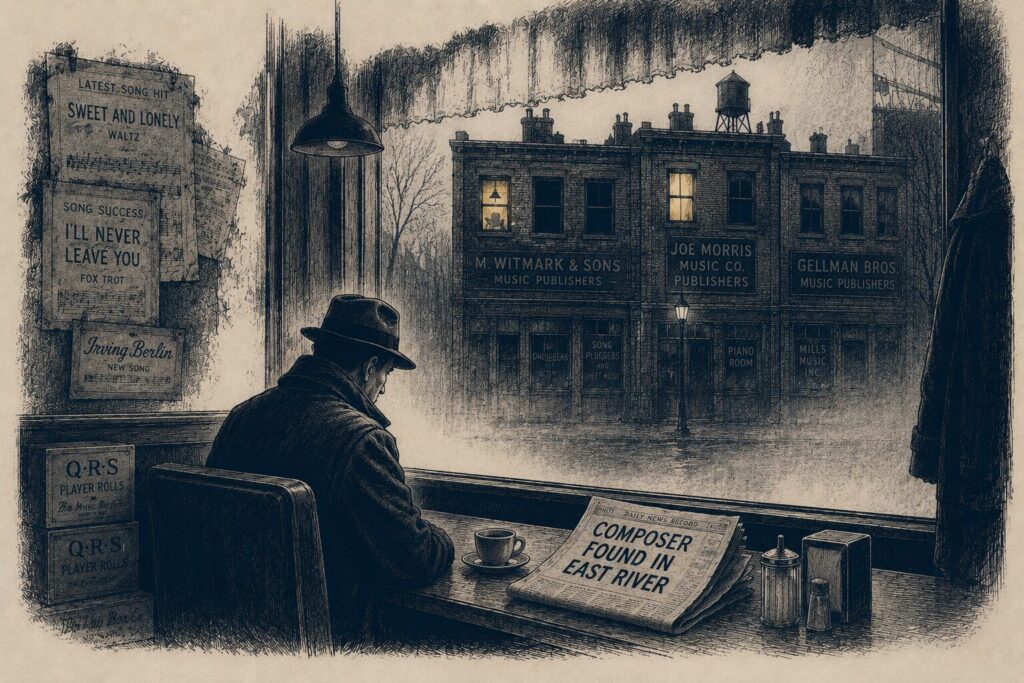
The man they pulled from the East River had worked six years as a composer on Tin Pan Alley, and that single fact was enough to bring Gil Vance back to West 28th Street after two years of staying away. The dead man’s name was Chet Rowe. He’d owed money to a publishing house called Gellman Brothers — or the official paperwork said he did — and now he was in the city morgue and the detective who caught the case had already written accidental drowning in his notebook and moved on, because men who owed money to certain people in this city had a particular way of ending up in the water, and the paperwork on those cases had a particular way of going very thin very fast.
Gil had been a song plugger on this block for eleven years. He knew Chet. He knew Gellman Brothers. He knew the difference between a man who fell and a man who was put somewhere.
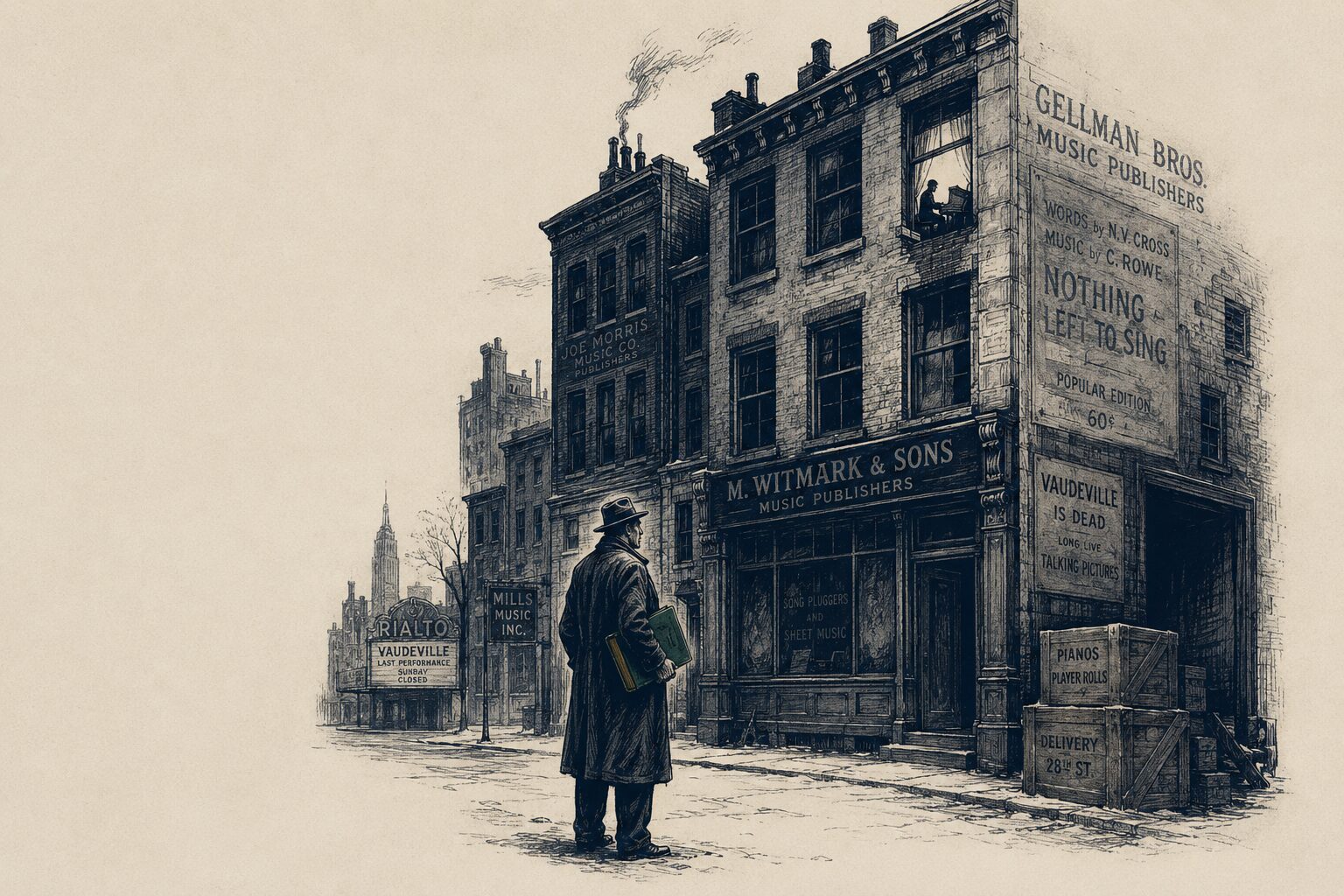
He got off the subway at 28th and Sixth on a Tuesday afternoon in November 1938 and stood on the corner and looked at the block.
Something was wrong.
Not the buildings. Not the storefronts. The people. They moved with their heads down and their eyes forward, in the specific way of pedestrians who have decided that eye contact on a particular street is something they can no longer afford. A woman Gil recognized — a copyist named Pearl who’d worked the block for a decade — came out of a building across the street, saw him, and looked away so deliberately it was almost a message.
Two men he didn’t recognize stood outside the Gellman Brothers building doing nothing. Not smoking. Not talking. Just standing there, present in the way of men whose job is to be seen being present, so that the people who belong on the block understand that the terms of belonging have changed.
Gil understood.
He turned up his collar and walked toward the coffee counter on Sixth Avenue, and he didn’t look back at the two men, but he felt them watching him until he turned the corner.
The Woman Who Had Been Waiting for Someone to Ask
Her name was Nora Vell. She was a lyricist who had worked the block for twelve years under the name N.V. Cross, because the publishing houses had a limited appetite for women’s names on sheet music covers and Nora had made the practical decision early that a name was a tool and tools should fit the job. She was the sharpest person Gil had known on the block — not just as a writer, but in the way she saw things, held them, connected them quietly until the connection mattered.
She was already at the coffee counter when Gil arrived, which told him she’d been expecting him, which told him someone had told her he was back on the block, which told him the block’s network was still functioning even under whatever pressure had settled over it.
She didn’t waste time.
“Chet came to me six weeks ago,” she said, keeping her voice at the level of the counter noise around them. “He was frightened. Not nervous — frightened. He’d been going through his advance records at Gellman Brothers and the figures were wrong. He’d borrowed one hundred and fifty dollars in 1933 and paid it back by the end of that year. The official record showed him still owing three hundred and forty.”
“More than double,” Gil said.
“More than double. And he wasn’t the only one. He’d talked quietly to others on the block — other composers at Gellman Brothers, at two other houses nearby. Same pattern everywhere. The official figures didn’t match what people had actually borrowed. Always inflated. Always in the same direction.” She looked at her cup. “The composers were trapped. They couldn’t leave the house because the official debt said they still owed money. They couldn’t argue the figures because the official records were the only records. And the debt kept growing on paper, which meant it would never clear, which meant they would never be free.”
Gil thought about the two men outside the Gellman Brothers building. “Who owns the debt?”
“That’s the question.” Nora’s voice dropped lower. “Gellman Brothers took outside investment in 1932. The sheet music business had collapsed, the vaudeville circuit was gone, they needed capital and they took it from someone who offered it when nobody else would.” She paused. “Nobody on this block says his name out loud anymore.”
“What’s his name?”
She said it quietly, the way you say something you’ve decided has weight. “Harlan Pitch.”
The name landed in the space between them and stayed there.
“Where does Pitch’s money come from?” Gil asked.
“Not from music,” Nora said. “Not from anything that files with a regulatory body.” She looked at him directly. “Chet figured out the debt structure was a trap. He figured out it had been designed that way deliberately. He wanted to fight it — wanted to take it to someone official, make the whole thing visible.” Her voice was steady, but something behind it wasn’t. “Three weeks after he told me that, they pulled him from the river.”
Gil sat with this. “And the composers who disappeared before Chet? The ones who just stopped showing up on the block?”
Nora looked at him carefully. “That’s the other thing Chet told me. He said there was a man — an old composer named Ruben, who had been at Gellman Brothers for thirty years — who had been keeping the real figures. A second ledger, running in parallel with the official one. The true amounts borrowed against the inflated official figures. Both versions, side by side, for five years.”
“Where is this man? Where is Ruben?”
“He walked out of his apartment eleven days ago,” Nora said. “Nobody has seen him since.”
She let that sit.
“So Ruben disappears,” Gil said slowly. “And four days later Chet ends up in the river.”
“Yes.”
“Either Pitch’s people found Ruben and the ledger is gone—”
“Or Ruben got out before they reached him,” Nora said. “And the ledger is somewhere else entirely.”
Tin Pan Alley at Night Feels Like a Street That Knows Something
He walked the block that evening alone, in the November dark, when the buildings showed their lit windows and the street had thinned to almost nothing.
He walked it the way he used to walk it between plugging sessions, when he needed to clear his head — not going anywhere specific, just moving through the geography, letting it tell him what it knew. Eleven years of walking this block had given him a physical memory of it that lived below conscious thought, in his feet and his peripheral vision and the part of him that registered change without being asked to.
Tin Pan Alley had been the loudest block in Manhattan for fifty years. The publishing houses had run their piano rooms from nine in the morning until eight at night, and the sound had leaked from every open window — competing melodies, different songs in different keys, overlapping until the whole block hummed with something that was almost music and almost noise and entirely its own thing. People had been describing that sound for decades as tin pans being struck together. The name stuck because it was honest. This was not a concert hall. It was a machine that processed music at industrial scale and distributed the profits toward the people who owned the paper and away from the people who made the music worth putting on paper.
The vaudeville circuit had been the distribution engine. Two hundred theaters across the country, through which a song written in a room on 28th Street could reach millions of people in a single touring season. When the talking picture destroyed the circuit between 1927 and 1930, it destroyed the engine. The sheet music revenues collapsed. The houses needed capital. Harlan Pitch had arrived with capital at precisely the moment the houses had no good options and no energy left to ask careful questions.
Now the windows were mostly shut. The piano rooms were silent. The block was running on the residual energy of what it had been, with the composers inside it held in place not by the industry’s former prosperity but by debt structures that had been carefully designed to ensure they never cleared.
Gil stopped outside the Gellman Brothers building and looked up at the lit window on the third floor.
A shadow moved across it. Someone crossing a room slowly, unhurried, with the ease of a person who considers the space entirely theirs.
Twenty feet from the entrance, a car sat with its engine off and its windows dark. The stillness of it was the wrong kind of stillness — not an empty car, but a car with someone in it who had decided not to move.
Gil turned and walked in the opposite direction without varying his pace.
He took the first left he came to, then another left, then he was moving fast through the side street with his coat open despite the cold, covering ground without looking like he was running, which was a distinction that mattered in the specific way it matters when someone might be watching.
Nobody followed him.
But the car had been there. The shadow in the window had been there. And the two men from the afternoon had been there, and the block’s particular held-breath quality had been there since the moment he stepped off the subway.
Whatever Harlan Pitch was, he was already aware that Gil was back on the block and asking questions.