The Restaurant on 29th Street
He’d gotten Cord’s routine from Nora, who had gotten it from the block’s accumulated ambient knowledge the way she got everything — by paying attention for long enough that the pattern became visible.
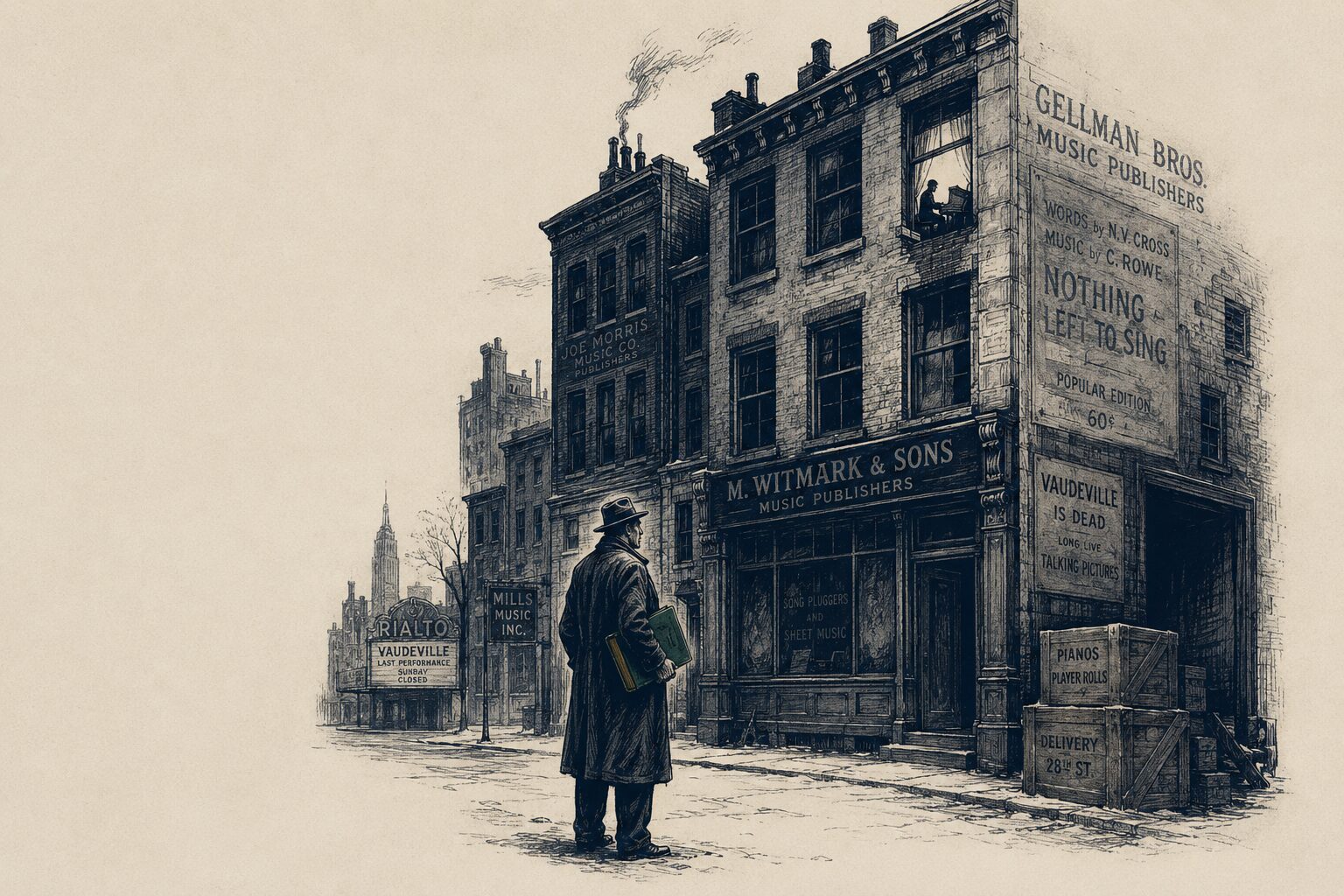
Cord ate lunch at a restaurant on 29th Street every Tuesday and Thursday. He arrived at twelve-thirty. He sat facing the door.
Gil arrived at twelve-fifteen on a Thursday, took the table nearest the wall, ordered coffee, and waited.
Cord came in at twelve-thirty exactly. Compact. Well-dressed. A face that was genuinely difficult to retain in the memory — not ugly, not distinctive, just somehow erasing itself as you looked at it, leaving nothing behind that you could describe with confidence to someone who hadn’t seen it themselves.
He was alone.
Gil stood before Cord had crossed the room, walked to his table, sat down across from him.
Cord looked at him with the mild, unhurried patience of a man who processed unexpected variables as a professional function and had a methodology for every category.
“Tell me your name,” Cord said.
“Gil Vance. Eleven years as a plugger on this block. My advance account at Gellman Brothers shows a balance of three hundred and twenty dollars.” Gil kept his hands flat on the table. “The real figure is zero. Discharged in August of 1934. I have the documentation, and copies of it are currently in the hands of three people in three different cities, none of whom have any connection to each other, all of whom have instructions about what to do if they stop hearing from me.”
Cord’s expression didn’t change. But something behind it recalibrated — a small, precise internal adjustment, the kind that doesn’t reach the face of someone practiced at keeping it away from their face.
“Records have errors,” Cord said.
“Nineteen records, across multiple houses, in the same direction, over five years.” Gil’s voice stayed level. “That’s not an error. That’s a design.” He looked at Cord steadily. “Chet Rowe is dead because he noticed the design. I’m not here to make the same mistake Chet made. I’m here to tell you what exists and where it is, and to establish the terms that keep it where it is.”
“What terms.”
“Every inflated advance record corrected. Real figures filed formally with ASCAP. Signed documentation from each house.” Gil paused. “And Walt Foss’s contract with Gellman Brothers dissolved. Today.”
Cord picked up his water glass. Set it down without drinking. “That’s significant.”
“Chet Rowe is in the ground,” Gil said. “Significant is the right scale.”
The restaurant moved around them — plates, conversation, the ordinary indifferent noise of a Thursday lunch. Cord sat with the stillness of someone who was not finished thinking but had decided not to let the thinking show.
“I’ll need to consult,” Cord said finally.
“You have a week,” Gil said.
He stood. Put on his coat. Walked out of the restaurant into the grey November afternoon without looking back, and he held his pace steady until he reached Sixth Avenue, and then he stood at the corner for a moment with his hands in his coat pockets, over the ledger, feeling it under his palms.
His hands were shaking.
He stood there until they stopped.
Tin Pan Alley Pays What It Owes
The correction came nine days later.
Felix called on a Wednesday morning and read from the formal letter in the even, controlled voice of a lawyer expressing satisfaction through precision rather than enthusiasm.
Every inflated advance account — corrected. Real figures documented and filed with ASCAP. Signed by an officer of each house.
Walt Foss’s contract with Gellman Brothers — dissolved, effective immediately.
Gil sat at his kitchen table and listened and looked at the ledger in front of him.
When Felix finished he said: “There’s one more thing.”
“Tell me.”
“The letter was signed by someone I don’t recognize. Not Cord. A different name entirely, someone above Cord in the operation.” A pause. “Which means either there’s a layer of Pitch’s structure I haven’t seen, or something has changed since this process started.”
“I don’t know which yet,” Gil said.
“Neither do I. But the corrections are real. They’re on the record. Whatever else is happening inside that operation, these particular nineteen people are free of it.”
Gil thanked him and set the phone down.
He opened the ledger to the last page. The list of twelve names. Ten with marks. Two without — Chet’s name with its five-word notation, and Walt Foss’s name with its blank space.
He took a pen and made the mark beside Walt Foss’s name. The horizontal line with the downward tick. The same mark that appeared beside every other name on the list — every composer Ruben had moved through the route, every person who had walked out through the door built for them and was now alive somewhere with their official debt record functioning as their cover.
He looked at Chet’s name for a long time. Would not take the route. He didn’t change it. He didn’t add anything. The record said what the record needed to say, and changing it would be a lie about what had happened, and the whole purpose of the ledger was to refuse the lie even when the truth was harder to carry.
He closed it.