The First Descent into the Seattle Underground
The first official tour happened on a Saturday in April. Eight people—the permit maximum—including a journalist from the Seattle Times, two high school history teachers, and a family of four from Minneapolis. Maya met them at the Thai restaurant entrance, gave the safety briefing, and led them down the fifteen steps into the cool absence.
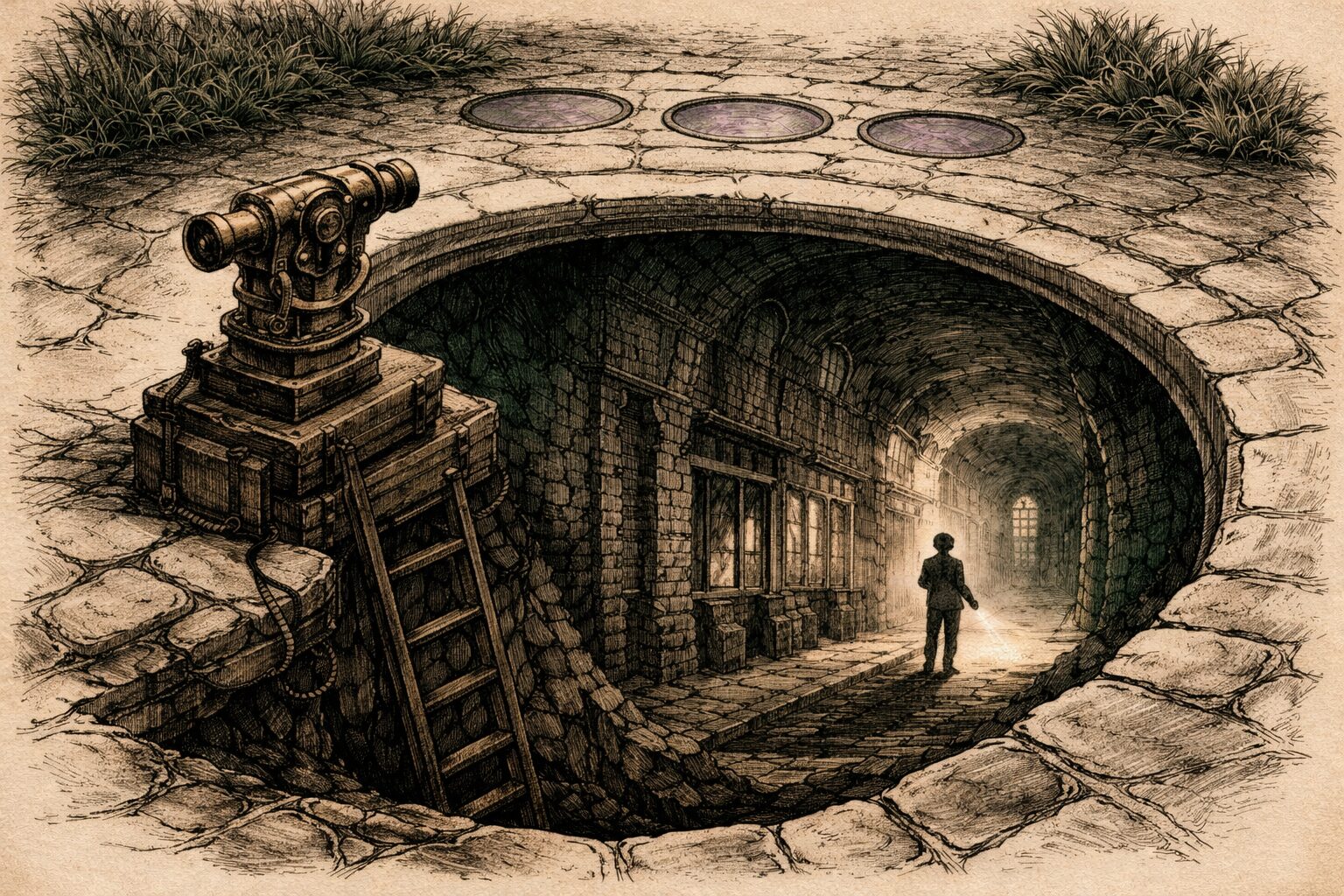
The vault lights glowed purple. Ama had convinced the city to power-wash the sidewalk above them the day before, and the improvement was dramatic. You could almost see sunlight through the layers now, filtered and strange but undeniably there.
“This is what I want you to understand,” Maya said, standing under the central light. “The seattle underground isn’t a tunnel system or a smuggling route or an abandoned subway. It’s the original street level of Seattle, buried by a deliberate act of engineering after the fire of 1889. You’re standing in a room that used to be at ground level. The ceiling you’re looking at used to be a sidewalk with foot traffic and carriages and daylight.”
One of the high school teachers—a woman in her fifties with careful posture—raised her hand. “Why don’t we just dig it out?”
“Because the modern city is built on top of it. If you excavated the underground, the current streets would collapse. The two levels are structurally dependent now. They hold each other up.”
The journalist was recording on his phone. “So preservation means keeping it buried.”
“Preservation means keeping it accessible enough that we remember it’s there.”
They moved through the hotel room, where Ama had installed a single interpretive panel with the before-and-after street grids. The family from Minneapolis studied it for five minutes, the father pointing out details to his teenage kids.
“This is what maps refuse to show,” the father said. “The vertical history. We teach geography like it’s flat.”
His daughter—maybe sixteen, with the slightly embarrassed posture of someone whose parent was talking too much—touched the warped hotel desk. “Did people know they were in a basement?”
“For a while, yes. But they kept shopping here anyway because it was cheaper rent than the new street level. Some businesses operated down here until 1907.” Maya pointed to the door that opened onto packed earth. “That was the back exit. It used to lead to an alley. Now it leads to dirt that’s been compacted by a hundred years of building weight.”
The journalist looked up from his phone. “Has anyone ever tried to tunnel through? To see what’s behind the dirt?”
“Once. In the 1960s, a group of urban explorers broke through a wall in Pioneer Square and found three intact storefronts from 1890. Barbershop, tailor, grocer. Merchandise still on the shelves. But the city sealed it again because there was no way to stabilize the structure.”
“Do you know where it was?”
“No. Frank documented it but he never told anyone the exact location. He was afraid people would break in and loot it.”
Tomasz, who’d been quiet during the tour, finally spoke. “So there are parts of the seattle underground that are perfectly preserved but completely inaccessible. A city we know exists but can’t reach.”
“Yes.”
The room fell silent. Even the sound of water dripping seemed to pause. Maya felt the weight of the statement, the way it transformed the tour from a historical walk-through into something more like mourning. They were standing in the only part of the buried city that could be safely shown, and everything else—the barbershop, the tailor, the grocer’s shelves—was sealed behind walls that would never be opened.
The Artifact That Chooses Its Keeper
On the way out, the teenager from Minneapolis stopped at the base of the stairs and looked back at the vault lights. Her father was already halfway up, calling her name, but she didn’t move.
“Can you take something from here?” she asked Maya.
“Like what?”
“I don’t know. A piece of brick. Glass from the sidewalk lights. Something that proves it’s real.”
Maya had been asked this before, by almost every tour group. The desire to take a physical piece of the underground was nearly universal, as if seeing it wasn’t enough to make it permanent.
“No,” Maya said. “But you can remember the color of the light. The way the purple glass made everything feel underwater. That’s yours.”
The girl nodded, but she looked unsatisfied. She climbed the stairs slowly, pausing on the seventh step to look back one more time.
After the tour ended and everyone had left, Ama sat on the bottom step with a notebook open on her knees.
“You need to give them something,” she said.
“I’m not selling pieces of the underground.”
“Not pieces. A representation. Something they can hold that reminds them of what they saw.” Ama sketched something quickly—a simplified vault light design, just circles and grid lines. “Make it wearable. Small. Something they’d want to keep even if they forgot the tour.”
Maya looked at the drawing. It was elegant, stripped down to pure geometry. The kind of design that didn’t announce itself but rewarded attention.
“I’ll think about it,” she said.
Tomasz appeared in the doorway at the top of the stairs, silhouetted by daylight. “The journalist wants to talk to you. He says his editor is interested in a feature story.”
“About the tour?”
“About the idea that Seattle has two ground floors and we only acknowledge one.”
Maya climbed the stairs, leaving Ama with her sketch. At the top, the modern city was loud and bright and moving at its usual speed. The sidewalk felt solid under her feet, but now she couldn’t walk on it without thinking about the vault lights underneath, glowing purple in the dark, doing their job perfectly for a world that had moved twelve feet away.
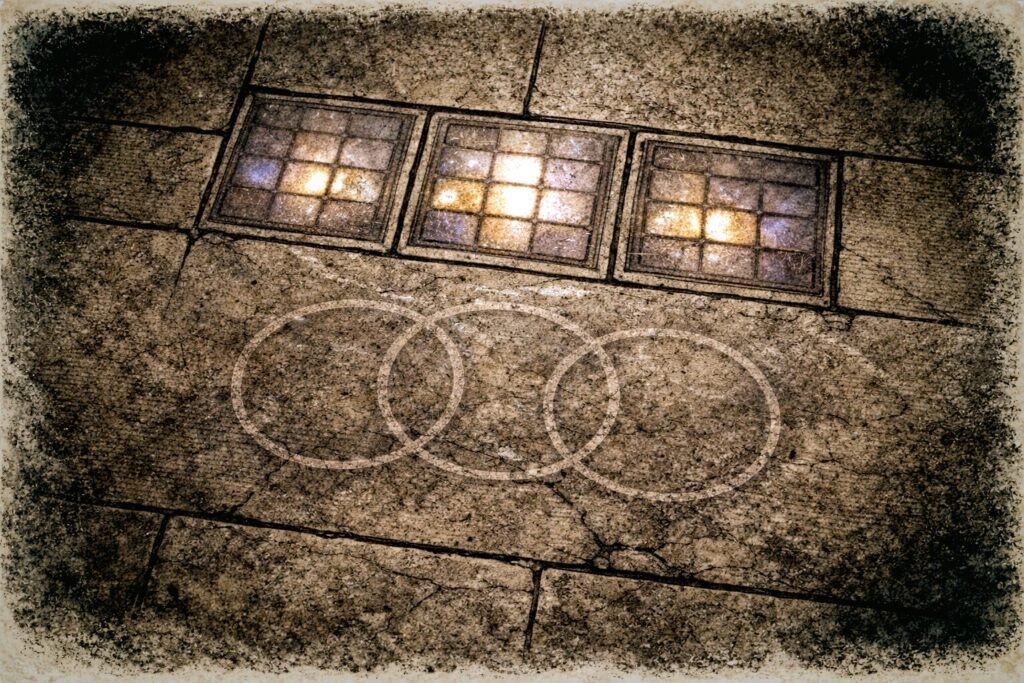
A simple artifact could carry the grid of vault lights—those purple circles that held the weight of two different cities—as a quiet reminder that some architecture survives by being buried, not destroyed.