The Flood That Taught the City Elevation
The second room had been a hotel. Maya knew this from the surveyor’s notes and from the remains of a registration desk, its wood warped and blackened by a century of moisture. Tomasz photographed it from three angles while Ama explained the concept of “ambient interpretation” to the grad students.
“You don’t need a plaque every six feet,” Ama said. “You need one strong emotional anchor and then you let people fill in the rest. The desk. The door to nowhere. The vault lights going dark. That’s enough.”
Cooper raised his hand like he was in school. “Can I ask about the flood?”
“Which one?” Maya said.
“The one that made them raise the streets. You said the sewage backed up.”
“That wasn’t a single flood. That was a chronic problem. Seattle was built on tideflats, and the original street level was basically sea level. Every high tide brought saltwater up through the sewage system. After the fire destroyed the downtown in 1889, the city engineer proposed a solution: raise the streets by one to two stories and make the old ground floor into a basement.”
Siri made a face. “That seems excessive.”
“The alternative was cholera.” Maya pulled out the 1890 map again, unfolding it on the warped hotel desk. “Look at the original street grid. First Avenue, Second Avenue, Third. They run parallel to the waterfront. When the tide came in, the whole downtown became a swamp. The fire gave them an excuse to solve two problems at once—rebuild and raise.”
Hannah leaned over the map. “But this doesn’t show the elevation change.”
“Because the change hadn’t happened yet when this was drawn. This is what the city looked like at ground level before they decided ground level was negotiable.”
Tomasz tapped the map with his pen. “So the regrade was a public health intervention disguised as urban planning.”
“Or urban planning justified by a public health crisis. Depends on who you ask.” Maya folded the map. “The city council approved it in 1890. Property owners fought it for years. By the time they finished raising the streets in 1907, most of the underground spaces had been abandoned.”
Cooper was still stuck on the sewage issue. “But why couldn’t they just fix the pipes?”
“They did. That’s the misconception. People think the seattle underground exists because of bad plumbing. But the raised streets were about prevention, not repair. They wanted gravity on their side. If you raise the streets twelve feet, sewage flows downhill away from the buildings instead of backing up into them.”
The grad student who hadn’t spoken yet—his name tag said “Marcus”—finally looked up from his phone. “So it’s a vertical infrastructure hack.”
“Exactly.”
Ama pointed at the hotel desk. “And this desk was serving customers while they were building the new street above it.”
“For almost fifteen years,” Maya confirmed. “People walked down here to rent rooms. There are newspaper ads from 1895 for hotels in the ‘lower level’ of Pioneer Square. It wasn’t underground yet. It was just downstairs.”
Purple Light Beneath the Seattle Underground
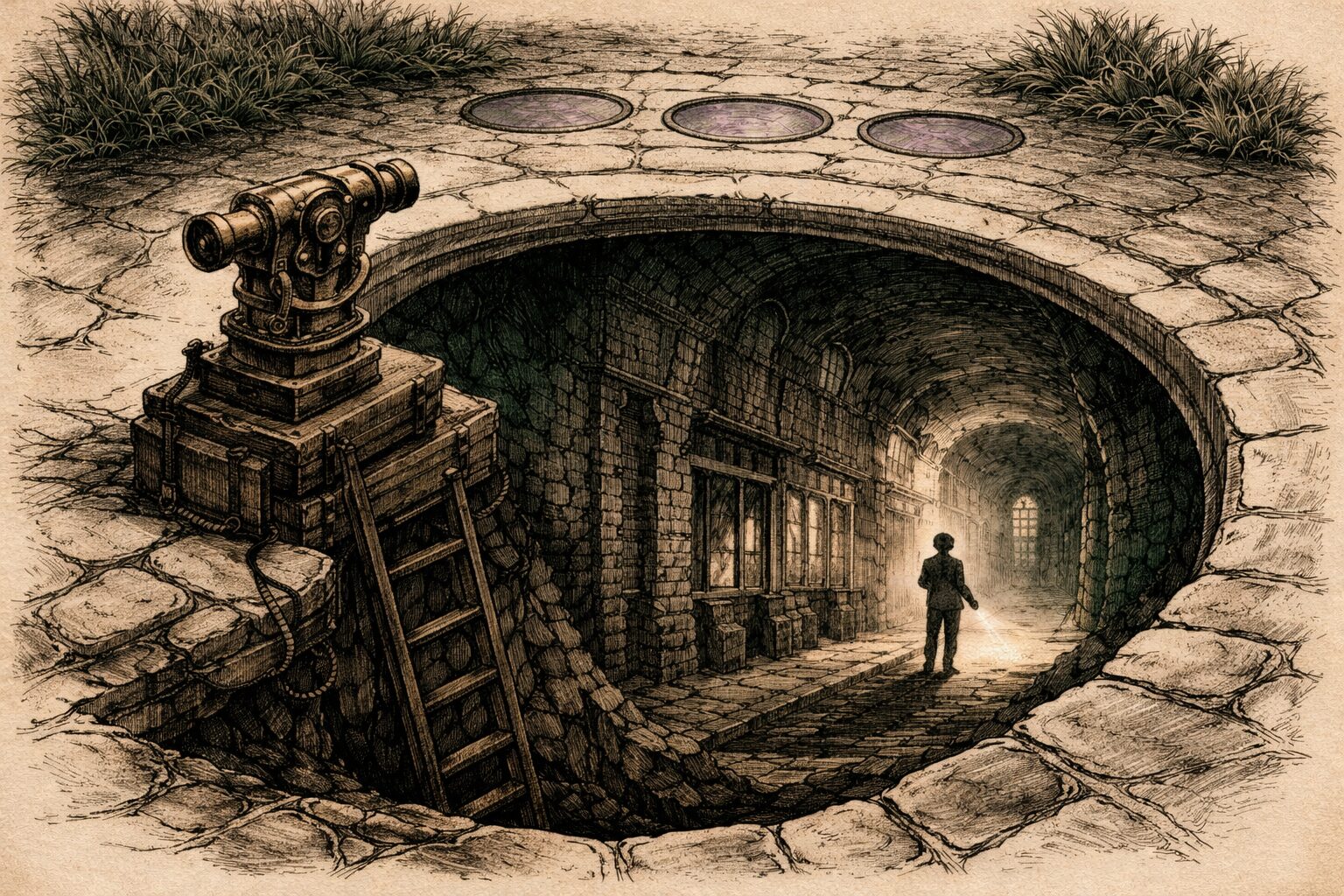
The third room had the best vault lights. Six of them arranged in a grid on the ceiling, their purple glass surprisingly clean. Maya had Frank to thank for that—he’d documented this section in the seventies and convinced the city to preserve it as a historical site, even though no one was allowed inside.
Tomasz turned off his headlamp and stood directly under the lights. The purple glow turned his face into something from a daguerreotype.
“This is the contradiction Ama was talking about,” he said quietly. “The lights work perfectly. They’re doing exactly what they were designed to do. But the world they were designed for is gone.”
Hannah looked up from her notebook. “That’s a metaphor for the whole project, isn’t it? The seattle underground isn’t about architecture. It’s about how we deal with infrastructure that outlasts its purpose.”
“I don’t think it’s outlasted its purpose,” Marcus said. He was crouched in the corner, examining a pattern of water stains on the brick. “It’s still here. It’s still teaching us something about how cities adapt.”
Cooper raised his phone to take a picture, then remembered the rules and lowered it. “In Sydney, we have parts of the old harbor infrastructure that got built over when they expanded the port. But no one thinks of them as underground. They’re just… obsolete.”
“Because you didn’t turn them into a story,” Ama said. “Seattle did. Probably by accident, but still. The minute you call something ‘underground’ instead of ‘abandoned,’ you give it mystery. You make people curious.”
Siri touched one of the brick walls. “So the tour is the preservation method.”
“The tour is the reason to preserve it,” Maya corrected. “Without people coming through here, the city would just seal it up and forget about it. Again.”
Tomasz walked to the far end of the room, where another door opened onto packed earth. “How much of the original underground is still accessible?”
“Maybe twenty percent. The rest is either collapsed, flooded, or intentionally filled in. The city used some sections for utility tunnels. Some got incorporated into building basements. But at least three square blocks are just… waiting.”
“For what?”
Maya didn’t answer right away. She was looking at the vault lights, thinking about Frank and his obsessive documentation, the way he’d spent forty years mapping spaces that most people didn’t believe still existed. The weight of the city pressing down on the ceiling felt less like a threat and more like a kind of patience—the architecture waiting for someone to remember it had been ground level once.
“For someone to prove they’re worth keeping,” she said finally.