A City That Learned to Stack Itself
The permits arrived on a Thursday, three months late and printed on paper so cheap it felt like newsprint. Maya spread them across the table in her apartment—a studio above a poke restaurant on First Avenue—and counted the restrictions. No groups larger than eight. No photography without additional insurance. Inspections every sixty days. The city wanted documentation of every brick.
She called Tomasz first because he’d been emailing her twice a week since their coffee stand encounter, each message a little more insistent. He arrived with a notebook that had water damage on the back cover and a headlamp that looked like it belonged on a coal miner.
“Is that necessary?” Maya asked.
“I don’t know yet.” He sat down without being invited and opened the notebook to a page dense with sketches. “I’ve been reading about hollow sidewalks. The purple glass.”
“Vault lights.”
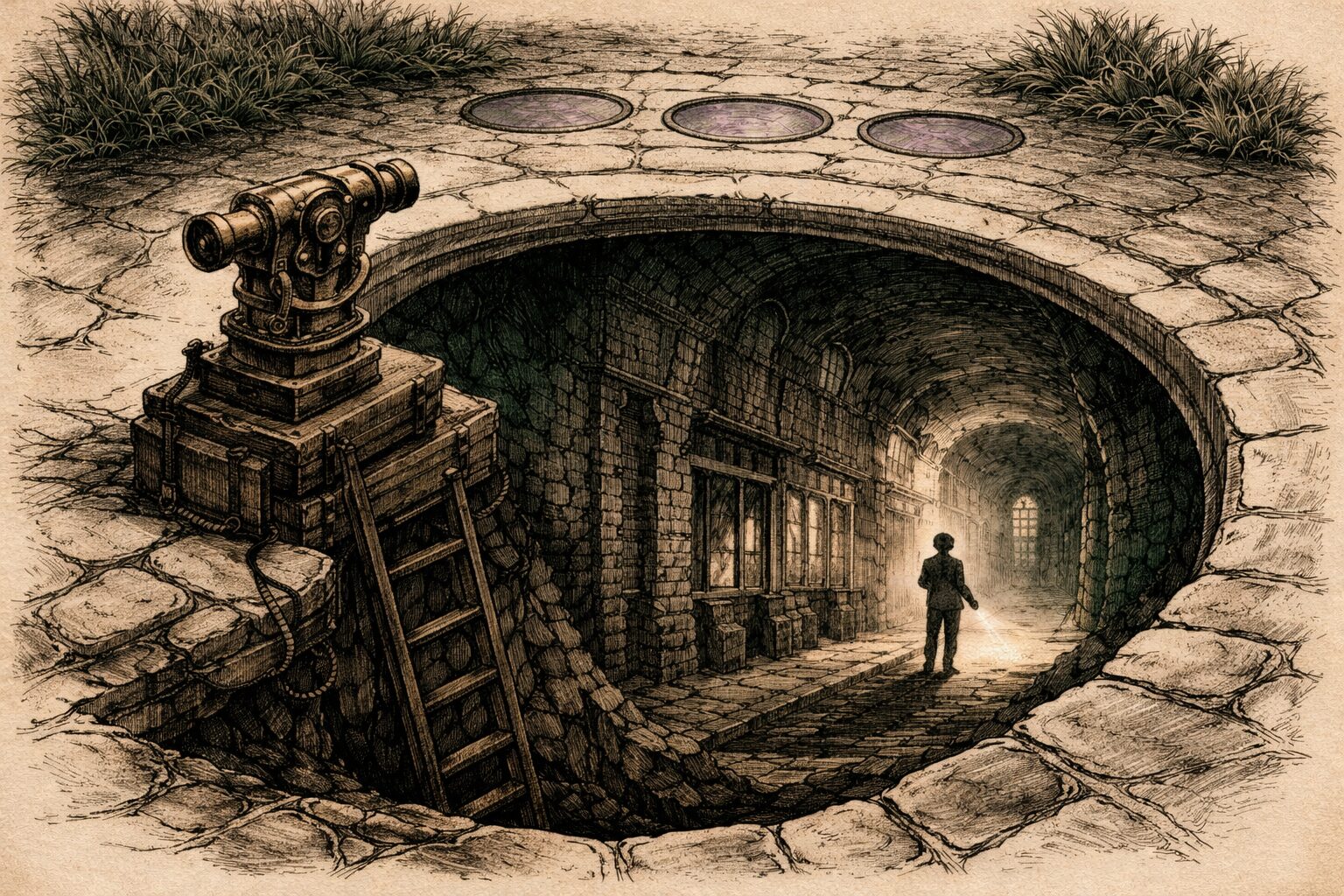
“Yes. These.” He pointed to a drawing that showed circles arranged in a grid. “They let daylight down to the shops below. But I can’t find anyone who’s seen them functioning.”
“Because they’re under the current sidewalk.” Maya pulled out her own map—a surveyor’s plot from 1890 that Frank had photocopied for her before he died. “The new street level covered them. Most of the glass is broken now anyway.”
Tomasz studied the map with the expression of someone checking a translation. “So the seattle underground is not underground. It’s just underneath.”
“It was the ground floor until it wasn’t.”
He wrote something in the margin of his notebook. His handwriting was small and slanted hard to the right. “In Kraków, we have tunnels under the market square. Very old, medieval. But they were always tunnels. This is different. This is a city that learned to stack itself.”
The phrase caught Maya off guard. She’d spent six months explaining the regrade project to grant committees and historical societies, and everyone focused on the fire or the sewage problems or the engineering feat. No one had described it as learning.
The Seattle Underground Beyond the Brochures
The first inspection took four hours. The city inspector—a man named Gerald who wore a respirator mask even though the air quality readings were fine—moved through the underground passages with a clipboard and a measuring tape, documenting cracks in the brick and the depth of standing water in the lowest rooms. Maya followed with the transit, taking elevation readings that matched Frank’s old survey notes within two inches.
Tomasz took notes but didn’t use his camera. At one point he stopped in front of a doorway that led nowhere, its frame intact but opening onto a wall of compacted dirt.
“This was the back exit,” Maya said.
“To what?”
“A pharmacy. The owner testified during the regrade hearings that he’d lost access to his storage room when they raised the street. He wanted compensation.”
“Did he get it?”
“No one got it. The city said raising the streets was a public health necessity. After the fire, the whole downtown was basically level with Puget Sound at high tide. Every time it rained, the sewage backed up into the buildings.” Maya aimed the transit at a chalk mark on the wall. “They had to lift everything or abandon the waterfront entirely.”
Tomasz wrote for a minute, then looked up. “But they didn’t lift the buildings.”
“They lifted some. But mostly they just built new streets on top of the old ones and told everyone to move their front doors to the second floor. The ground floor became the basement.”
“And people kept using them?”
“For a while. Until they didn’t.” Maya lowered the transit. “That’s what the tourist books never mention. It wasn’t a sudden burial. It was gradual. Business owners kept operating down here until the city condemned it in 1907. Almost twenty years of people shopping and working in what was technically a basement.”
Gerald called from somewhere deeper in the passage, his voice muffled by the respirator. Something about water damage and load-bearing walls.
Tomasz clicked his pen twice, a nervous habit. “So when people say ‘the seattle underground,’ they’re describing a transition period, not a place.”
“Exactly.”
“That’s a terrible way to market a tour.”
Maya laughed before she could stop herself. The sound echoed off the brick in a way that made it seem like someone else had laughed, somewhere in the dark past Gerald’s inspection light.