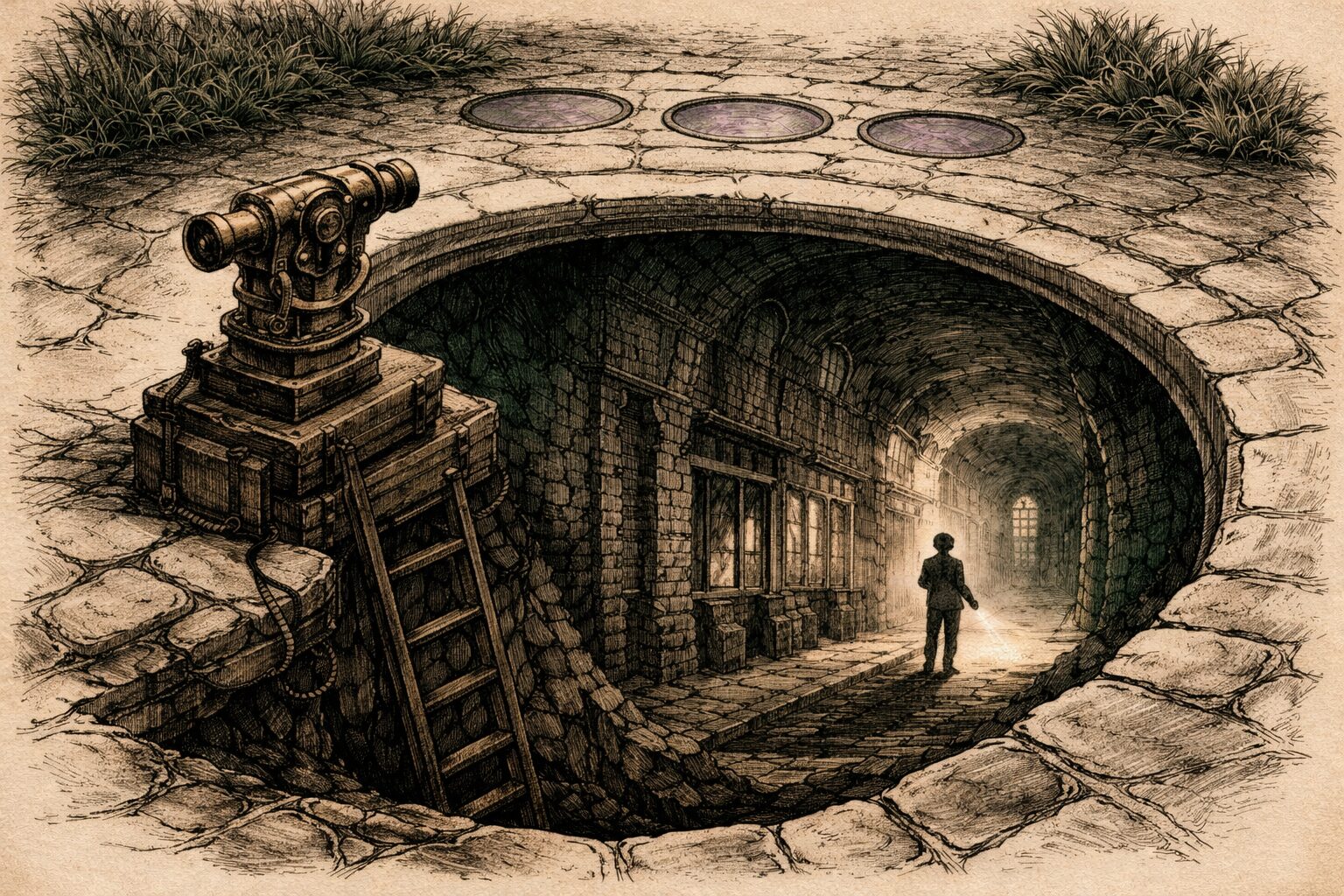
The Test of the Sidewalk Skeptic
The problem arrived in the form of an email from the Seattle Department of Transportation. Gerald forwarded it with no comment, just the subject line: “Structural Concerns Re: Underground Tour Permits.”
Maya read it three times, then called Ama.
“They’re questioning the load capacity of the vault lights,” Maya said. “They want an engineering survey to prove the sidewalk won’t collapse if people start walking on it more frequently.”
“But people already walk on it. It’s a sidewalk.”
“I know. But now they’re worried about ‘concentrated foot traffic patterns’ above the tour spaces. They think we’ll create weak points.”
Ama was quiet for a moment. “They’re looking for a reason to shut you down.”
“Maybe. Or they’re genuinely concerned about hundred-year-old glass under a modern city.” Maya pulled up the engineering specs Frank had included in his notes. “The vault lights were rated for horse-drawn carriages. Cast iron frames, four-inch glass. But that was at surface level. No one tested them for supporting twelve feet of concrete and asphalt.”
“So test them now.”
“With what money?”
Ama laughed, but it wasn’t a happy sound. “This is how they kill projects. Death by feasibility study.”
Tomasz showed up at Maya’s apartment that evening with a bottle of Bulgarian wine and a plan. He spread a printout on her kitchen counter—a technical drawing of a vault light cross-section with calculations in the margins.
“I called a friend who works in civil engineering in Warsaw,” he said. “She says the load capacity is not the issue. The issue is documentation. If you can prove the vault lights have been supporting the modern sidewalk for fifty years without failure, the city can’t claim they’re suddenly unsafe.”
“How do I prove that?”
“Photos. Maintenance records. Anything that shows the sidewalk hasn’t moved.” He poured wine into two mugs because Maya didn’t own proper glasses. “Also, you need to show that the seattle underground tour will reduce stress on the infrastructure, not increase it.”
“How?”
“By moving foot traffic underground. Right now, everyone walks on the sidewalk. If some of them walk below it, the surface load decreases. You’re not adding pressure. You’re redistributing it.”
Maya stared at the diagram. The logic was sound, but she had no idea if the city would accept it. “I need an engineer.”
“I know someone,” Ama said from the doorway. Maya hadn’t heard her come in. “My brother’s friend does historical building assessments. He might do it pro bono if you let him publish a paper about it.”
“What’s his name?”
“Wei Chen. He’s in Vancouver but he comes down to Seattle every month for a project at the university.”
Tomasz refilled his mug. “Then we have our structural consultant. Now we just need to prove historical precedent.”
When the Engineer Arrives with Questions
Wei showed up three weeks later with a laser measuring tool and a skepticism that felt personal. He walked the underground tour route twice, saying nothing, then sat on the floor in the room with the best vault lights and opened a laptop that looked like it had survived a war.
“The structural integrity is fine,” he said, not looking up. “That’s not your problem.”
“Then what is?” Maya asked.
“Scale. You’re treating the seattle underground as a fixed entity. But it’s not. It’s a transitional layer between two different city plans.” He pulled up a map on his screen—modern Seattle overlaid with the 1889 street grid. “Look at this. The old streets don’t align with the new ones. The angles are off by three to five degrees in some sections.”
Tomasz leaned over Wei’s shoulder. “Why?”
“Because the regrade wasn’t uniform. They raised some blocks faster than others. Some property owners resisted longer. By the time they finished, the street grid had been adjusted to accommodate the new elevation, but the underground layer still follows the old angles.” Wei zoomed in on Pioneer Square. “This is why you can’t just open three blocks for tours. You’d be sending people through a space that doesn’t geometrically match the city above it. They’ll get lost.”
“People get lost in regular cities,” Ama said.
“Regular cities have GPS. The seattle underground is a Faraday cage. No signal. No way to call for help if someone panics or gets hurt.”
Maya felt her carefully constructed tour route collapse in her mind. “So you’re saying it’s not safe.”
“I’m saying you need better wayfinding. And emergency exits. And probably a structural engineer on call every time you run a tour.” Wei closed the laptop. “Which makes this project economically unviable unless you charge a hundred dollars per person.”
The room went quiet except for the sound of water dripping somewhere deeper in the underground. Maya thought about Frank’s notes, his decades of mapping, the way he’d described the underground as “a city in waiting.” She’d always assumed he meant waiting to be discovered. Now she wondered if he meant waiting to be reconstructed.
“What if we don’t open all three blocks?” she said. “What if we just open one? The section with the vault lights and the hotel desk. Make it a contained experience.”
Wei considered this. “That could work. But you’d need to tell people what they’re not seeing. The context. The scale of what’s still buried.”
“We can do that,” Ama said. “That’s what interpretive design is for.”
Tomasz was already writing in his notebook. “And it makes the tour better. If people know there’s more underground that they can’t access, it creates desire. They’ll want to come back. They’ll advocate for expanding access.”
Wei looked at Maya. “You’re okay with that? Showing people a fraction of what you wanted to show them?”
“Frank documented forty years of a city that no one else believed existed,” Maya said. “If I can get people to understand even one room of it, that’s worth something.”
Where the Seattle Underground Disappears on Paper
The compromise meant redesigning everything. Maya spent a week creating new interpretive materials—maps that showed the full extent of the buried city with the tour route highlighted as a single thread through it. Ama designed a display panel that explained why the rest wasn’t accessible, using Wei’s overlaid street grids to show the geometric mismatch.
“This is actually better,” Ama said, pinning a test print to the wall of Maya’s apartment. “You’re not just showing them a historical site. You’re showing them an ongoing urban condition. The seattle underground isn’t finished. It’s still being negotiated.”
Tomasz disagreed. “It feels like defeat. We’re telling people there’s something amazing here and then immediately saying they can’t see most of it.”
“That’s how historical preservation works,” Wei said. He’d stayed in Seattle longer than planned, fascinated by the engineering challenges. “Most of the past is inaccessible. We save the parts we can document and protect, and we accept that the rest is speculation.”
Hannah and Marcus came by to help with the final layout. They brought coffee and a suggestion from their urban planning professor: include a section in the tour about “vertical urbanism” and how other cities dealt with elevation conflicts.
“Like Guanajuato,” Hannah said, pulling up photos on her phone. “The whole city is built on different levels because of the mountain terrain. Streets become tunnels become streets again.”
“Or Seattle’s other regrades,” Marcus added. “Denny Hill. Jackson Street. This wasn’t the only time the city decided to move its own ground.”
Maya added the references to her notes, grateful for the expansion but also aware of how much the story was growing beyond her original vision. She’d started with a simple idea: give people access to the seattle underground. Now she was documenting a city’s entire relationship with its own verticality.