Something in the old grass smelled like a different century
After the coffee, Lena went outside. This was something she did when a problem in the archive room was too large to think about while sitting still. The open air helped her think, and the burial mounds — massive, silent, grass-covered — had a way of making smaller worries feel proportionate.
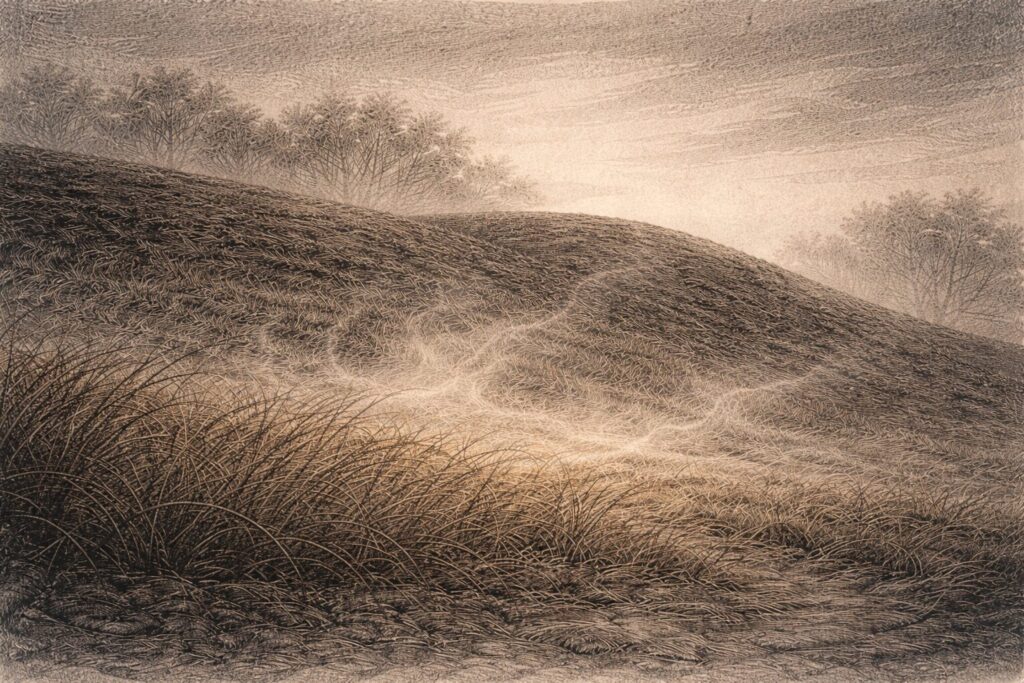
The three mounds stood in a row against the gray October sky. The largest one, called Kungshögen, contained the cremated remains of a king whose name historians have never agreed on. The grass on all three mounds was kept trimmed by museum staff, but it still grew unevenly, as grass tends to do over ground that was disturbed once and never fully settled.
Lena stood at the base of the largest mound. The air was cold and carried a faint smell she could not immediately identify — something mineral and slightly sweet, like old paper that had been pressed shut for decades. She had smelled it once before, years ago, after a strange June storm. She had never been able to explain where it came from.
While she stood there, a van pulled into the gravel car park behind her. She heard the crunch of tires and the engine cutting off, but she did not turn around right away. Without thinking about it, she shifted her weight to her left hip.
He had filmed stranger things than a time slip, and believed none of them
The man who climbed out of the van was named Marcus Adeyemi. He stepped down and immediately caught his foot on the last step, grabbing the door frame to stop himself from falling. He swore quietly in English, then stood for a moment and looked at the landscape with the calm, careful expression of someone whose job required him to observe things before reacting to them.
Marcus was a documentary filmmaker. He was here to film a three-part series about Norse mythology sites for a streaming platform that had recently become interested in places that made people feel uneasy. The burial mounds qualified. The week before, he had filmed the Viking ship museum in Oslo. Before that, a stone circle in Orkney that had caused his sound engineer to refuse to sleep in the van. He had seen a great deal of strange material and had found explanations for most of it.
He set up his tripod near the museum entrance and adjusted the angle.
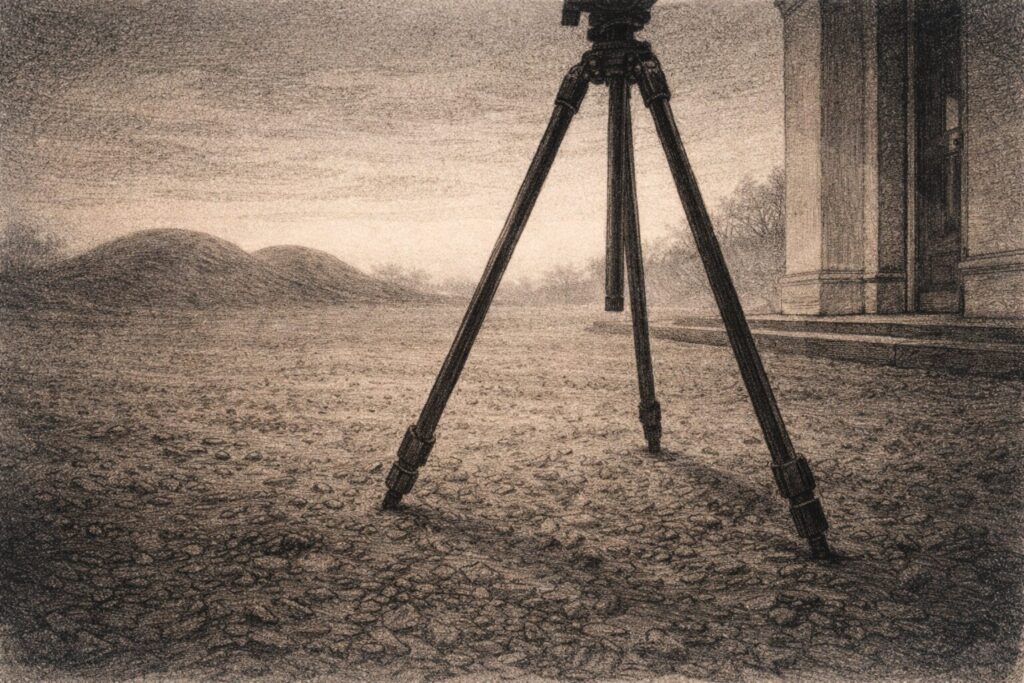
While doing so, he noticed the woman standing very still at the base of the far mound, looking at the ground. He left her alone. In his experience, places like this attracted people who were working something out privately, and the polite approach was to film the landscape and wait until someone offered you coffee.
Inside the museum’s small café, a woman named Solveig was just opening up. She greeted Marcus in Swedish first, then switched to English without any fuss when he answered in English. She told him that the archivist would be his main contact during the filming. Then she nodded toward the window. ‘She goes out there sometimes,’ Solveig said. ‘When something has upset her.’
Marcus looked out the window. The woman at the mound had not moved.
A time slip, she said, as though naming it made it manageable
At half past eleven, a second visitor arrived. Her name was Petra Voss. She drove into the gravel car park in a rented car that already had two small scratches on it — both from that morning. She drove it quickly and deliberately, and she was through the café door with her coat still half-on before Marcus had finished his second coffee. She sat down across from him without being invited, with the ease of a person who is used to arriving at situations mid-stream and catching up quickly.
Petra had spent twenty years as a forensic psychologist in Frankfurt. After retiring from that work, she had taken a research position she had more or less invented for herself, focused on what she called temporal displacement reports — documented accounts from people who believed they had, however briefly, experienced a different time period than the one they were living in. Not while asleep, and not as a result of any medication or illness. While fully awake, in ordinary circumstances.
She was here because Lena had written to her earlier that morning — not as the museum archivist, but personally, after finding Petra’s name in a footnote of an academic monograph. Lena had sent a short email describing what she had found and asking for a meeting. Petra had driven up from Stockholm that morning.
‘A time slip,’ Petra said, settling into her chair. ‘That is the popular name for the experience. It refers to the sensation — or, in the more extreme documented cases, the apparent reality — of briefly perceiving a different historical moment. Not a dream. Not a hallucination in the clinical sense. Something else, which the evidence does not yet allow us to define cleanly.’
Marcus looked at her. ‘How did you know to come inside before anyone called you?’
‘Lena contacted me earlier today,’ Petra said. ‘I drove up this morning.’ She looked around for somewhere to put her coat. ‘You’re the filmmaker.’
‘Marcus Adeyemi.’
‘Voss. Have you spoken with Lena yet?’
‘She’s been outside since I arrived.’
Petra looked out the window at the mound. ‘Then something has happened,’ she said.
The burial mounds had been holding this particular silence for fifteen hundred years
When Lena came back inside, she was carrying the photograph in a clear plastic sleeve. She put it on the table without introduction and sat down. She looked at both of them — Marcus, whom she had not yet formally met, and Petra, whom she had only spoken to by phone — with the expression of someone who has decided to say something they know will sound strange, and has made peace with that decision.
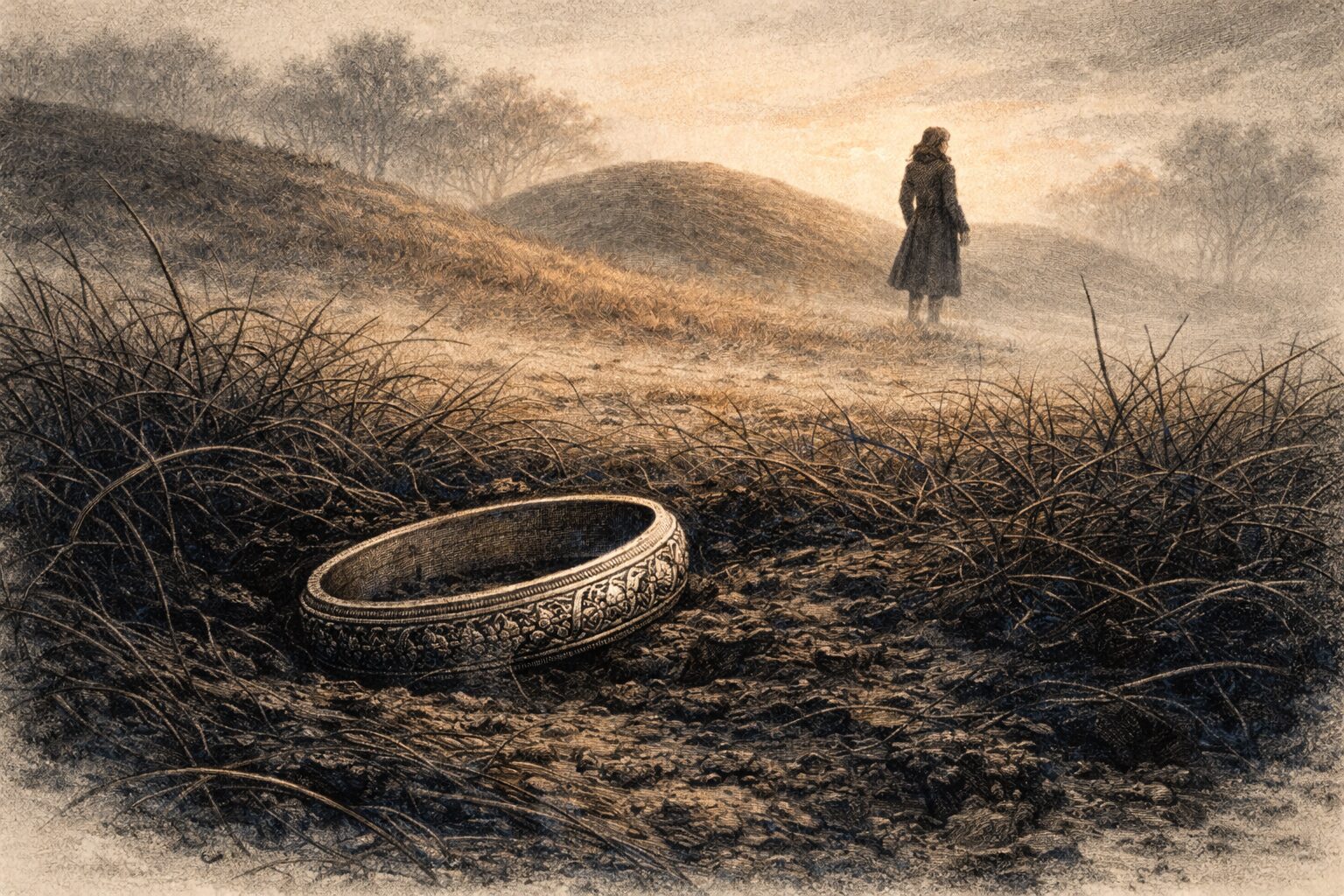
‘This photograph was in a sealed box from the 1980 accession,’ she said. ‘That box had not been opened since it was catalogued forty-five years ago. I opened it earlier today for a researcher who had requested access to something unrelated. This photograph was inside it, mislabeled as 1923.’ She paused to let that date register. ‘The woman in the photograph is wearing a ring. A silver ring with an engraved band. My grandmother owned a ring that matches that description exactly. My grandmother was born in 1931 — which means she was not yet alive in 1923.’
The café was quiet. Outside, through the window, the three mounds held their usual silence.
‘So either the photograph is simply mislabeled, and it was actually taken later,’ Marcus said.
‘I had the photographic paper tested,’ Lena said. ‘The chemical composition is consistent with photographic materials from the 1920s. The paper is not modern.’
Petra pulled the plastic sleeve toward her and studied the photograph. ‘The ring could be a similar design,’ she said carefully. ‘Silver engraved rings are not unusual. Many were made with the same pattern.’
‘I know,’ Lena said. ‘But that is not the only thing that troubles me.’
What a time slip is not, and why the difference matters
Over the course of her research, Petra had documented forty-seven separate time slip accounts. Her witnesses had come from Liverpool, from the gardens of Versailles, from a village in Andalusia where three people claimed to have watched a market operating in a square that had been a car park since the 1960s. She had interviewed architects, historians, and trauma specialists. She had followed every lead she could find.
Because Lena had directly asked, Petra explained what the research actually showed — not as a lecture, but because understanding the definition was necessary before they could discuss the photograph properly.
‘The most common mistake people make is to assume that a time slip is a hallucination,’ she said. ‘That word carries a specific clinical meaning. It implies that the brain is producing false information — malfunctioning, in some sense. But the cases I find most significant involve witnesses who report accurate historical details they had no way of knowing beforehand. Details that later checked out against historical records they had never accessed.’
‘The most well-known example is the Versailles case of 1901. Two English academics — Eleanor Jourdain and Annie Moberly — were walking in the palace gardens when both of them, separately and without speaking to each other, perceived the same scene: people dressed in 18th-century clothing, moving through a garden layout that had been redesigned over a hundred years earlier. They each wrote up their account independently. The details matched each other, and they also matched historical records of the gardens as they had appeared before the redesign.’
‘They could have read about it somewhere beforehand,’ Marcus said. He had his notebook out now. He was not filming yet, but writing by hand — an old habit from his earlier career as a journalist.
‘They could have,’ Petra said, acknowledging the objection. ‘But they described a specific garden path that had been removed before any published plan included it. That detail was not available in any source that existed at the time they visited.’ She turned the photograph over and placed it face-up again. ‘A time slip, by the working definition most researchers now use, is a spontaneous and uncontrolled perception of a past moment in time. It happens at sites with strong historical weight. It involves no deliberate mechanism and no preparation. You are simply walking through a place — and then, briefly, you are perceiving that same place as it existed at a different point in time.’
‘And then it ends?’ Lena asked.
‘And then it ends,’ Petra said. ‘And you are standing in the present again, holding the full weight of what you saw.’