What shifts when a time slip clicks into place is not the world — it’s the witness
Back inside. Late afternoon. The café was closed and Solveig had gone home, so all four of them sat in the archive room with the door open, the two photographs side by side in their plastic sleeves on the work table.
The room was lit by the fluorescent overhead, which gave everything a slightly flattened look — the same flat light that Lena worked under every day, the light that made documents look exactly like what they were: old paper, old marks, things that had been made by people who were now gone.
Petra spoke first, and she spoke differently than she had earlier in the day. Not as a researcher presenting evidence, but as someone working through something in real time.
‘In every documented time slip case that involves multiple witnesses or corroborating physical evidence, the same structural feature appears,’ she said. ‘The slip does not happen to random people at random locations. It happens to people who are already connected to that specific place in some way — through family history, through emotional resonance, through a grief that has not yet finished its work. The place and the person seem to find each other.’
‘You’re saying my grandmother slipped,’ Lena said.
‘I am saying the evidence you have — a photograph of a woman wearing her ring, printed on period-appropriate paper, taken at a location she returned to in the final weeks of her life — is the most coherent cluster of indicators I have encountered in twenty years of research,’ Petra said. ‘I cannot tell you what happened. I can tell you it fits the pattern more precisely than anything I have documented before.’
‘And the first photograph?’ Marcus said. He had turned on his camera now and was pointing it at the two photographs on the table — not at the people, just at the images, their amber light side by side. ‘If the first photograph is also her — a younger version of her, taken from behind — that would mean—’
He stopped. He was a person who chose his words carefully, especially when he was not sure he had the right ones.
Lena said it for him. ‘It would mean she slipped twice. At different ages. At the same location.’ She looked at the warm amber light in both images — that light that had no business being there in October, the kind of light that belonged to a different season. ‘Or it would mean that a time slip does not always move in the direction we assume. Not always from present to past. Sometimes perhaps from past to a moment that has not yet arrived.’
Petra looked at her for a long moment. ‘That is a possibility,’ she said slowly, ‘that I have not been able to rule out.’
The ring had been in the museum collection for thirty years
Before anyone moved, Soren corrected himself about the ring. He had pulled the full cataloguing record while the others were talking, and the facts were different from what he had initially reported.
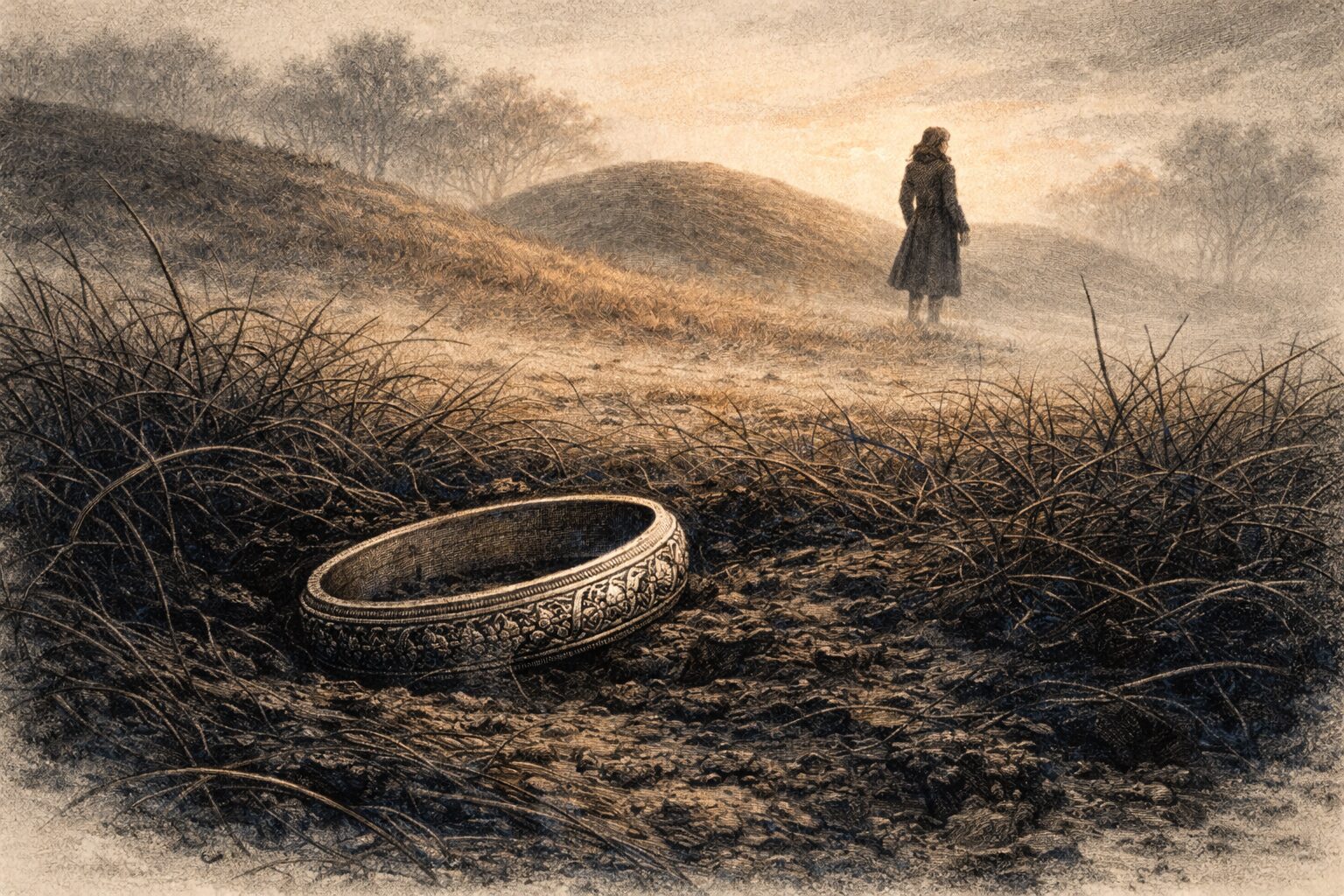
The ring found near the mound surface was not, as he had first said, discovered in March of this year. It had been in the museum’s collection since 1994. The March entry was a data error — a staff member had re-entered an old record without checking for duplicates. Soren had corrected it in the system. The original survey that found the ring had taken place in 1993.
‘How old was your grandmother in 1993?’ Petra asked.
Lena calculated. ‘Sixty-two.’
‘Not at the end of her life,’ Petra said.
‘No,’ Lena said. ‘In 1993 she was living in Gävle. Teaching piano to children in the afternoons. Growing a garden she complained about constantly.’ A pause. ‘Living a normal life.’
‘Did she ever come here before February of this year?’ Marcus asked.
Lena thought about this carefully, and then she understood something.
‘She brought me here when I was eight,’ she said. The words came out slowly, as though she were watching them arrive from some distance. ‘For a school project about Viking burial traditions. I remember — she walked up to that slope and I stayed at the bottom. I thought she was looking at the view. I was impatient because she was supposed to be helping with the project and she was just standing there.’ She stopped.
‘What year were you eight?’ Marcus asked. He said it quietly, not as a filmmaker collecting detail, but as someone following a thread carefully, not wanting to pull too hard.
‘1993.’
No one said anything for a moment.
‘She placed the ring in 1993,’ Soren said, ‘while you were waiting at the bottom of the slope.’
She had not dropped it. She had not lost it. She had pressed it deliberately into the turf above a king whose name no one had ever agreed on — placed it there for someone to find, thirty years later.
Nobody asked her to choose between what she knew and what she had seen
The drive from Gamla Uppsala back to Uppsala takes about twenty minutes on the straight flat road east of the mounds. The fields on either side are either harvested or waiting, depending on the season. In October, most of them were waiting.
Lena drove alone. Petra stayed at the museum to photograph both documents properly with archival equipment. Marcus stayed to film the mounds in the last light of the day. Soren locked the archive room and left first, cycling back toward the university with his head down against the October wind.
Lena drove the twenty minutes without turning on the radio. She almost never drove in silence. Tonight she did not notice until she was halfway there.
She was thinking about when she was eight years old, standing at the base of the mound, pulling up grass while her grandmother stood on the slope above her. She had been impatient — too young to understand that standing still in a place and paying attention to it is a form of work, not idleness. She had not watched her grandmother on the slope. She had looked at the ground and pulled up grass stems one by one.
The thought arrived with a quality she recognized from documents. It was the quality of something that had been waiting, sealed and still, inside the right box, for the right person to open it at the right moment.
What if the woman in the first photograph — half-turned, just beginning to turn toward something behind her — was her grandmother fifty years younger than the woman in the second image? What if the amber light in both photographs came not from the angle of the sun, but from the slip itself — from the thin place in time where one moment pressed up against another and let through a little warmth? What if her grandmother had first slipped as a young woman, had seen something on that slope that she spent the rest of her life living toward — and had returned in her final weeks not to say goodbye to the mounds, but to confirm that what she had seen the first time had been real?
Lena understood the difference between a conclusion and a possibility. She was an archivist. She knew that a document could point toward something without proving it. That evidence could be coherent and still incomplete. That some files stayed open.
The road curved slightly, and the city lights came into view: Uppsala’s cathedral towers and university buildings rising against the darkening sky. The same skyline she had driven toward for eleven years, every working day, without ever once stopping to think about what it meant that she recognized it so completely. That recognition — the feeling of arriving somewhere you already know — had always been part of the drive home. She had simply never had a reason to name it.
She drove home in the late afternoon light and did not play the radio — carrying the weight of a time slip she could not yet name
There was one more thing. She had not told the others because she could not yet say it aloud in the archive room, with the photographs on the table and the fluorescent buzzing overhead and three other people present. Some things needed to be carried home first.
When she had been standing on the northern slope that afternoon — after Petra’s comment about recognition, after the wind — she had smelled it again. The mineral smell. The old paper sweetness. The smell she associated with documents that had been closed for decades and were now being opened.
She had smelled it in the open air, on the dry grass, with nothing nearby that could have produced it.
And for a moment — three seconds, perhaps four — the light had not been October.
She had not slipped anywhere. She was clear about this. She had remained in the present. She could see the gravel car park to her right. She could hear Marcus adjusting his tripod somewhere behind her. She was standing on a slope in October, in Sweden, in the present.
But the light had been amber. And in that amber light, for those three or four seconds, she had not felt alone on the slope.
She had felt accompanied. Not frightened — she thought about this carefully, because the distinction mattered. She had not been frightened at all. She had felt the specific way she felt when she found a document that completed a sequence — when she found the missing piece that made a record whole. The feeling of a thing that had been waiting, patient and still, for exactly as long as it needed to wait.
Like recognition. Exactly like recognition.
She parked in front of her apartment building. The street was quiet. A neighbor’s cat sat on the low wall and watched her get out of the car with the mild indifference of cats watching humans do things that don’t quite make sense.
She stood on the pavement for a moment with her keys in her hand.
The archive key — the old one, the one that had been cut in 1924 — was on her key ring. She had carried it with her every working day for eleven years, automatically, without ever stopping to look at it. She had always assumed it was a standard key. It had always worked. She had never questioned it.
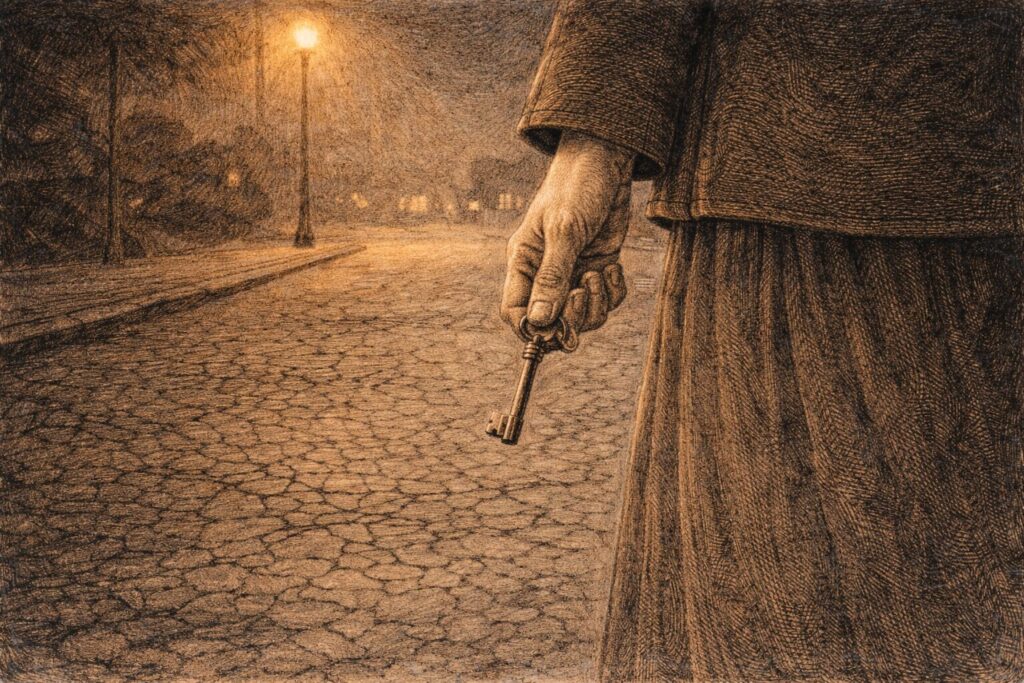
She looked at it now under the yellow street light. She saw, for the first time — or noticed for the first time, which is a different thing — the older style of cut. The different weight of the metal. The surface worn completely smooth, not by eleven years of her own handling, but by decades of handling before hers. Worn smooth by someone else’s hands, over many years, before the key arrived in her possession.
By whose hands, she did not know.
She closed her fist around it and went inside.
A quiet shirt could carry the amber path and the lone figure inside the lens — a small reminder of the October light that did not belong to its year.