Petra had a list of documented cases and very little patience for dismissal
There was a misconception that had come up several times during Petra’s work that week, and she addressed it because it was relevant to how they should think about the photograph.
‘People assume that time slip experiences happen only to imaginative or suggestible individuals,’ she said. ‘That assumption is not supported by the evidence. Two of my most detailed, most precisely documented accounts come from engineers. One is a structural engineer in Liverpool who stepped onto Bold Street during his lunch break and found himself in a version of that street as it appeared in the 1950s — with period shopfronts, period vehicles, and period pedestrians. Witnesses standing nearby reported that he disappeared briefly and then reappeared. The other account is from a bridge surveyor in Portugal. Engineers are professionally trained to notice when what they are seeing does not match what the physical record says should be there. They are, in some ways, the most reliable kind of witness.’
Marcus wrote Bold Street in his notebook.
‘The other misconception,’ Petra continued, ‘is that a time slip is always a dramatic, overwhelming event. In reality, many of the accounts I have collected describe something very brief and very quiet. A smell that does not belong in the present moment. A voice without a source. A corner of a room that looks wrong for a second and then looks right again. People dismiss these smaller experiences because they do not match the dramatic version they have seen on television. But in my experience, the smaller experiences are often the most significant — because they are harder to explain away.’
Lena was looking at the photograph again. ‘My grandmother used to say that the mounds made her hear things,’ she said. The comment came out quietly, not quite directed at anyone in particular. ‘I always assumed she meant the wind.’
The heating in the building clicked on. Through the half-open door, the fluorescent light in the archive room buzzed once.
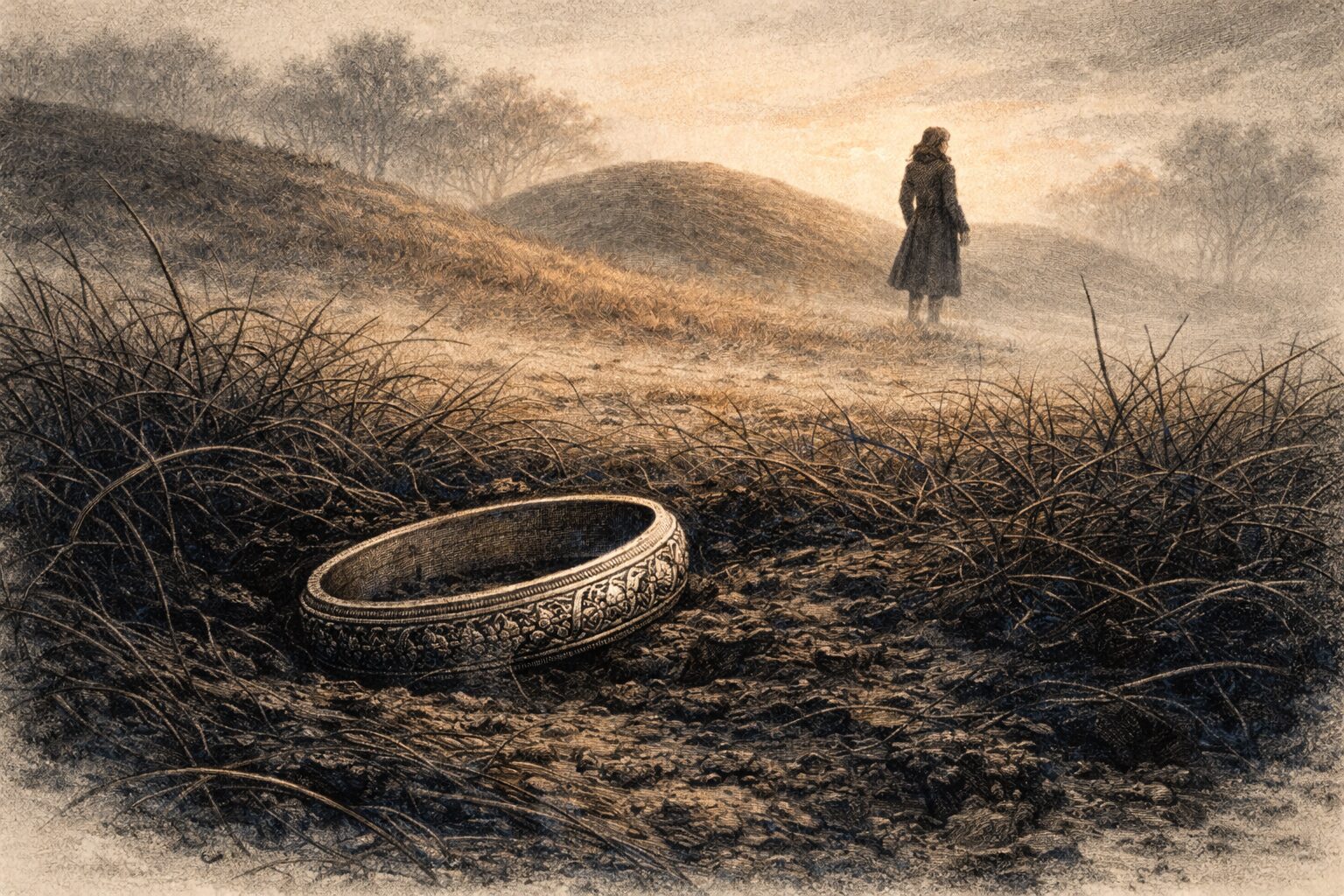
The woman in the photograph was wearing Lena’s grandmother’s ring
At this point, a fourth person entered the situation — not through the front door, but through the back of the museum. His name was Soren Brandt. He was twenty-three years old and was completing his archaeology dissertation at Uppsala University. He worked two days a week at the museum, handling soil samples from a survey of the mound perimeters, in exchange for access to the excavation records he needed for his research.
He came in carrying a box of catalogued samples, set it down near the archive room entrance, and noticed the three people at the café table. They were looking at a photograph with the particular focused attention of people who had stopped pretending to be casual about something. He came over to look.
He studied the photograph in silence for a moment. Then he said: ‘The ring.’
Lena looked up sharply. ‘You recognize it?’
‘I catalogued a ring last spring,’ Soren said. ‘It came up during the mound perimeter survey — not from the burial itself, but from the upper surface layer near the northern slope. It had been placed deliberately, pressed into the turf. Someone had put it there intentionally, not lost it.’ He took out his phone and scrolled to the image. ‘Here.’
He showed Lena the photograph on his phone screen. It showed a silver ring with an engraved band.
Lena did not move for several seconds.
‘When was it catalogued?’ Petra asked.
Soren checked his notes. ‘March. This year.’
‘My grandmother died in February,’ Lena said. She said it in the flat tone of someone stating a fact they are not yet ready to connect to other facts.
A time slip leaves no evidence — which is either proof of nothing or proof of everything
They moved from the café to the archive room, because the archive room was where the records and documents were, and documents were now the most important thing. Marcus brought his camera with him. He held it at his side rather than raising it — partly because he was a filmmaker and found it easier to think with equipment in his hand, and partly because he was not yet sure what he was documenting.
Lena laid the contents of the 1980 box out on the long work table in a careful row: surveyor sketches, a church register, three postcards from the 1940s, a water-damaged field report, and the photograph in its plastic sleeve.
‘The rule for this box,’ Lena said, ‘was that it was sealed after the 1980 donation and was not scheduled to be opened until the 2026 review. I opened it early because a researcher requested access to the field report. The photograph was already inside it when I opened it. Someone placed it in this box in 1980, before I was born. But the photograph is labeled 1923, and the photographic paper has been confirmed as period-appropriate.’
‘Which means,’ Petra said carefully, ‘that a photograph of a woman wearing what appears to be your grandmother’s ring was placed in an archive box forty-six years ago — and your grandmother would have been forty-nine years old in 1980.’
‘Yes,’ Lena said.
‘What if the ring in the photograph simply isn’t the same ring?’ Marcus said. He said it not as a dismissal but as a genuine attempt to find the simplest explanation first. ‘What if your grandmother had one like it, and the connection you’re building is something your mind is constructing because you are grieving?’
‘I know what I’m building,’ Lena said.
She did not say it sharply. She said it carefully, the way she said most things. ‘I have spent eleven years as an archivist. I know what confirmation bias looks like, and I am trying very hard not to do that. But I have also spent eleven years working with documents that do not behave the way they should. And I have learned that when a document is telling you to look more carefully, the right response is to look more carefully.’
Here Petra offered an explanation that the room required — not a lecture, but a clarification, because three people standing around old paper in a narrow room needed the terminology placed clearly.
A time slip, in the documented research literature, leaves no physical evidence behind. There is no chemical trace, no change to the physical surface of the location, no measurable alteration of any kind. What a time slip leaves is the account of the person who experienced it — and that account can be neither proven nor disproven by conventional means. The relevant question is therefore not whether the event happened in a way that science can currently measure. The relevant question is what changes in the witness afterward. What they carry back with them into the present.