The archive key had been cut in 1924
Soren found the second anomaly while Marcus and Petra were reviewing the photographs again. He had gone to reorganize the key cabinet near the archive room entrance — a routine task — and had noticed something about the key on the hook labeled Arkiv nedre. He almost said nothing, because it was the kind of small detail that could mean nothing at all. But the ring had made him careful.
The key was an older style of cut — pre-modern, with proportions that were inconsistent with mid-century Swedish locksmithing. Soren had enough practical experience with heritage materials to notice this. He looked up the museum’s key log. The earliest entry for that hook was 1980, when the museum had been formally reorganized. But the key itself — he showed it to Petra, who had spent enough years doing forensic work to recognize material provenance — had the metal composition and surface wear of something considerably older.
‘Could be a reused key from an earlier building,’ Marcus said.
‘The lock it fits was installed in 1978,’ Soren said. ‘I checked the maintenance log. Standard 1970s mechanism. The key should match that period.’ He paused. ‘The key is approximately fifty years older than the lock it opens. And it opens the lock correctly. I tested it.’
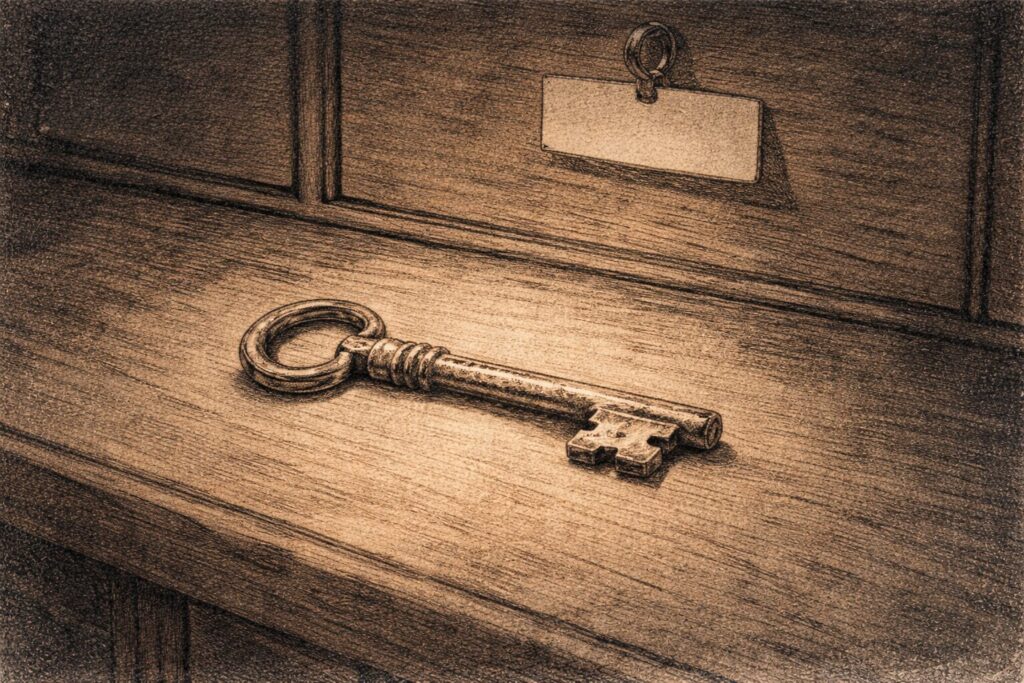
Petra looked at the key for a long moment. ‘So someone used a key from 1924 to open a lock that did not exist until 1978,’ she said.
‘Or,’ Soren said, ‘someone placed a 1924 key in this building in 1978, knowing it would fit a lock that was about to be installed.’
The archive room was quiet in the specific way that archive rooms are quiet — all the absorbed silence of old paper, old ink, old sealed things waiting for the right moment to be opened.
Lena, standing at the table with the photograph in front of her, understood now that she had been looking at this mystery for most of her life without recognizing it.
She stood at the edge of the mound and understood why time slip witnesses never quite recovered
In the early afternoon, all four of them went outside together. The October light in central Sweden has a particular quality in the hours before sunset: it becomes thinner and more golden, making everything look slightly more exposed than it does at midday — as though the world has decided to be more honest about itself.
The air carried the cold smell of dry grass and, underneath it, that faint mineral sweetness that Lena could not name.
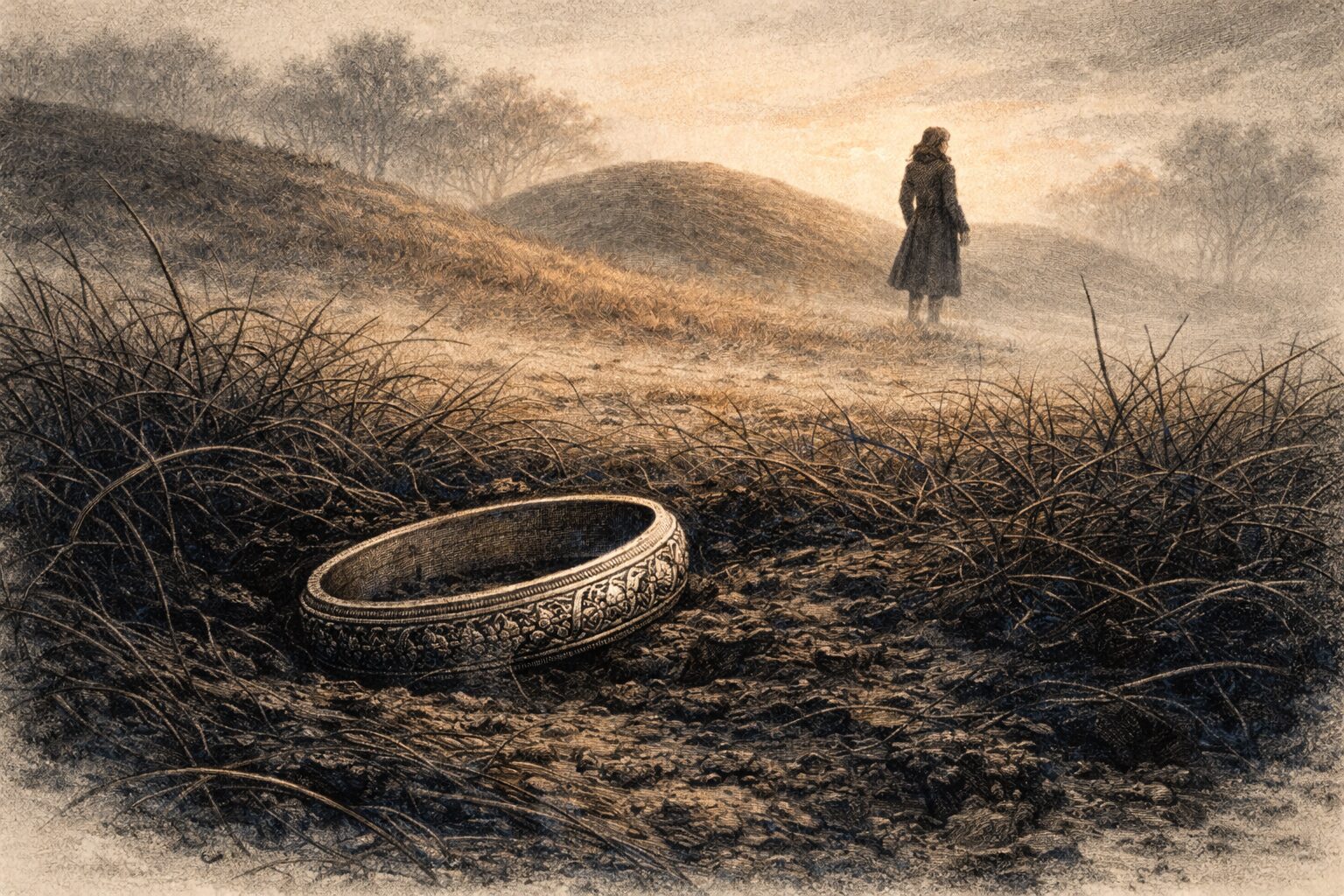
She walked to the northern slope of the largest mound and stopped at approximately the spot where the woman in the photograph had been standing. Marcus stayed back, holding his camera at his side. Soren stood at the base of the slope. Petra walked up beside Lena.
The grass on this particular section of the slope was drier than the rest. The ground had an unusual quality underfoot — not soft, but not as solid as it should have been, as though the soil were thinner than expected over whatever lay beneath.
‘The thing that is most consistent across all documented time slip accounts,’ Petra said quietly — not to anyone in particular, but to the space around them — ‘is what witnesses report feeling afterward. Not awe. Not fear. Something else.’ She paused. ‘They almost always say they recognized the place they slipped into. As though it was somewhere they had already been, and were returning to.’
The wind moved slowly through the dry grass. From somewhere behind the museum, a low rhythmic sound arrived — footsteps on gravel, perhaps — and then stopped.
Lena looked at her right hand. She had never worn a ring on it. Her grandmother had — always the same ring, always on the right hand, even in the last year of her life when it had become too large for her thinning fingers.
‘She came here,’ Lena said. ‘At the end of her life. She asked me to drive her, and I thought she simply wanted to see the mounds one last time before she died. That kind of thing.’ She looked at the pale, dry patch of grass where the photograph had been taken. ‘She walked up here alone. I waited in the car. She was up here for about twenty minutes.’
She stopped speaking.
‘And she didn’t tell you what happened while she was up here,’ Petra said.
‘She never told me anything after that visit. She died three weeks later.’ Lena was still looking at the patch of grass. ‘When she came back to the car, she looked different. She looked like someone who had set something down — something they had been carrying for a very long time.’
Soren found the second photograph before anyone thought to look
While the others were standing on the mound, Soren went back into the archive room. He had returned to it because the first photograph had unsettled him in a specific way: it had made him feel he had not been thorough enough the first time. He was a careful person by training. He went back to the 1980 box and examined it from the beginning, checking every flap and fold.
The second photograph was folded in half and tucked inside the lower flap of the box — not catalogued, not labeled, not part of the official contents. He smoothed it flat on the work table and stood very still.
The photograph showed the same northern slope of the same mound. The same amber light. The same dry grass. The same camera angle, as though the photographer had stood in an identical position both times.
The difference was this: the woman in the second photograph was not half-turned away from the camera. She was facing it directly. Her face was completely visible and in clear focus.
Soren photographed it with his phone and sent the image to Lena before she had come back inside.
When Lena looked at her phone screen and saw the image, she sat down on the grass slope without meaning to. Her legs simply did not hold her. Marcus, who was standing beside her, said nothing. He reached down and steadied her arm without looking away from the mound.
The woman in the second photograph was Lena’s grandmother. Not probably. Not possibly. Definitively — the face, the posture, the ring clearly visible on the right hand. Astrid Strand, standing on the northern slope of Kungshögen in the same amber light that appeared in the first photograph. Her expression was unlike any Lena had ever seen in the family photographs from the bedroom cupboard — not the cheerful midsommar expressions, not the formal Christmas ones. It was the expression of someone who had arrived, finally and with complete certainty, somewhere they had always known would be there.
The second photograph had been printed on the same paper as the first. The same 1920s photographic chemistry.
Astrid Strand had been born in 1931.