The Command That Asteroid Mining Made Necessary
Nobody argued. This surprised him slightly, and then it didn’t — they had worked the problem honestly, all of them, and the problem had arrived at the same place he was standing, and the team was made of people who followed honest work to its conclusion.
Fasil built the command packet. It took twenty-five minutes, which was fast. Oren reviewed it and found one thing he wanted adjusted — the landing vector, moved slightly to aim for the softest part of Risa’s density profile rather than the geometric center of the target zone. Kael approved the adjustment. Dmitri read the full packet and handed it back without comment, which was Dmitri’s way of saying it was correct.
Kael read it himself. He read it twice.
He was thinking about the investors in Denver. Three people who had believed him when he stood in a glass-walled conference room and told them that asteroid mining was not a gold rush — that this was real work, real physics, real economics, and that the reason no one had done it yet was not because it couldn’t be done but because it required the right team with the right approach on the right target. He had believed every word of that. He still believed it. He was also about to send a command that had a 29-percent chance of ending the machine, the mission, the company, and those investors’ money in a single thirty-eight-minute round trip.
He thought about what he’d say to them afterward if it failed. He could not construct the sentence. So he stopped trying and authorized the packet instead.
The signal left at 5:44 in the morning. Nineteen minutes to the probe. Thirty-eight minutes until they would know.
The Irreversible Packet
Dmitri made coffee. This was unusual — Dmitri did not typically make coffee, he accepted coffee that other people made — and the fact that he did it now without being asked told Kael something about how the thirty-eight minutes were going to feel.
They felt long.
The call lasted thirty-seven minutes.
Kael did not go to the kitchen. He sat at his station and looked at the telemetry feed, which showed Cutter-3 exactly as it had been for eleven days — anchored, nominal, patient. The probe had no awareness of what was coming. In about four minutes it would receive a packet of instructions it would execute without hesitation, without doubt, without the nineteen-minute gap between question and consequence that had defined every decision made in this room.
He envied it slightly.
Fasil said, not looking up: “The spectral survey wasn’t wrong.”
“I know.”
“I keep wanting to find something wrong with the survey. I’ve been going through the raw files for the last hour. The data is clean. The mineral classification is correct for every observation window. The asteroid just—”
“Wobbled,” Kael said.
“Four point one degrees.”
“Four point one degrees.”
“It was in the risk file.”
“Item fourteen,” Kael said. “Low probability. I read it and moved past it.”
Fasil was quiet for a moment. “I read it too.”
“I know you did. I was the one who decided the landing site. That’s not distributed responsibility, Fasil. That one is mine.”
Fasil nodded. He didn’t argue, which was correct.
Oren said: “Eight minutes.”
Thirty-Eight Minutes
They waited.
The room had the specific quality of people who have done everything available to them and are now inside the part where the universe decides. Risa had her density profile open on her screen and was updating a secondary calculation. Dmitri stood at the back with his coffee. Fasil watched his station. Oren watched the clock.
Kael watched the telemetry.
At 6:03, Cutter-3 received the packet.
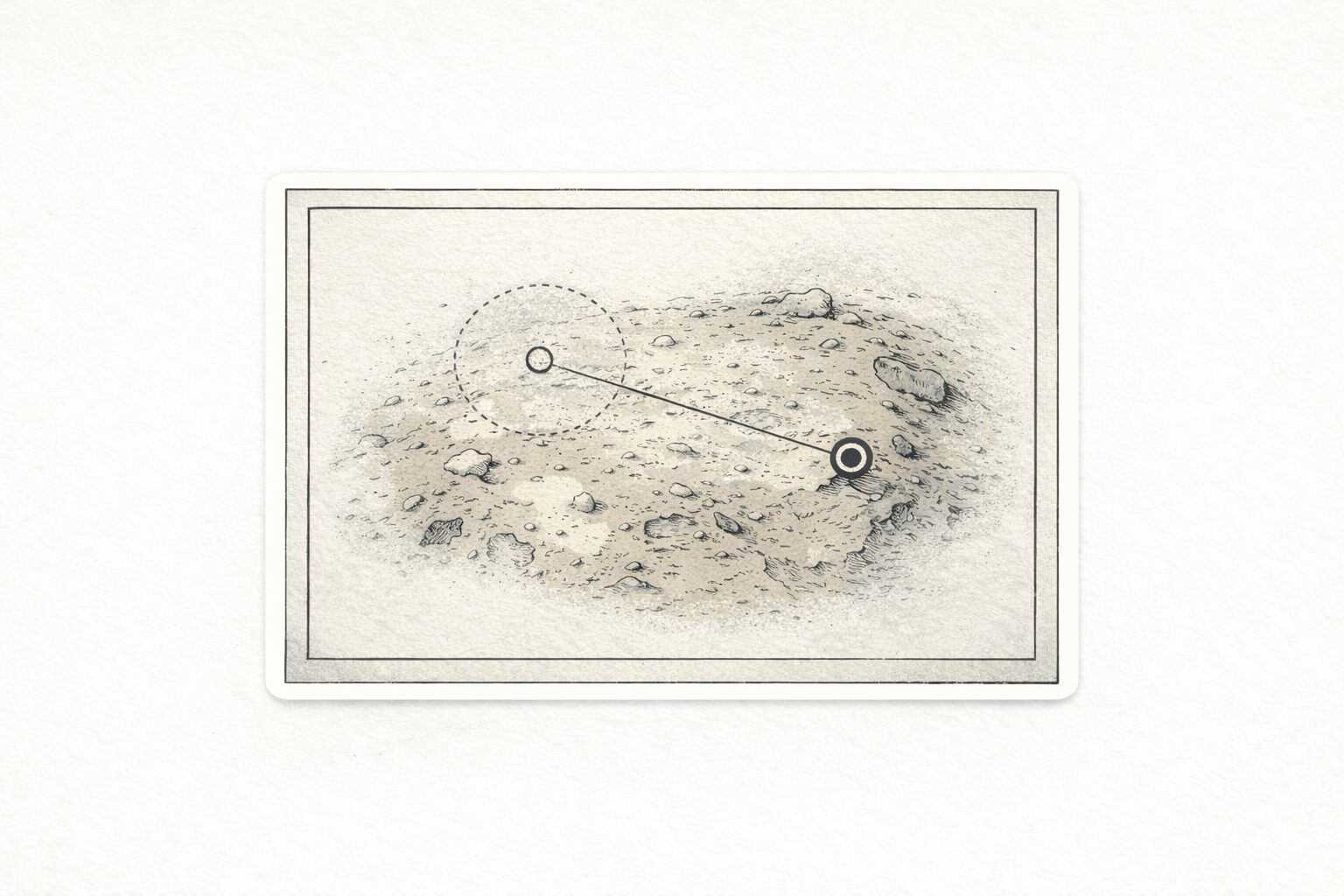
At 6:04, the bolt release charges fired. Two bolts — the thermal release function, a small precisely directed heat pulse that fractured them at a designed break point. The probe lifted fractionally from the surface, the thrusters firing simultaneously to push it laterally, the arc calculated to move it 10.8 meters across the face of 2103 Yoro at a speed slow enough that the asteroid’s slight gravity would bring it back down.
None of them could see this. They were looking at numbers on a screen in Pasadena, California, and the numbers would not update for another nineteen minutes.
At 6:06 — they did not know this yet, would not know it for nineteen more minutes — Cutter-3 contacted the new surface.
At 6:06 and four seconds, the remaining two bolts fired into the new regolith.
In Pasadena, the room waited.
Kael thought: if this works, the first thing I do is rebuild the precession analysis protocol. Not in a lessons-learned document that gets filed. In the mission planning framework itself. Mandatory. Before any landing site is selected, ever, on any body, by anyone using the methods we built. He was not doing this as penance. He was doing it because it was the right structure and he had not built it the right way the first time, and knowing the right way now was what the last eleven days were for, regardless of what the next two minutes showed on the screen.
The confirmation packet arrived at 6:22.
After the Signal
Fasil read the numbers first because his station received the telemetry feed. He said nothing for three seconds, which was long enough for the room to notice.
Then he said: “Both bolts. Nominal depth. Probe stable.”
Oren made a sound that was not a word. Risa turned around from her station for the first time in two hours. Dmitri set his coffee down on the edge of a desk and folded his arms again, but differently this time — not the preparatory stillness of before. Something else.
Kael looked at the anchor confirmation data on his screen. Two bolts, both at correct penetration depth, lateral stability confirmed, probe orientation within two degrees of vertical.
He said: “Start the first heating cycle at the new position. Standard parameters.”
There was no celebration in his voice. That was not performance — he genuinely felt no urge to celebrate. The probe was anchored. The probe had been anchored before and produced nothing for eleven days. What mattered now was the next thirty-eight minutes.
He stood up and went outside.