What Eleven Meters Means on a Rock in Space
Oren said: “Can we move the probe?”
Dmitri said: “That’s the question.”
“Then answer it.”
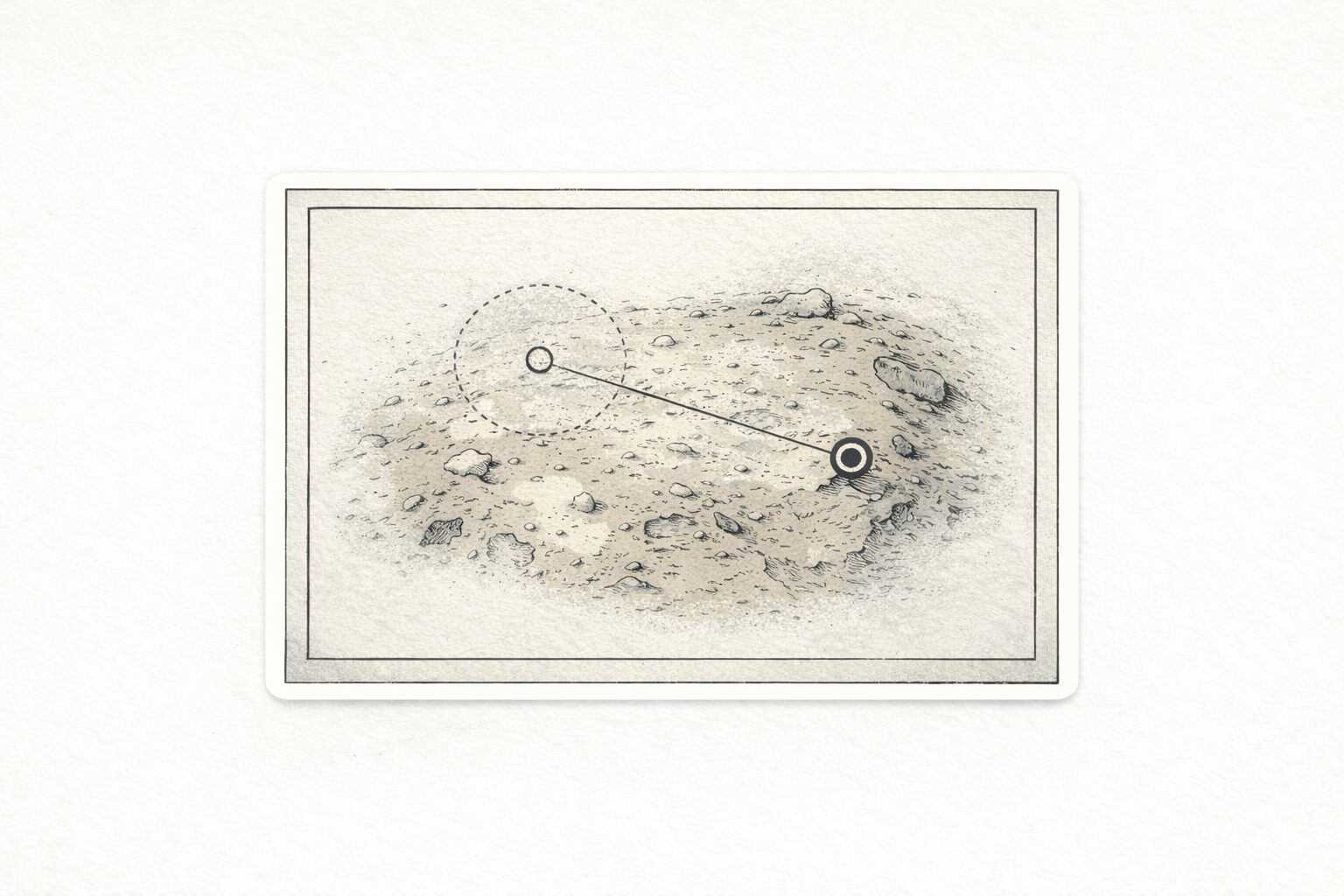
Dmitri walked to the whiteboard and uncapped a marker. He drew a rough circle — the asteroid — and put a dot on it. “The probe is anchored. Four bolts, fired into the rock on landing. To move it, we release the bolts and use the small thrusters to push it across the surface to a new spot, then re-anchor.” He drew an arc between two dots. “In the mission documents this is called a hop maneuver.”
“Then we do that,” Oren said.
“The re-anchor success rate from our pre-mission testing was sixty-three percent.”
Silence.
“Meaning,” Oren said slowly, “there is a one-in-three chance that when the probe tries to land at the new spot, it doesn’t anchor. It bounces.”
“And if it bounces?” Fasil asked.
“This asteroid is small,” Dmitri said. “Its gravity is almost nothing. If the probe bounces off the surface at anything above a slow walking pace, it doesn’t come back down. It just — keeps going. Very slowly. Until it’s gone.”
The room took this in.
“Sixty-three percent,” Oren said again.
“That was the test number,” Risa said from her end of the room. “Those tests used a surface material we knew. We don’t fully know this surface. The real number could be higher or lower.”
“How do we find out?” Kael asked.
“We’ve been sitting next to the target landing zone for eleven days,” Risa said. “The probe’s sensors have been picking up vibration and density data from the surrounding surface continuously. I can use that to estimate the surface conditions at the hop target. It won’t be perfect. But it will be better than the test number.”
“How long?”
“Forty minutes.”
“Build it.”
What Asteroid Mining Gets Wrong About Safety
While Risa worked, Fasil said: “There’s something else.”
Kael looked at him.
“Even if the hop works and the probe anchors at the new site — we only have seventeen hours left in the power window. After that the solar angle drops and the probe goes into hibernation automatically. If we’re in hibernation when the contract deadline hits, we’re in default.”
“I know the timeline.”
“I’m saying — we need the hop to work and we need it to produce yield, and we need it to do both fast enough to matter. It’s not enough to just move the probe.”
“I know,” Kael said.
“I’m not trying to—”
“Fasil. I know.”
Kael stood up and walked to the small kitchen at the back of the room. He filled a glass of water and stood at the counter. Through the half-wall he could see the tops of his team’s heads — Dmitri still at the whiteboard, Oren at his station, Fasil turned back to his screen, Risa working quietly at the far end.
He had chosen the landing site himself. Eight months ago, in this same room, he had stood at the front and argued for it against two other candidates his team had proposed. The other options had things going for them — one had a better thermal profile in the pre-mission models, one was in a zone that had been observed more frequently. But this site had the highest confidence spectral rating, and Kael had trusted that above everything else because spectral data was not a model. It was a measurement. You pointed a telescope at the asteroid and the light that came back told you what was on the surface. That was hard information.
He had been right that it was hard information. He had not been wrong about any of the reasoning. The asteroid had simply moved in the eighteen months between the survey and the landing, rotating with a wobble that was larger than the pre-mission estimate, shifting the surface until the patch the telescope had measured and the patch the probe was sitting on were eleven meters apart.
He had not checked that specifically.
He had read item fourteen in the risk register — wobble uncertainty, low probability — and moved on. Low probability was not zero probability, and he had known that, and he had moved on anyway.
He went back to the room.
The Three Things on the Board
Dmitri had put three options on the whiteboard while Kael was in the kitchen.
Try to reach the water-bearing zone with the drill arm extended laterally: The arm had a reach of about two meters from the probe’s center. The target zone was eleven meters away. This was not a real option. Dmitri had written it on the board anyway because in a crisis you wrote everything, even the things that were already ruled out, because seeing them written and crossed off was different from them living unwritten in the room’s air.
He had crossed it off.
Push the heater to maximum and try to force yield from the current site: The heater maxed out at 650 degrees. The dry mineral — if that was what was under the drill — needed temperatures the heater could not reach. Risa had already said this. Running the heater at maximum would not get yield. It would wear the heater down and get nothing.
Dmitri had crossed this off too.
Hop: That was what remained.
Kael stood in front of the whiteboard and looked at the single word. Dmitri stood beside him.
“If Risa’s surface estimate comes back favorable,” Kael said, “what does the re-anchor probability look like?”
“She’ll have a number. I don’t want to speculate.”
“Speculate.”
Dmitri considered. “If the density profile at the target matches what the spectral survey suggested should be there — loose, unconsolidated material, relatively soft — then re-anchor improves. Maybe meaningfully. The test failures came mostly from hard surface contacts where the bolts couldn’t penetrate at the correct angle. Soft material is more forgiving.”
“And if her estimate says the surface is hard?”
“Then sixty-three percent was generous.”
Kael looked at the whiteboard. One option. One word.
“What does losing the probe do to the company?” Fasil asked from his station.
Nobody answered immediately.
“I know what it does,” Fasil said. “I’m asking out loud so we all agree on what we’re deciding.”
Dmitri said: “The anchor system is single-use. A rebuild is fourteen months minimum. The investors have a clause at the twelve-month mark. If we’re not operational by then, they can withdraw.”
“So we lose the probe, we lose the mission, and we lose the company,” Fasil said.
“In sequence, yes.”
“And if we don’t hop?”
“We lose the mission and the company. The probe survives on the wrong rock doing nothing.”
Fasil nodded slowly. “So the probe surviving doesn’t actually help us.”
“No,” Dmitri said. “It doesn’t.”
Asteroid Mining and the Hop Nobody Wanted to Name
Risa came back in thirty-eight minutes. She walked to Kael’s station and set a printed page in front of him rather than putting it on the main screen, which meant she wanted him to see it first.
He looked at it.
A density profile of the hop target zone, built from eleven days of vibration and sensor data collected by the probe from its position eleven meters away. The profile showed soft, loose material at the surface — the kind that bolt anchors penetrated easily, the kind that was consistent with what the spectral survey had said should be there.
At the bottom of the page, in Risa’s handwriting: Estimated re-anchor probability: 71%. Confidence interval wide — real number is somewhere between 62% and 80%.
Kael looked at the number.
“Better than sixty-three,” Oren said, reading over his shoulder.
“The low end of the interval is worse than sixty-three,” Dmitri said.
“The middle is better.”
“The middle is an estimate from incomplete data.”
“Everything in this room is an estimate from incomplete data,” Risa said. She had gone back to her station. “That is the situation we’re in. I gave you the best number I can give you. What you do with it is not my decision.”
Kael looked at the page for another moment. Then he set it face-down on the desk and turned to face the room.
“We hop,” he said.