Kael Morrow had been awake for thirty-one hours when the third extraction cycle came back empty, and the number on the screen was so close to zero that the decimal places felt like a joke. He stared at it. He had eaten something an hour ago — someone on the team kept putting food near his right hand, and his right hand kept raising it to his mouth — but he couldn’t have said what it was. He had been running asteroid mining operations out of a converted warehouse on Cordova Street in Pasadena for eleven days, and for the first ten of them he had believed the machine was working. Now the machine was working perfectly and producing nothing, and those were two different problems, and only one of them was fixable.
He pushed back from the desk.
“Run it again,” he said.
Fasil, at the station to his left, looked at him. “It’s the third cycle, Kael.”
“I know what cycle it is. Run it again.”
The Warehouse on Cordova Street
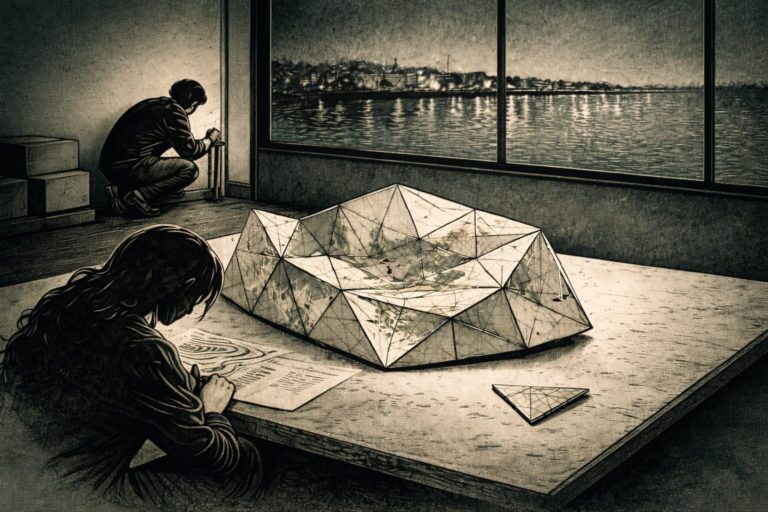
The building had been a machine parts warehouse before Helix Extraction leased it eighteen months ago. The floor was sealed concrete, the ceiling high enough that the air near the top of the room was always a different temperature than the air near the workstations, and the east wall had a freight door that they’d covered with a whiteboard but whose outline you could still see if the light hit it right. At three in the morning there were nine people in the room. Kael’s systems lead, Dmitri Vance, stood behind the chair bank with his arms crossed. Fasil Tekle ran the command stations. Oren Blass handled software. Risa Holdt sat at the far end near the propulsion desk, which had nothing to do with the current problem, which was exactly why Kael noticed she hadn’t left.
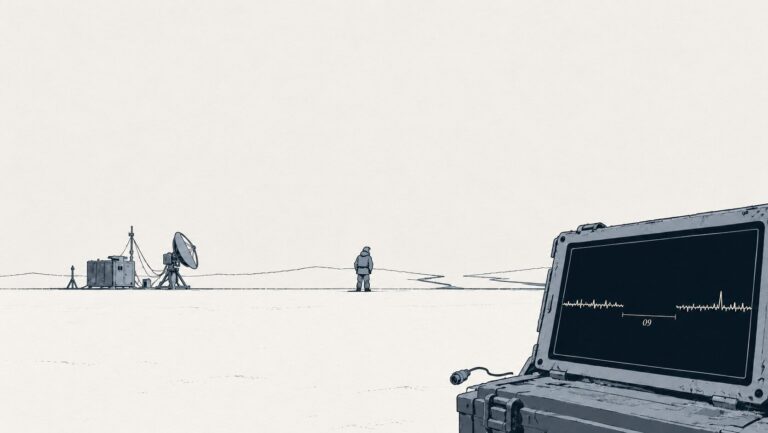
The main screen showed the probe — Cutter-3 — in surface mode on the asteroid designated 2103 Yoro. Every system on the probe read green. The drill was down. The heater was running. The collection tube was pressurized and waiting. On paper, the operation was going fine.
The collection tube was empty.
Fasil ran the fourth cycle. They watched the numbers come in on the nineteen-minute delay — nineteen minutes for the command to reach the probe, nineteen minutes for the result to travel back — and when the result arrived it was the same. Near zero. The decimal places were not a joke. They were a verdict.
“Stop running cycles,” Dmitri said.
“I didn’t ask you,” Kael said.
“You’re wearing the heater down chasing a number that isn’t going to change.”
Kael turned in his chair. Dmitri held his gaze without flinching, which was what Dmitri always did when he was right and knew it and was waiting for Kael to catch up.
“Fine,” Kael said. “Stop the cycles. Talk to me.”
What Asteroid Mining Looks Like When the Drill Hits Nothing
Risa spoke first, from her end of the room, still not turning around. “Pull the underground temperature reading.”
Fasil pulled it. A column of numbers appeared on the secondary screen. Kael read down the column and felt something settle in his chest — not panic, something quieter and more permanent than panic.
The temperature was going up as the drill went deeper. Not down. Up.
“That’s wrong,” Oren said.
“Yes,” Risa said.
“Heat should be decreasing with depth. The heater is at the surface end. If the temperature is increasing downward, the rock is absorbing the heat instead of—”
“Instead of releasing anything,” Risa said. “Yes.”
Oren stared at the column. “So the heater is running, the energy is going somewhere, but nothing is coming out.”
“Now you have it,” Risa said.
Kael said: “Why.”
Risa finally turned around. She had the look she got when she had been sitting on something for a while and had decided it was time to say it regardless of how the room received it. “When we planned this mission, the whole extraction process was designed around one assumption. That the rock under the drill contained a specific kind of mineral — one that holds water in its structure and releases it when you apply heat. Around 600 degrees. Our heater runs to 650. We built in margin.”
“I know what we built in,” Kael said.
“What if the mineral under the drill isn’t that mineral?”
Silence.
“There’s another type of rock that looks almost identical in a telescope survey,” Risa said. “It holds no water at all. And when you heat it, it doesn’t release anything — it just absorbs the energy and gets warm. Which is exactly what we’re seeing.”
Dmitri said: “The survey classified this site as the water-bearing type.”
“The survey classified the surface it could see from Earth,” Risa said. “I’m asking if that surface and the surface the probe is sitting on are the same surface.”
Nobody answered.
The Number That Changed Everything
“Pull the rotation history,” Kael said.
Fasil looked at him. “The rotation history?”
“Yoro’s full rotation record. I want to see how the asteroid was oriented during every observation window over the eighteen-month survey period.”
Fasil started building it. It took six minutes. The room was quiet in the way rooms go quiet when people have stopped arguing because they’ve realized the argument is about to be settled by something larger than any of them.
When the model came up, Kael stood and walked to the main screen. He looked at the time-stepped image — the asteroid rotating slowly, the observation windows marked in yellow, the surface orientation at each window shown relative to the probe’s landing site.
He looked at it for a long time.
“The wobble,” he said.
Fasil said: “What wobble?”
“The spin axis. It’s not perfectly stable. It shifts — slowly, over months. Show me the total shift over the full eighteen months.”
Fasil ran it. The number appeared.
Four point one degrees.
Dmitri said: “That was listed in the risk file. Two point three degrees was the estimate.”
“The estimate was wrong,” Kael said. “It was four point one. And four point one degrees on an asteroid this size—” He stopped. He turned to Fasil. “Calculate the surface displacement. How far does four point one degrees of wobble move the surface relative to where the telescopes were pointing?”
Fasil ran it.
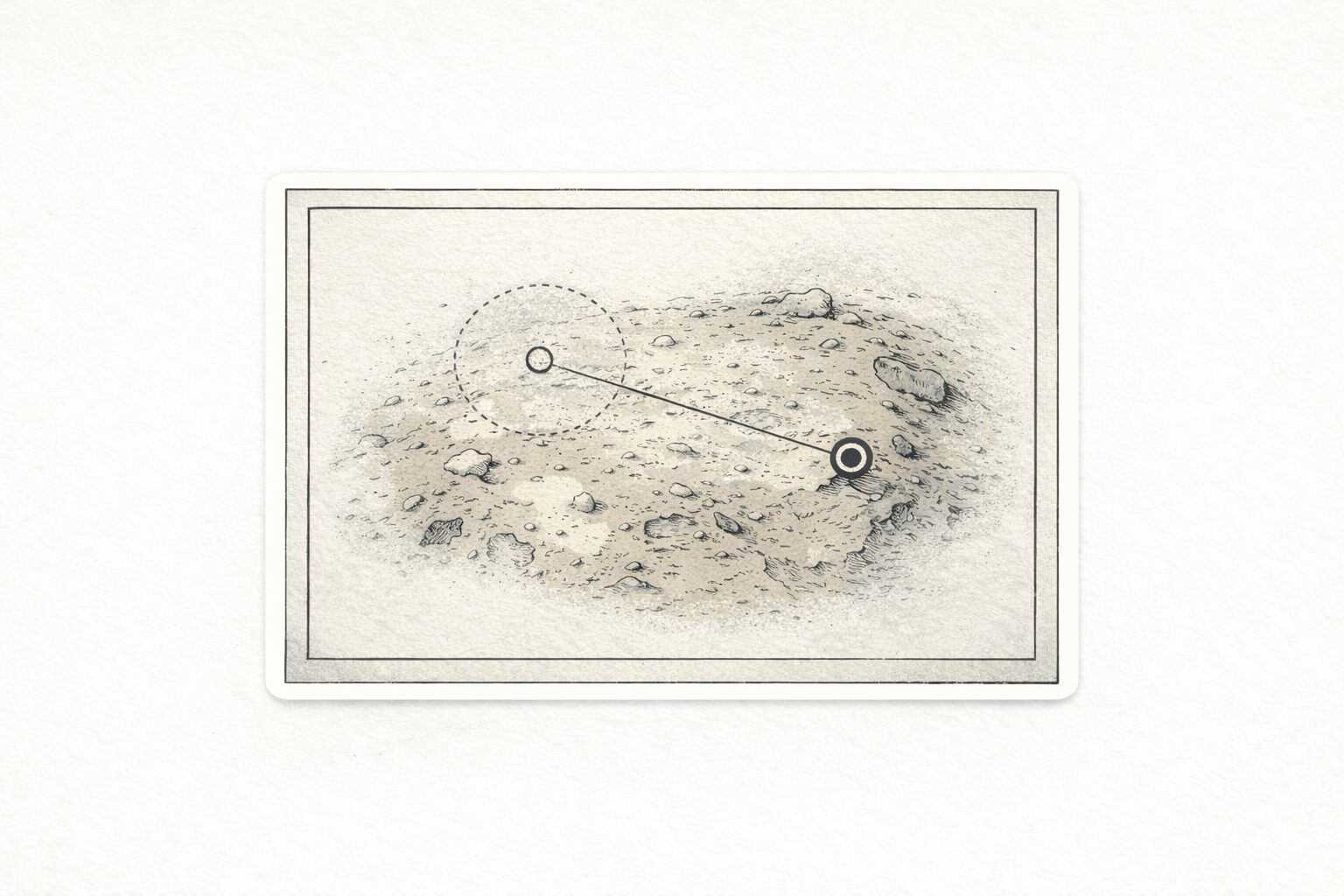
Eleven to fourteen meters.
The room understood this at different speeds. Oren got there first and sat back in his chair and said nothing. Dmitri got there a few seconds later and his arms dropped from where they’d been crossed. Fasil looked at the number on his screen and then looked at Kael.
“The survey was reading a patch of surface,” Kael said. “And the probe landed on a different patch. Eleven meters away. Because the asteroid wobbled.”
“The asteroid wobbled,” Fasil said. Not questioning it. Just saying it out loud the way you say something that needs to be heard in the room’s air before it becomes real.
“The survey data was correct,” Kael said. “The water-bearing mineral is there. It’s eleven meters that way.” He pointed at nothing, at the wall, at the direction that meant away from where the probe was sitting. “We’re eleven meters off.”