The last numbers were the ones we didn’t write down
Later, when the hallway returned to its usual rhythm, Lucía sat back in the Audio Room alone for a minute. I watched through the glass panel as she opened the envelope, took out the folded page of handwritten numbers, and stared at it like it might blink.
She didn’t try to decode it. She didn’t pretend she could.
Instead, she placed the page inside a clear sleeve, then set it atop the catalog form—two simple layers, one protecting the other.
Sunil waited near the door, rubbing his hands again. Alma leaned against the wall, ink-stained fingers now smudged with sweat, as if the day had tried to erase her proof.
Lucía walked out with the sleeve held flat, like a fragile photograph.
“I thought courage was… big,” she said quietly. “Like shouting. Like fighting.”
Alma’s mouth softened. “Sometimes it’s paperwork,” she said. “Sometimes it’s refusing to let someone rename your fear.”
Sunil nodded toward the sleeve. “Keep it clean. Keep it honest.”
Lucía looked at me. “Do you think the listener heard us up there?”
I thought of the voice counting into the sky, indifferent, endless. I thought of the man’s shoes with no dust. I thought of how the library’s glass walls reflected everything, even people who wanted to move unseen.
“I think the listener hears nothing but the numbers,” I said. “But someone else hears what we choose to do with them.”
Lucía held the clear sleeve closer, as if the thin plastic could keep the world from touching the page. Outside, the library lights made the shelves glow like floating streets. Somewhere beyond the city, the ionosphere did its quiet work, bending signals across distance. And in the corner of the room, the computer’s silent waveform waited—ready to be played again, ready to count again—while Lucía stood still, deciding what she would protect next.
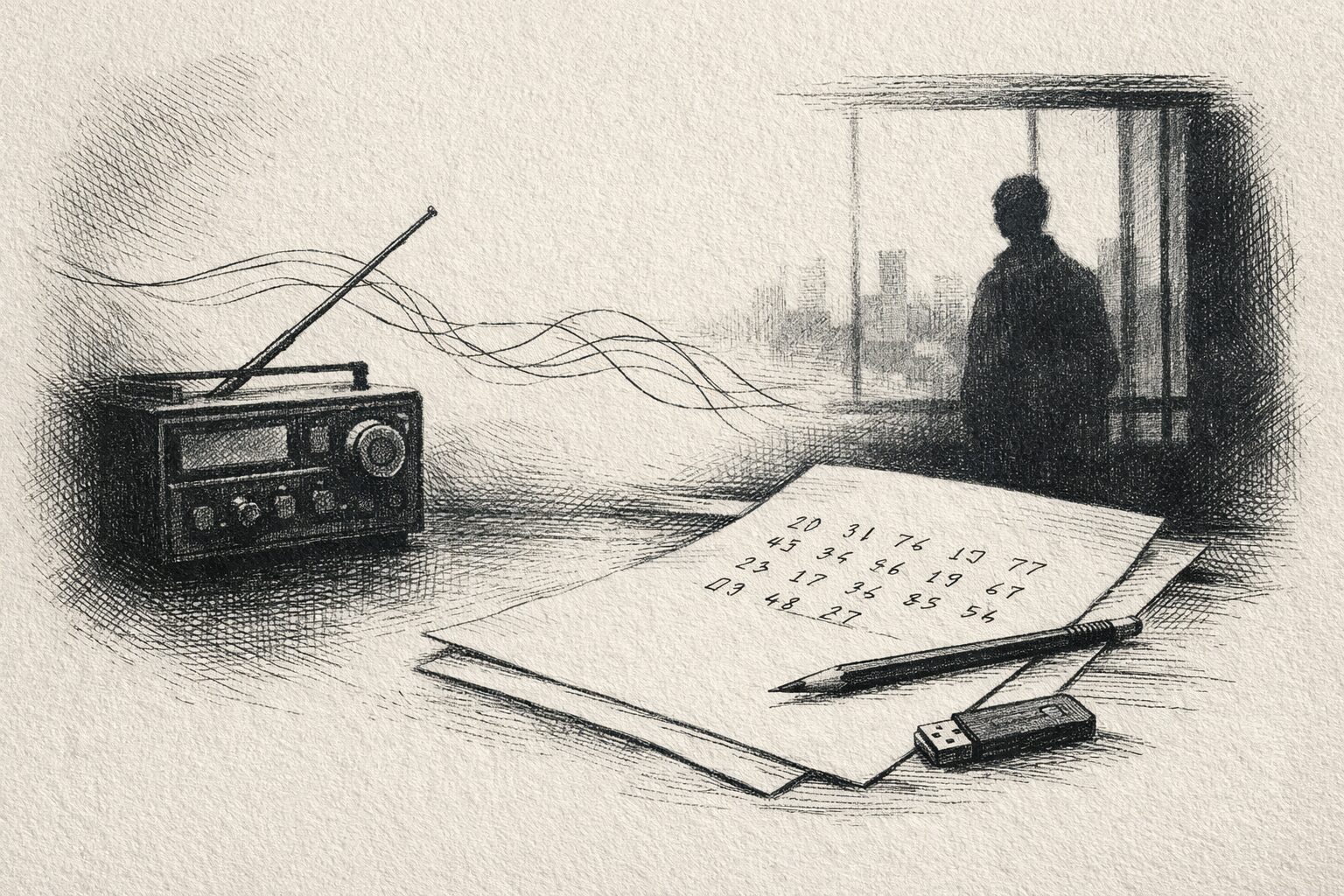
A quiet design could carry a small grid of grouped digits near the hem, with a thin line that drifts slightly, like a signal refusing to stay perfectly still.