The numbers station demanded proof, not belief
We needed someone who knew radios—not from stories, but from hands-on patience. Someone who could tell if the recording was a real capture or a staged performance.
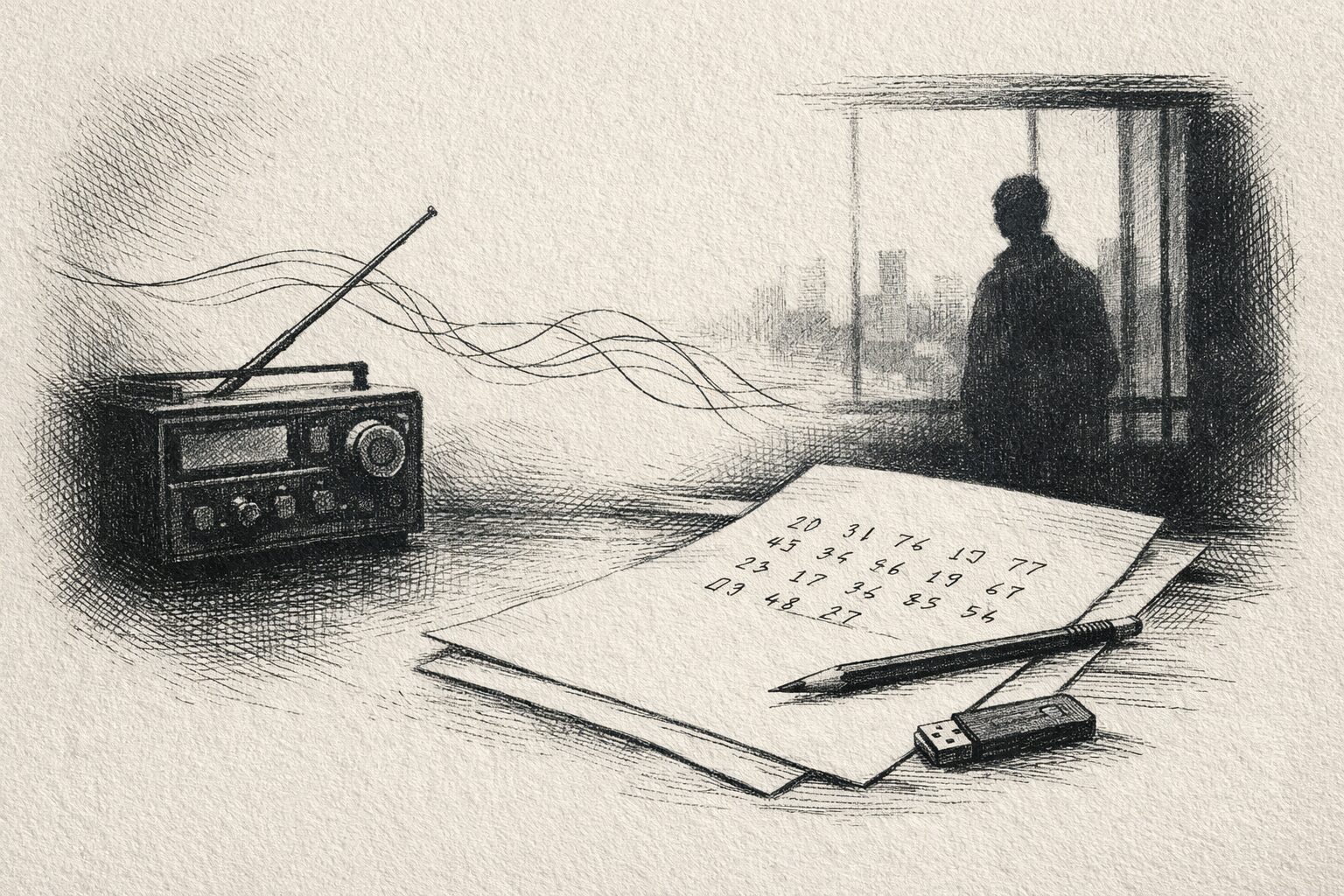
Lucía didn’t pull out her phone like a dramatic gesture. She simply opened a drawer, took out a folded note, and smoothed it on the table. Her pencil had left indents from previous stress.
“Ham radio club,” she said. “They meet in the cultural center near here sometimes. A guy named Sunil. He helped us once when a microphone system kept picking up… something.”
Sunil arrived later, not announced, pulled by the situation like a hook in water.
He came into the room rubbing his hands together, as if he’d just washed them. His backpack straps were worn from use. He didn’t scan the room for importance; he scanned the equipment, like a mechanic seeing a familiar engine.
“You said weird audio,” he said, and his accent carried traces of many places without being pinned to any one. He set down a small handheld receiver on the table—careful, like it mattered.
Lucía pointed at the screen. “This.”
Sunil listened for ten seconds, eyes half-closed, then reached over and adjusted the volume with a thumb that looked used to fine movements.
He nodded once. “That cadence. It’s not random reading. It’s structured. Whoever made this wanted it to feel like a real numbers station.”
“You’re saying it’s fake?” Lucía asked, hope and dread mixed.
Sunil shrugged. “Could be a recording of a real broadcast. Could be produced. But there’s a way to test.” He tapped the portion where the beeps appeared. “That’s likely Morse, or a marker. Many stations use an intro tone, sometimes a repeated phrase, sometimes a call sign in code. Not always. But if this has a marker that matches known patterns, it leans real.”
“How do we check?” I asked.
Sunil lifted his receiver. “We listen again. But not just with ears.”
He pulled a small cable from his bag and connected the receiver to the computer, then opened a simple spectrum display. The screen filled with thin lines—peaks and valleys that looked like a city skyline.
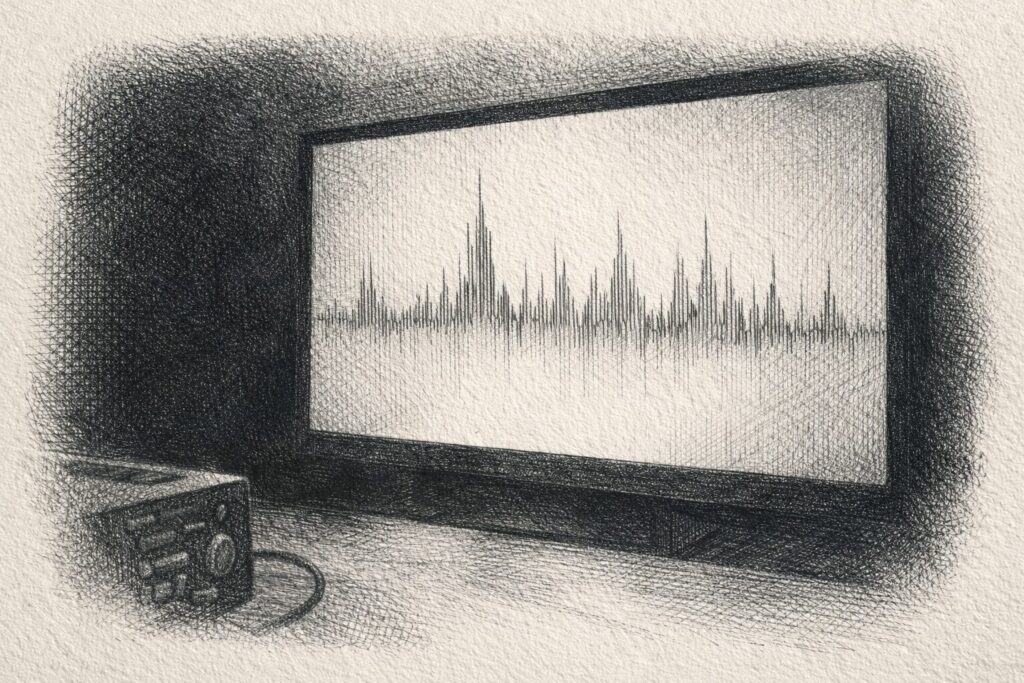
“This is the thing people misunderstand,” Sunil said, not lecturing, just impatient with ignorance. “They think a numbers station is about the voice. The voice is the mask. The signal behavior—frequency drift, the way the carrier wobbles—those are harder to fake.”
Lucía leaned close, her hair brushing the screen’s edge. “So if it drifts like a real transmitter…”
“Then someone recorded it from air,” Sunil said. “And if they recorded it, they were somewhere. That matters.”
Why it matters. There it was, but it landed like a stone, not a lesson.
Because if the recording was real, it had a location chain. A human chain. And someone had tried to hide it inside a library book like a confession.
A woman with ink-stained fingers refused to be scared quietly
We were bent over the spectrum when the door opened again. Not the man with the folder.
A woman stepped in carrying a stack of printed forms. She didn’t knock. She didn’t apologize. She moved like she had decided the hallway belonged to her.
Her fingers were stained with ink, like she’d been handling old posters. She set the forms down, then looked at Lucía.
“I’m Alma,” she said. “Facilities called. They said someone is pushing around upstairs. Asking questions about staff names.”
Lucía’s jaw tightened. “He’s back.”
Alma’s gaze landed on the waveform, then on Sunil’s receiver. “Is this the reason?”
Sunil lifted a hand slightly, as if greeting. “Maybe.”
Alma didn’t ask for a full explanation. Instead, she picked up the envelope from Lucía’s pocket—Lucía flinched, then let her—and weighed it in her palm like it had gravity.
“Who wants it?” Alma asked.
Lucía said, “A man claiming he’s federal.”
Alma’s mouth twitched, not quite a smile. “Claiming is easy.”
She slid the envelope back to Lucía, then pulled a stamp from her forms. She stamped the top sheet hard enough to sound like a gavel.
“I can get you access to the roof stairwell,” Alma said. “There’s a maintenance hatch. If you need to move without being obvious.”
Lucía looked at her like she’d never noticed how brave Alma was in plain daylight.
I said, “We’re not running.”
Alma tilted her head. “Sometimes moving is not running. Sometimes it’s choosing the ground.”
Her ink-stained fingers tapped the table twice, impatient. “Decide.”
The numbers station had an older history than the man with the folder
Sunil scrubbed back and forth over the spectrum window, following a faint wobble.
“See that?” he said. “Carrier drift. It’s small, but it’s there. This isn’t a perfect studio file.”
Lucía stared. “So it’s real.”
“Recorded from a real broadcast, yes,” Sunil said. “Or recorded from a transmitter built to behave real. But that’s expensive. Why would someone do that just to scare a librarian?”
I listened again, focusing on the gaps. The blocks were consistent. The beeps returned in the same place every cycle, like a doorbell.
“Could it be older?” I asked. “Like… history older?”
Sunil nodded slowly. “Numbers stations have been around for decades. Cold War era is the famous period—both sides used shortwave because it reaches far and doesn’t need local infrastructure. Some stations were tracked by hobbyists. Some still exist. The point was always the same: one voice to many ears, but only one ear can understand. It’s elegant.”
Lucía swallowed. “So someone could have used this in Mexico too.”
“Could,” Sunil said. “And there have been stations reported in Spanish. But don’t romanticize it. Most of the time, the listener is just… a person. Sitting in a kitchen, writing down digits, trying not to shake.”
Alma watched us, arms crossed. “And the misconception?” she asked, like she’d heard people gossip already.
Sunil exhaled. “People think it’s aliens. Or criminals sending open codes to gangs. Or that it’s a radio puzzle show. Sometimes criminals use radio, sure. But the classic numbers station format is designed for a secure cipher with a pad. Without that pad, hearing it gives you almost nothing. The danger isn’t the public decoding it. The danger is why someone is broadcasting at all.”
Alma nodded once, satisfied.
Lucía whispered, “So what do we do with a real recording found in a book?”
Sunil looked at the beeps. “We try to pull the marker. The beeps might carry a call sign, or a timestamp, or an identifier. If we can show it matches a known station, you can argue it’s historical interest, not ‘public safety.’”
“And if it doesn’t match?” I asked.
Alma’s ink-stained fingers flexed. “Then it’s someone’s new game.”