Colchester Road Leads to Bunny Man Bridge and Asks Something of You
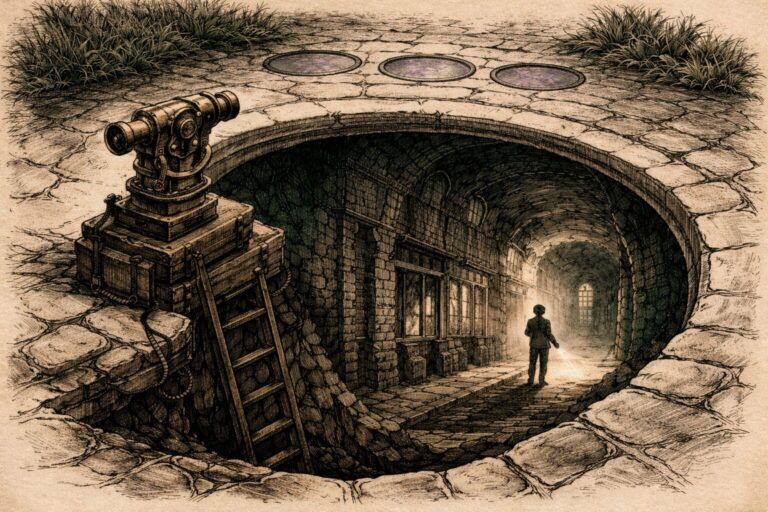
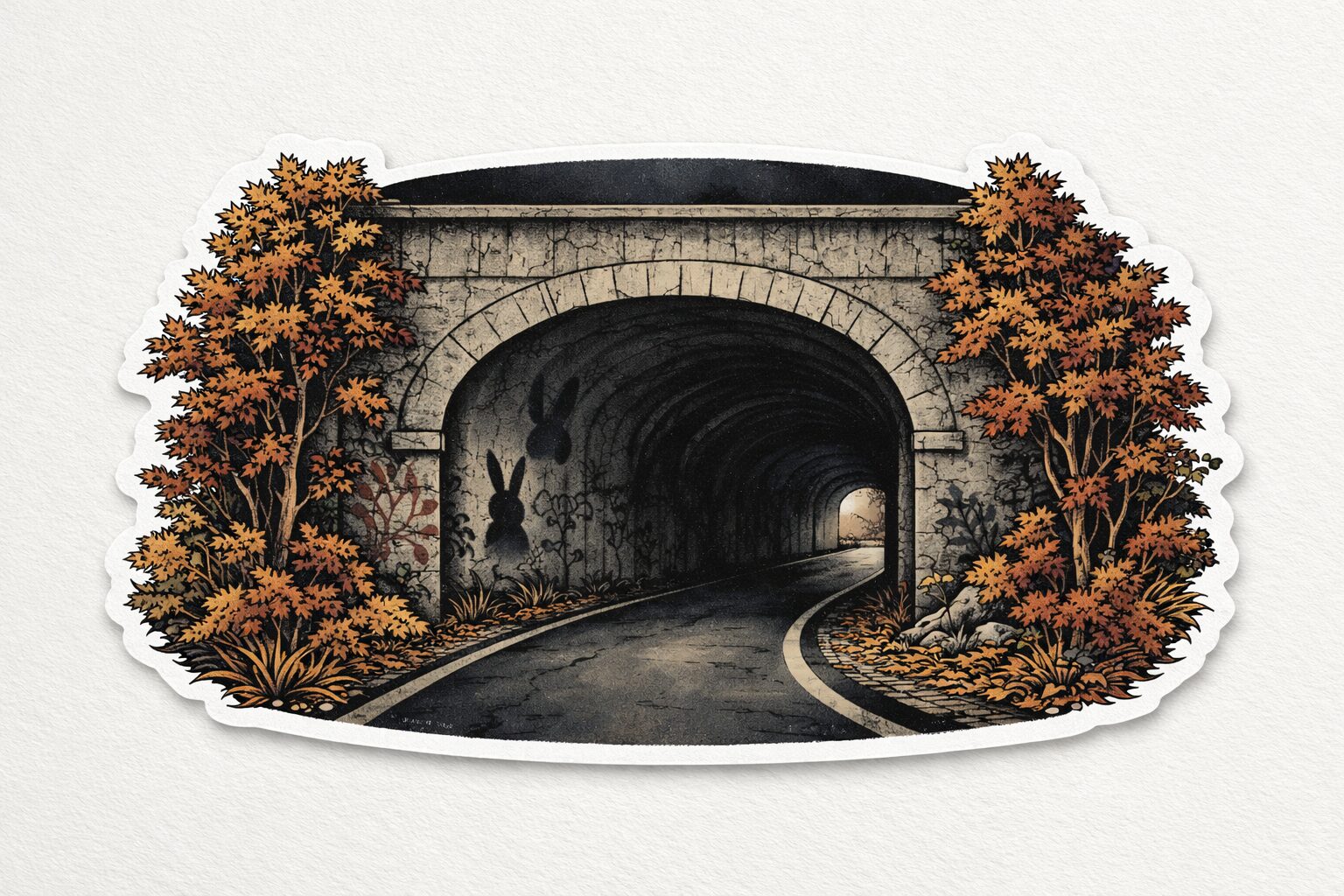
The approach to Bunny Man Bridge was not gradual. Colchester Road ran between banks of earth that rose on both sides, the trees arching overhead, and then descended into a cut where the overpass sat, and you were simply there — no warning, no escalation. The opening of the tunnel was ahead of them in the headlights, the concrete arch and the layered graffiti and the single lane through, and beyond it the exit that Yusra had described: a circle of light, slightly off-center.
Ren stopped the car.
“The bridge,” he said. Not to her. More to himself.
The graffiti on the near wall was layered enough to constitute a kind of archaeology — old names faded to grey beneath newer ones, shapes and marks and the word BUNNY in three different hands. Someone had drawn a rabbit silhouette with surprising skill. Someone else had crossed it out, and someone after that had drawn it again.
He got out of the car. The air in the cut was colder than on the road above — the earth banks trapped it, held the cold down. He walked to the entrance and stood at the mouth of the tunnel and looked through.
The exit was exactly as described: a grey oval of remaining daylight, slightly to the left of center. The road curved inside the tunnel so that you couldn’t drive straight through — you had to steer, make an adjustment, commit not just to entering but to actively navigating. The walls were close. The arch was low enough that the car would clear it but not so low that you wouldn’t notice.
He heard Yusra come up beside him.
“He was never here,” Ren said. “The man with the hatchet. He was on Guinea Road.”
“Twenty miles away,” she said.
“But people kept coming here.”
“They still do.”
He lifted the camera and took a shot of the tunnel entrance — the arch, the graffiti, the off-center circle of light at the far end. Then he lowered it and just looked.
“The Forbes version ends with a threat,” Yusra said. “Come here at midnight on Halloween and he’ll hang your body from the bridge. That’s the ending it gives you.”
“And the real version?”
“The real version ends with a police case that was never closed,” she said. “And a hatchet in an evidence room somewhere in Fairfax County that nobody ever claimed.”
He thought about the man — whoever he was — skipping away through the dark on Guinea Road in October 1970, hatchet thrown, already disappearing back into the suburban fabric of Northern Virginia. Going home. Going to bed. Waking up the next morning in the ordinary world, which was still his world, which he’d never left. While behind him, the story began its long strange life — Guinea Road to courthouse records to university folklore papers to internet message boards to television to this road, this bridge, this ongoing procession of cars on October evenings.
Inside Bunny Man Bridge There Is No Going Back
He drove through.
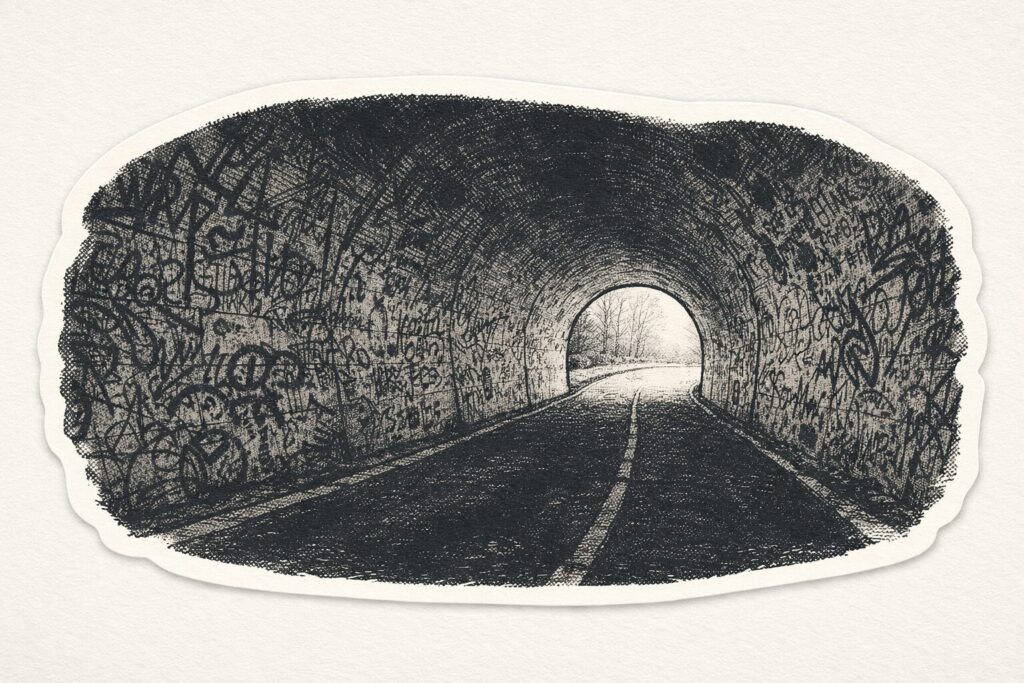
The tunnel was exactly as Yusra had described and nothing like he’d expected. The walls were close — close enough that the graffiti passed within arm’s reach of the window — and the sound of the engine changed immediately, bouncing back off the concrete in a way that made the car feel smaller. The curve was subtle but absolutely real: the circle of light at the far end shifted as he drove, moving from left to center, so that the exit arrived from a slightly different direction than the entrance had pointed him toward.
Then they were through. A short stretch of road ran ahead to a gate, trees beyond it, the last of the daylight nearly gone now. He stopped. Turned around in the small space. Drove back through.
The entrance appeared, and then they were back on Colchester Road with the October night assembling itself in the trees around them.
“That’s it,” he said.
“That’s it,” she said.
He sat for a moment with the engine running. Through the tunnel, a train went over the bridge — invisible, just a sound, a rhythmic percussion above the concrete arch, and then gone.
“I’m going to come back tomorrow morning,” he said. “The light on the entrance wall in October morning light — the graffiti layers, the arch. I think it’s the image I came to Virginia for.”
Yusra was quiet. Then: “The real or the invented version?”
“Of what?”
“Of why you’re here.”
He looked at her. She was watching him with the steady, unguarded expression that had replaced the measuring one sometime during the afternoon — he wasn’t sure exactly when the shift had happened, somewhere between Guinea Road and the restaurant and the long back roads.
“I came for a photography assignment,” he said. “That’s the real version.”
“And the invented one?”
He looked at the tunnel entrance. The graffiti rabbit, drawn by someone, crossed out by someone, drawn again. The darkness inside the arch, and the curve that meant you couldn’t see what was coming, and the exit that arrived from a direction slightly different than you’d expect.
“I’m still working that out,” he said.
She didn’t say anything, but he heard the small sound she made — not quite a laugh, not quite not — and it was enough. He put the car in drive.
What Yusra Said on the Drive Back to Clifton
They drove back through the dark. The road unspooled through the trees, and the headlights made a travelling corridor of light ahead of them that the world reassembled itself behind. Ren drove without the GPS — Yusra navigated from memory, which she did quietly, with small directional observations delivered just early enough that he never had to slow down.
“My mother would have liked today,” she said, after a long while.
He waited.
“She would have liked that someone wanted to do it properly,” she said. “Guinea Road first. The actual sighting locations. And then the bridge.”
“She doesn’t come anymore?”
“She died four years ago,” Yusra said. Not as a bid for sympathy — just as a fact, stated cleanly.
“I’m sorry,” he said.
“She left me the photocopy,” she said. “The county police record. The page with the line about it could not be determined whether there really was a white rabbit. I have it in a frame.”
Ren thought about this. A framed photocopy of an official county document containing an inadvertent poem about uncertainty. He thought it was one of the most specific and perfect things he’d heard anyone describe.
“Does it bother you?” he said. “That the invented version is the one most people know?”
She was quiet long enough that he looked over, and in the passing dark her expression was thoughtful rather than sad.
“The invented version brought people to Conley’s research,” she said — referring to the Fairfax historian whose work she’d mentioned at the restaurant, who had spent years working backward through the legend to the documented truth. “It brought people to the archive. It brought you to Virginia. In October. To a line at the Lost Corner Store.”
“Cause and effect,” he said.
“The legend created the investigation,” she said. “That’s not nothing.”
He turned onto Main Street in Clifton, the old buildings along the road lit warmly, the railway crossing with its silent tracks ahead.
“I’ll be here tomorrow morning,” he said. “For the light on the bridge.”
“I know a better angle,” she said. “From the top of the bank, looking down into the cut. You can see the whole tunnel from above, with the road going in and the trees on either side.”
He stopped in front of the inn. Neither of them moved immediately. The engine idled.
“You’ve been here before,” he said. “From the top of the bank.”
“Every October,” she said. “For years.”
He turned to look at her. She was already looking at him — not the measuring look and not the thoughtful look but something quieter and more direct, the expression of someone who has decided to stop deciding.
“Seven o’clock,” she said. “The light’s best early.”
“Seven,” he said.
She got out of the car. He watched her walk to the door of the inn, and then she stopped and turned back, and the look she gave him across the bonnet of the car in the October dark was the kind that doesn’t require anything else to be said.
He sat in the car after she’d gone inside. The railway crossing was quiet. The street was quiet. Somewhere in a Fairfax County evidence room, a hatchet was sitting in a locker that had last been opened more than fifty years ago, and nobody knew the name of the man who’d thrown it, and the case was technically still open, and the story it had started was still running, still growing new versions, still bringing cars down Colchester Road on October evenings and through that narrow tunnel where the exit arrived from a direction you didn’t quite expect.
He thought about the framed photocopy. It could not be determined whether there really was a white rabbit.
He thought he understood, now, something about unresolved things — about how the absence of an ending was not a flaw but a structure, a tunnel that curved so you couldn’t see through it, that required you to commit before you could know what was on the other side. And how sometimes what was on the other side was not what you’d been trying to find when you started.
He started the car. Drove the two blocks to his motel. Sat in the parking lot for longer than he needed to.
Seven o’clock. The light’s best early.
He got out of the car and went inside.
Bunny Man Bridge Is Still There, and the Question Still Isn’t Answered
He was at the bank above the tunnel at six forty-five, which he told himself was about the light. The sky was pale grey deepening to blue at the horizon, and the cut below held the last of the night’s cold, the tunnel entrance dark against the lightening walls of earth. He set up on the bank and worked the angle Yusra had described — from above, looking down into the cut, the road going in on one side and the road coming out the other, the single lane of old concrete passing through the 1906 arch with its layered graffiti and its rabbit drawn and crossed out and drawn again.
He heard her on the path behind him at three minutes to seven.
She came and stood beside him and looked down at what he was shooting without speaking, and he took three more frames and then lowered the camera and they both looked at the bridge in the early light. A train went over — invisible above the trees, just the sound and the vibration through the ground — and for a moment the whole structure was alive with it, trembling slightly, and then it passed and the tunnel was as still as it had been.
“Did you get it?” she said.
He looked at the last frame on the preview screen. The tunnel from above, the curve of the road visible, the off-center exit a pale ellipse at the far end. The graffiti on the near wall catching the early light in a way that gave it texture. The trees pressing in on both sides.
“Yes,” he said.
She leaned slightly to look at the preview screen. Close enough that he was aware of the warmth of her, the October cold making it distinct. He tilted the camera so she could see better.
“That’s the real thing,” she said.
“The bridge.”
“The bridge, the curve, the fact that you can’t see the exit straight-on.” She straightened. “My mother always said the bridge worked as a legend location because it made you choose before you could see. And once you were in, you were in.”
He thought about the drive through the previous evening — the walls close, the sound changing, the exit arriving from its unexpected angle. He thought about the day before that, the line at the Lost Corner Store, the woman arguing with her GPS.
“I want to come back,” he said. Not about the bridge.
She looked at him. The early light was doing the same thing to her face that it did to old Virginia landscapes — making everything it touched look precise and worth attention.
“The assignment ends when?” she said.
“End of the month.”
“That’s two weeks.”
“Yes,” he said.
She looked back at the bridge. Down in the cut, the light was reaching the far wall now, the circle at the tunnel exit brightening as the sky above them opened.
“There are other sites,” she said. “The sighting locations I haven’t been to. There’s a park in Annandale that came up in the 1970 reports. A stretch of road in Springfield.” She paused. “If you wanted to do it properly.”
“I want to do it properly,” he said.
She didn’t say anything else, but she didn’t move away either, and they stood together on the bank above Bunny Man Bridge in the early October light, watching the darkness inside the tunnel give way to the first pale reach of morning, the exit circle shifting from grey to gold as the day came in — not straight-on, not where you’d have aimed for, but slightly to the left, at the angle the curve demanded, illuminating exactly what it was always going to illuminate, arriving from exactly the direction the bridge had always intended.