The Sightings Map Across Northern Virginia
They drove back north through Burke and then west, Yusra navigating from her phone and occasionally looking up to name something they passed — this shopping center had been a farm, this interchange had been a crossroads, this stretch of road had been the edge of developed land in 1970, the precise boundary between suburb and countryside that the Bunny Man had apparently patrolled.
“The sightings in the weeks after the two real incidents,” Yusra said, reading something, “ranged from Fairfax County out to Washington, DC and into Prince George’s County, Maryland. Over fifty calls to police departments. Children telling their parents. Teenagers claiming to have seen him in parks. Someone in Northeast Washington. Someone in Southeast.”
“All of them real?”
“Almost certainly not. But here’s the thing — the two original incidents were real. Two police reports, one hatchet in evidence, documented in the Washington Post. And then whatever the cadet saw, and whatever the security guard encountered, it created a kind of template. People started seeing something that fit the template. Fear is contagious. So is a story with no ending.”
They passed through a stretch of older Fairfax — neighborhoods built in the sixties, the trees full-grown and imposing, the houses set back behind deep front lawns. A pair of children in the yard of a corner house were decorating a carved pumpkin, one holding it steady while the other added something with a marker.
“He never came back,” Ren said. “After October 1970. Nothing in November, nothing the following year.”
“Nothing ever confirmed,” Yusra said. “Which is its own kind of answer.”
“What kind?”
She looked out at the children with the pumpkin. “The kind that means he was a person, not a ghost. Ghosts don’t stop. People stop — because they got what they wanted, or because they got scared, or because whatever drove them out in the first place stopped driving them.”
Ren thought about this. He’d been photographing places for three years — places that held something, that had absorbed something from whatever had happened in them — and he’d developed a rough theory about the relationship between location and event, which was that the event left nothing in the location itself, only in the people who knew about it and came carrying that knowledge. The place was ordinary. The knowledge was the whole thing.
Guinea Road had felt completely ordinary. And yet.
“Pull over,” he said.
She looked at him. He’d stopped in a small parking area beside a creek path, the water just visible below a bank of fallen leaves. He got out of the car, lifted the camera, and spent ten minutes working the light through the trees — the specific quality of October afternoon light in Northern Virginia, which had something in it he hadn’t been able to name until now. It was the light of a place that had been suburbanized fast, that still carried the memory of having been something else. The trees were old enough to remember. The houses weren’t.
When he got back in the car, Yusra was looking at him with the measuring expression again.
“Did you get something?” she said.
“I think so,” he said. “I’m not sure what yet.”
The Version of the Bunny Man Bridge Story Nobody Posts Online
They stopped for lunch at a place in Clifton proper — a small restaurant in what had been someone’s house within living memory, the bones of it still readable in the proportions of the rooms, the staircase visible from their table. They ordered without looking at the menus too carefully, the way you do when a conversation has momentum and the food is beside the point.
Yusra had her phone on the table, open to something she’d been reading on and off since Burke. “The 1973 paper,” she said. “A University of Maryland student named Patricia Johnson collected fifty-four versions of the Bunny Man story in 1973. Three years after the original incidents. Fifty-four versions.”
Ren looked up from his coffee. “In three years.”
“The story moved fast because it had everything a legend needs — documented reality at the center, which made it credible, and total lack of resolution at the edges, which made it expandable. In some of the fifty-four versions collected in 1973, he was already killing people. There are body counts that appear in versions from the mid-seventies. By the eighties, he’s a ghost. By 1999, someone gives him a detailed history and a name.”
“And by 2001, he’s on a television show,” Ren said. He’d found this detail the night before, in the motel.
“The Scariest Places on Earth,” she said. “Used the Forbes version — the asylum, the crash, the name. Called the bridge one of the most haunted sites in America.”
“Based on a story someone posted online two years earlier.”
“Based on a story that felt more true than the truth did,” she said. “That’s the mechanism. The Forbes version has the texture of research — specific names, specific dates, specific institutions. It reads like recovered history. The real version reads like an incident report, which is what it is. Two incidents, no resolution, case never closed.”
The food arrived. They ate for a while without talking, which was its own kind of conversation — the comfortable kind that Ren associated with people he’d known for years rather than half a day, and which surprised him enough that he looked at her across the table and she caught him looking and didn’t look away immediately.
“You drive out here specifically to look into this?” he said.
“I drive out here every October,” she said. “Or I used to. I stopped for a few years.”
“Why did you stop?”
She considered this with the particular care she brought to questions she’d been asked before but hadn’t fully answered. “I think I got tired of the version people wanted to hear. The asylum, the ghost, the Halloween threat. Every year there would be articles, and every year they’d use the same invented details, and every year I’d think about my mother sitting at the kitchen table in the summer, checking dates and records, and I’d feel this—” she paused. “Irritation, I suppose. On her behalf.”
“And this year you came back.”
“This year I thought I’d go to Guinea Road first,” she said. “I’ve never gone to Guinea Road. I’ve been to the bridge dozens of times and never to the actual location of the actual incidents.”
He nodded. “And instead you found me in a queue.”
“And instead I found someone who’d spent the night reading the worst possible version of the story,” she said, and the way she said it was not quite a joke and not quite not a joke, and he smiled at his coffee and she smiled at hers.
Kings Park West and the Edge of What Actually Happened
After lunch they drove to Kings Park West — a neighborhood in Burke that Yusra had found mentioned in a secondary account of the Bunny Man incidents, a name that had appeared in one of the 1970 newspaper follow-up pieces as a location of reported sightings in the weeks after the original encounters. It was a quiet neighborhood of colonial-style houses, the streets named for old Virginia geography, the cul-de-sacs deep enough that the road noise from the arterials dropped away entirely.
They parked and walked. There was nothing to see — no marker, no indication that anything of consequence had happened here, no acknowledgment that this neighborhood had once been part of a geography of collective fear. A woman walked a terrier past them. A kid on a bike. The ordinary machinery of a Tuesday afternoon in a suburb.
“This is the part nobody talks about,” Yusra said. They were standing at the end of a cul-de-sac, the houses arranged in a quiet semicircle, a maple at the center of the turning circle dropping leaves in the wind. “The spread. In the weeks after the two real incidents, the story jumped across the entire metro area. Dozens of people seeing something. All of it feeding back into itself.”
Ren had his camera out and was working slowly around the turning circle, not quite sure what he was shooting. “And none of it confirmed.”
“One woman called the police in November 1970 to say she’d seen the Bunny Man in her backyard,” Yusra said. “She was convinced. I’m sure she was genuinely convinced. But the two original incidents were on Guinea Road — here, miles away, there was nothing but fear that had traveled faster than the facts.”
He stopped at the edge of the maple’s shadow. The light here was different from Guinea Road — later in the day, the sun lower, the shadows longer. He took three shots in quick succession and knew one of them was something.
“Can I ask you something?” he said.
“You’ve been asking me things all day.”
“Something else,” he said. He lowered the camera. “Your mother — the summer she spent checking the records. How old were you?”
She thought about it. “Fourteen. Maybe fifteen.”
“And she told you what she found?”
“Everything,” Yusra said. “She sat me down and went through it. The Lorton Prison dates that didn’t work. The library that didn’t exist. The name that appeared in no court document. I remember thinking — I’d been telling the asylum version to my friends for years, the dramatic version, the ghost version. And sitting there listening to my mother, I felt — not embarrassed exactly. More like the story had been taken away from me.”
“But it hadn’t,” Ren said. “The real version is stranger.”
She looked at him with a slight shift in expression that he was beginning to understand meant he’d said something she’d thought herself and not yet said aloud.
“It took me years to see that,” she said.
The terrier from earlier came back around the corner without its owner, investigated their shoes with professional thoroughness, and trotted away again.
“The real version,” Ren said, “is a man in a rabbit suit who appeared twice on a Virginia road in October 1970, threw a hatchet, threatened a security guard, and vanished forever. And in the official police record, after extensive investigation, someone typed: it could not be determined whether there really was a white rabbit.“
Yusra was quiet for a moment. “My mother read me that line,” she said. “From a photocopy she’d made of the county record.”
“An official document,” he said. “Asking whether the rabbit was real.”
“And not answering,” she said.
They walked back to the car in the long afternoon light, and he didn’t say anything about the fact that they were walking close enough that their arms occasionally touched, and neither did she.
The Road to Bunny Man Bridge Narrows in a Specific Way
They drove to Clifton the back way, which was Yusra’s way, cutting down through roads that had no shoulders and were posted at speeds that seemed optimistic. The trees on either side were fully turned now, the late afternoon burning through the canopy in oranges and golds that made the road feel like something happening inside amber. Ren drove slowly because the light was extraordinary and because he wasn’t in a hurry to arrive and because slowing down seemed, for reasons he didn’t examine, like the correct choice.
“Tell me the bridge part,” he said.
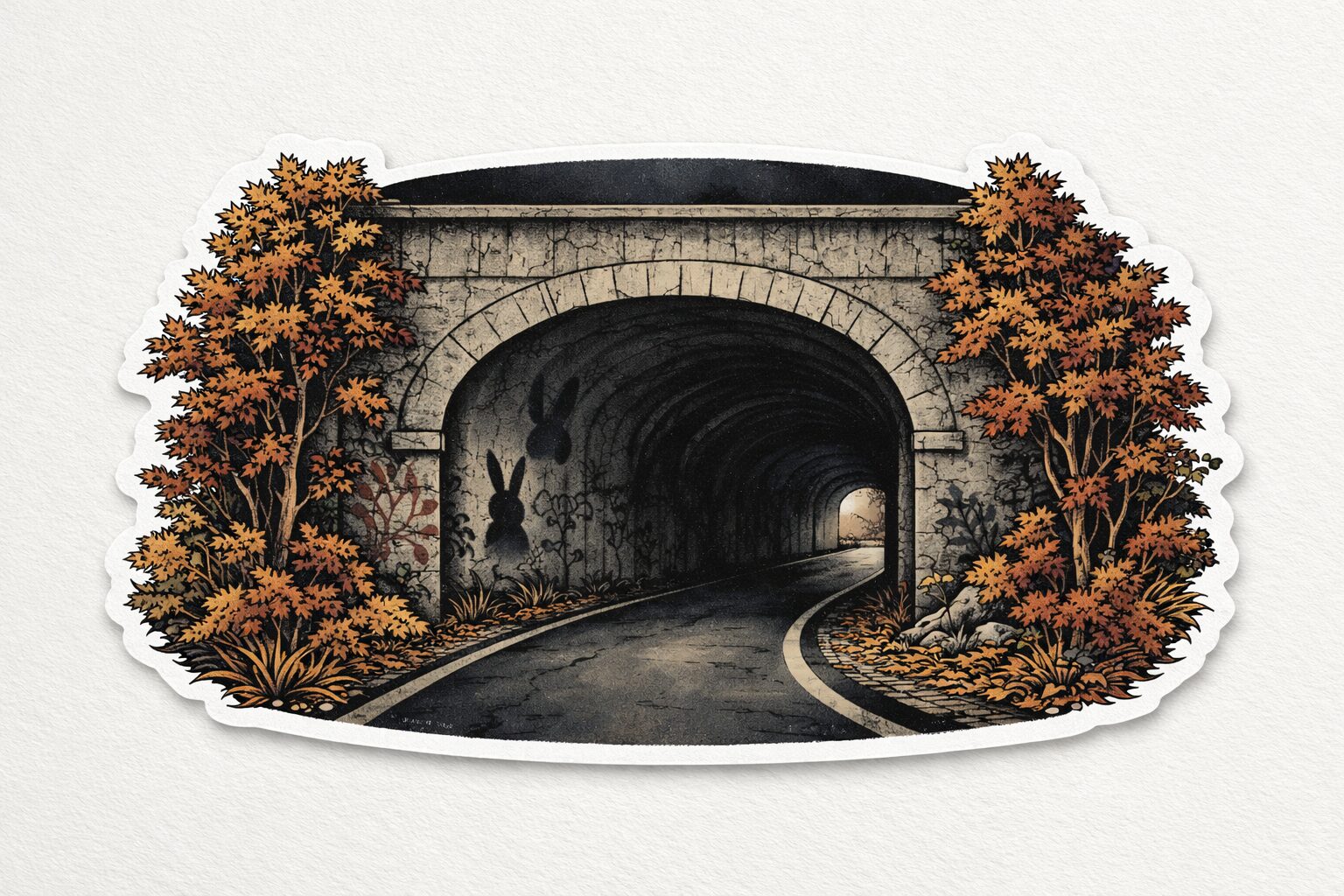
“The bridge wasn’t in either original incident,” she said. “It’s a railroad overpass near Clifton — the Colchester Overpass, built in 1906. One lane. Dark. It was already a local teenage gathering spot by the time the Bunny Man legend reached it in the early seventies, and it had the right architectural quality for the story.”
“What quality?”
“You can’t see through it,” she said. “It curves. So you’re standing at the entrance and you can see a circle of light at the far end, but it’s slightly off-center — the road curves inside the tunnel so the exit isn’t quite where you’d expect it. And once you commit to going through, you can’t turn around.”
He turned this over. “The bridge was a better setting than the actual setting.”
“The story needed a physical place to live,” she said. “Guinea Road is just a road. The bridge has architecture. By the eighties, the story had fully migrated. By 2003, the local authorities were blocking the road every Halloween because too many people were showing up.”
“Officially haunted.”
“The road closure is real. The police presence is real. The television segment is real. All of that happened because of a story that was invented in 1999 to explain incidents from 1970.” She paused. “There’s something almost elegant about it.”
He glanced at her. She was looking ahead through the windshield with the expression of someone following a thought to its end.
“The invented version created real consequences,” he said.
“The road gets blocked every Halloween,” she said. “There are real officers standing real shifts. That’s a real resource expenditure, traceable directly to a story someone made up on an early internet message board.”
The road curved and dropped, and suddenly the trees were very close on both sides and the sky was a narrow strip above them.
“We’re close,” she said.