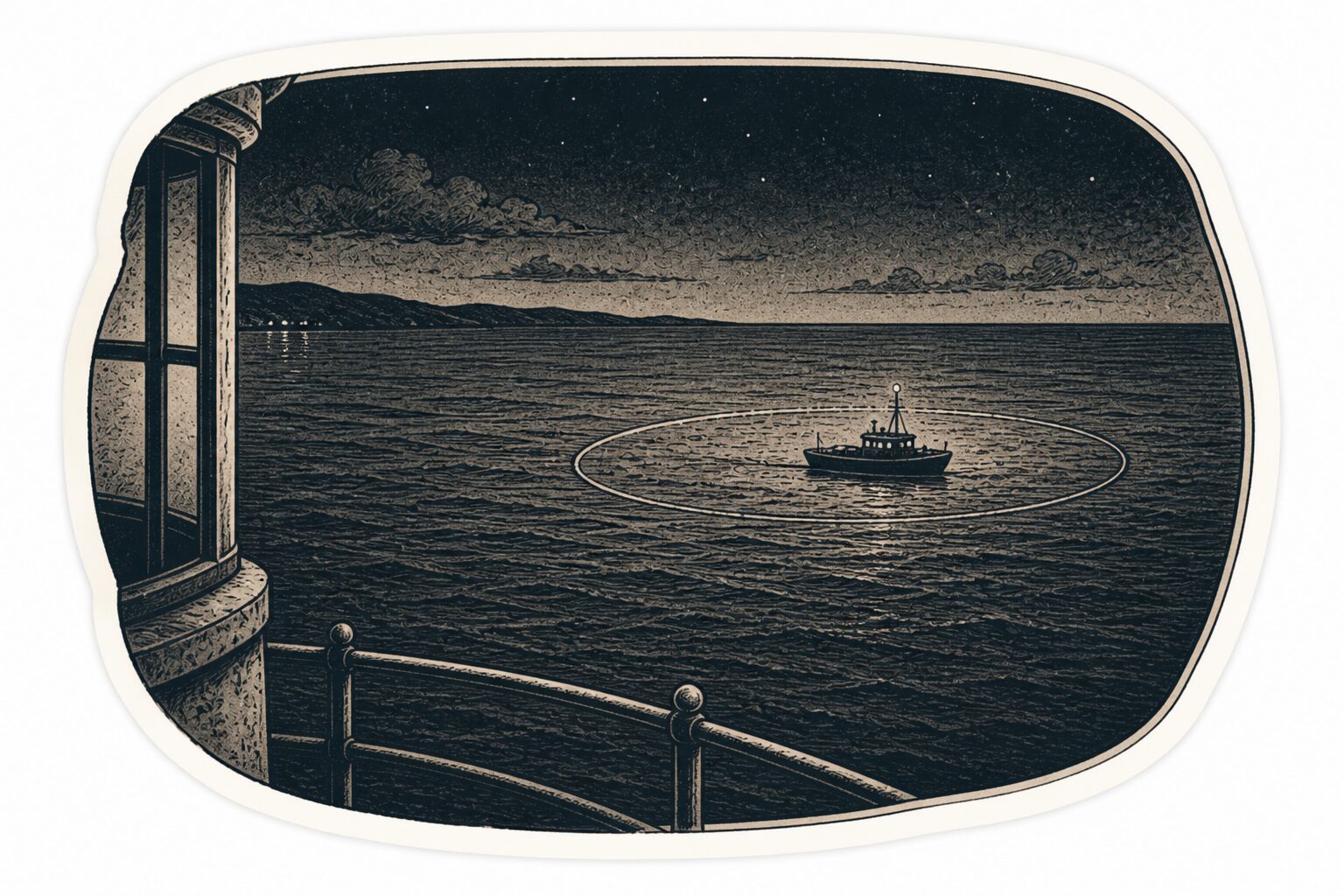
What the Lighthouse Keeper Carries Out
Sohel, the relief keeper, arrived on the morning of the last day — thirty-one years old, two previous postings, the manner of someone who had made peace with a thing Karim was still in the process of understanding. He looked at the tower the way you look at something you know well enough not to be surprised by. They shook hands at the jetty.
“Quiet?” Sohel asked.
“Mostly. Survey vessel for the first two weeks — BNHD sediment project, night transects. All logged.”
“I heard about that project. Didn’t expect them to still be running.”
“They finished on the fourteenth,” Karim said. “You won’t see them.”
Sohel nodded. Karim handed over the logbook, the weather pattern notes, the supply inventory, the handover sheet. He explained the lamp maintenance schedule and the radio’s quirk on Channel 6. He went through everything the way you go through things when you understand for the first time that the information you’re transferring belongs to the posting, not to you — that the lighthouse keeper is not the keeper of the lighthouse, not really, but something more like a temporary occupant who pays attention on behalf of whoever comes next.
He picked up his duffel bag. It was heavier than it had been when he arrived, though nothing obvious explained it. Two filled notebooks weighed more than three empty ones, maybe. Or maybe the weight was just the weight of thirty days of watching something that didn’t stop moving.
The speedboat pushed off from the jetty at 0910. Karim stood at the stern and watched the lighthouse shrink — the skeletal red and white tower going pale against the morning sky, the lamp room catching the sun in one brief white flash before the angle changed and it became simply a shape, and then a point, and then the island’s casuarina line closed over it and it was gone.
In his notebook, between the pages of personal observations he had written for no one in particular, was the folded fax from the hydrographic centre. He had put it there at some point in the last night — he couldn’t remember the exact moment, only that he had folded it and tucked it away with the particular carefulness of someone setting something aside rather than discarding it.
He didn’t look at it on the boat. He looked at the water instead — dark blue and wide and completely ordinary, the surface telling nothing about what moved beneath it, which was everything, always, the silt coming off the river systems to the north, the seabed shifting in patterns that made last year’s chart a question mark and this year’s survey a necessity, the Bay rewriting its own floor in the dark with the patience of something that had never needed anyone to watch.
The Bay Doesn’t Wait
Mognama Ghat appeared on the eastern horizon the way familiar things appear when you’ve been away from them — smaller than memory, more specific. The dock. The noise of it. The smell of diesel and salt and the particular mud of a coast that was always in the process of becoming something slightly different from what it had been.
He disembarked with his bag and his notebooks and the question he had decided not to make into a phone call, not yet, maybe not ever. He stood on the dock for a moment — the same water moving underneath, technically, the same Bay in the way that a bay is always the same bay regardless of whether any particular water has moved through it.
The lighthouse keeper had logged the channel. He had done the job. The light had continued its rotation — three flashes, ten seconds — without interruption, and the Bay had its record, and the next keeper was in the tower now, looking at the same approaches, beginning to know the same trawlers.
Karim thought about the blank field one more time. Not with alarm, not with the urgency he had carried in the first week, but with something quieter — the specific feeling of a fact that doesn’t fit the explanation you’ve been given, sitting in the mind not as an accusation but as a question that keeps its shape.
He walked off the dock into Mognama.
The Bay kept moving behind him, as it had been doing since before anyone thought to put a light on its edge, as it would keep doing long after the light was no longer necessary, or no longer there. Somewhere beneath its surface, off the western shore of the island he had just left, the stone crown of the original batighar sat at the position it had always occupied — fixed, present, going nowhere — while the water moved around it in every direction and the new tower above the shore sent its three flashes out into the dark every ten seconds, for any ship that needed something real to check itself against.
Somewhere between what was logged and what was understood, one detail refused to stay in place. The record was corrected. The pattern remained. And the mind kept something the page did not.