The Dymaxion Map was not the truth; it was an argument in paper.
Sofia stayed near the doorway, recorder lowered now, watching Asha’s hands.
“You’re not done,” Sofia said.
Asha didn’t deny it. “No.”
Leo rubbed his badge again, a habit returning under new worry. “If we change the unfold again, we might upset the system.”
Kaito’s fingers drew a small triangle in the air. “Or we might reveal what it’s really for.”
Rui’s keys chimed as he shifted. “You’re telling me there’s more than a locked door and a projection.”
Noura looked toward the ceiling as if she could hear machinery thinking. “The system asked for a center. It accepted ocean. Then it demanded correction. That’s a sequence.”
Sofia’s eyes were sharp. “Sequence implies purpose.”
Asha looked at the map’s seams. The Dymaxion Map wasn’t only showing Earth. It was behaving like a key that required you to understand the ethics of keys.
She spoke quietly, mostly to herself. “Fuller didn’t just redraw coastlines. He challenged the idea that the page has a natural top.”
Leo nodded. “And the shape matters. Projecting onto flat faces—triangles—reduces some of the stretching you see in other projections.”
Rui frowned. “So the solid is the trick.”
Kaito corrected gently. “Not a trick. A method. You can take a globe and map it onto a polyhedron—faces that are already flat. Then you unfold. The seams become visible choices.”
Sofia’s recorder dipped. “You said a public version was in 1943.”
Kaito nodded. “Yes. A cut-out people could fold. The idea was meant to be handled, not worshipped.”
Asha felt the map warm again, like it liked the word “handled.”
Leo added, “Later it was refined. Shoji Sadao worked with Fuller. Airocean became a common layout, emphasizing one connected ocean.”
Rui’s gaze hardened. “And that matters to a building in Lisbon because…?”
Asha looked at the projection, dimmer now but still present. “Because whoever built this system chose this language. The building is asking the same question the map asks: where do you put the center, and why?”
Sofia’s eyes moved to Asha’s face. “And now you want to pick somewhere weird.”
Asha nodded.
Kaito’s hands drew triangles in the air like a language.
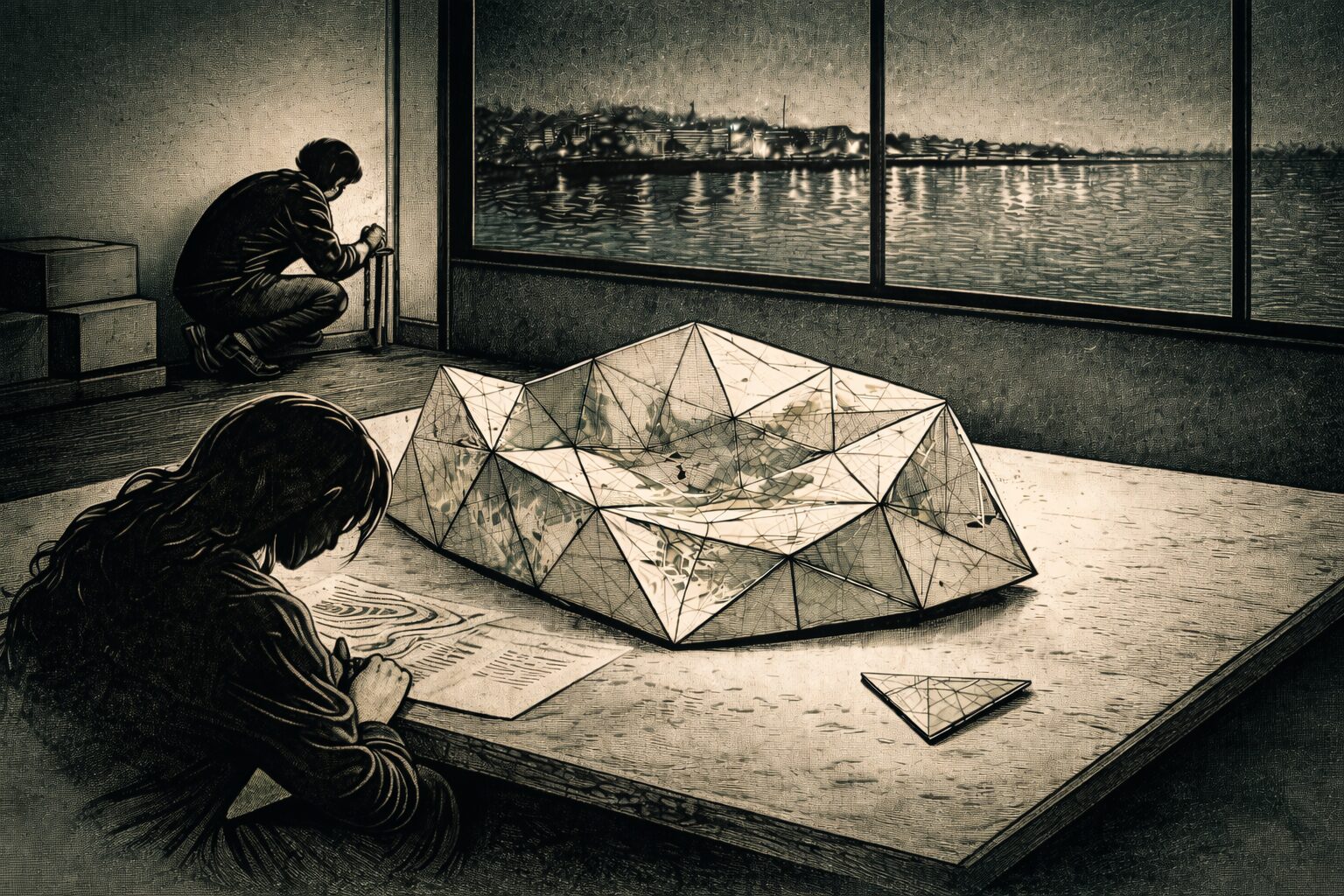
Asha unfolded the Dymaxion Map again on the table, careful not to place it under the harshest light. The triangles looked ordinary for a moment—printed lines, familiar coast hints—but the seams felt alive under her fingertips, ready to answer choices.
Kaito stood beside her, hands hovering, fingers making those small folding shapes as if his body spoke geometry without needing permission. He didn’t dominate the moment. He offered options like a person offering tools.
Rui stood farther back, still close enough to intervene, still pretending he didn’t care. His keys chimed softly each time he shifted, like the building itself had a metronome.
Noura watched the ceiling more than the table, listening for changes. Sofia watched Asha’s face, recorder down, as if sound would ruin the moment.
Leo leaned in, voice low. “If we re-center the net, we can put almost anything ‘in the middle’.”
Asha nodded. “Not just countries.”
Noura’s eyes sharpened. “Connections.”
Leo frowned. “Undersea cables.”
Sofia’s mouth twitched. “That is weird. And real.”
Asha’s fingers moved along seams, rearranging triangles so that ocean cuts lined up differently—not to flatter land, not to keep any one place comfortable, but to bring hidden lines into focus.
She didn’t say “cables” out loud yet. She didn’t need to. The Dymaxion Map seemed to anticipate the idea.
Writing appeared again, faint, like it was emerging from beneath the ink:
CENTER ON LINKS.
Rui’s voice went tight. “It can read minds now?”
Asha didn’t look up. “It can read patterns.”
She folded one seam, then another, not forming the full globe this time, but shaping the net into a new flat arrangement. Leo helped by holding corners steady. Kaito guided with small gestures. Noura listened for the hum. Sofia watched like she was trying to memorize the exact second the world shifted.
The projection on the wall shimmered once, then rearranged to match.
For a heartbeat, the map looked less like continents and more like pathways—routes across sea, the logic of movement, the skeleton of connection humans forget they depend on.
The museum’s hum settled into a steady rhythm.
Then new text appeared, clean and calm:
YOU ARE NOT LOST. YOU ARE UNFOLDED.
Asha felt her throat tighten. The words weren’t dramatic. They didn’t need to be. They landed like a hand on a shoulder, not pushing, just acknowledging.
Sofia whispered, “That’s the message.”
Rui stared, and for once his voice lost its bite. “Who wrote that?”
Kaito’s fingers hovered over the seam. “Someone who wanted a building to remember how to be part of the planet, not above it.”
Leo let out a breath that sounded like a laugh he didn’t mean to make. “That’s… unsettling.”
Noura shook her head slightly. “It’s grounding.”
Asha looked from the words to the river beyond the glass, then back again. The map cooled in her hands, like it had delivered what it came to deliver.
But as she folded it back toward a compact shape, she felt a subtle shift—like a tab loosening.