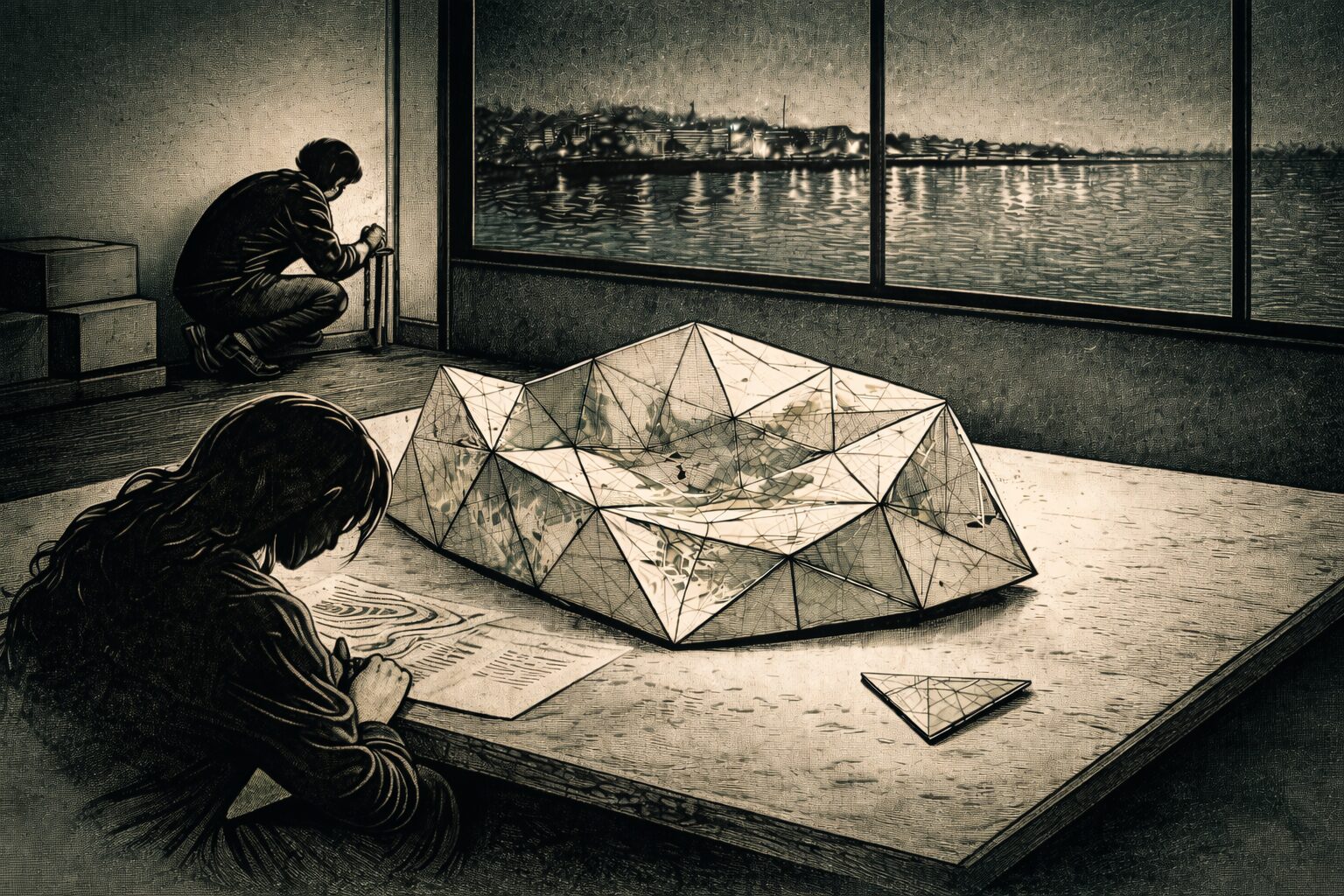
Sofia showed up with a recorder and no patience.
Upstairs, the gallery wall where there had been blank concrete now glowed with a projection: the world in triangles, huge and crisp. The map in Asha’s hands pulled faintly toward it, like two magnets noticing each other.
Asha stepped in first, then Leo, then Rui, keeping his shoulders squared as if posture could enforce sanity. Kaito followed last, hands still making those tiny folding motions.
A woman stood near the doorway as if she’d been there a while, holding a small audio recorder like it was a passport. She didn’t rush or introduce herself. She simply pointed at the projection.
“That’s not part of any public program,” she said.
Rui’s relief at seeing a normal kind of trouble flashed across his face. “Who are you?”
“Sofia,” she replied, voice carrying a gentle Brazilian rhythm under her English. “I was in the café area when doors shifted. I record things that people prefer to forget happened.”
Leo stared. “The doors opened for you?”
Sofia’s eyes moved to the folded net in Asha’s hands. “It opened for that.”
Asha didn’t offer her the object. “We’re stabilizing a system.”
Sofia raised the recorder slightly. “With a map.”
“With a Dymaxion projection,” Leo blurted, then winced like he’d broken a vow.
Sofia’s mouth twisted. “The one people claim is ‘the real world.’”
Asha felt the map warm again, like it disliked the word “real” being used that way. “It’s not ‘the real world,’” she said. “It’s a different compromise.”
Sofia stepped closer, stopping short of the projection’s light. “Compromise how?”
Asha kept it plain. “It puts the sphere onto flat faces of a solid, then unfolds the solid. Shapes and sizes on land can look more balanced than some other maps, but it has cuts. The ocean breaks.”
Sofia’s eyes narrowed. “And people pretend the cuts don’t count.”
Asha nodded. “They pretend it’s perfect.”
The Dymaxion Map clicked once, and new writing surfaced on a seam:
OUTSIDER TEST REQUIRED.
Sofia read it and let out a quiet laugh. “That sounds like bureaucracy, not magic.”
Rui’s radio crackled. “Rui? Rui, do you copy?”
Rui snapped the button. “I copy.”
Static. “Stay on position.”
Rui looked at Asha. “We do not have time for a test.”
Asha looked back at the map. “We might not have a choice.”
On the Dymaxion Map, ‘up’ was a choice, not a law.
The projection shifted on the wall, cycling through different unfold layouts. In one, Eurasia sprawled in a familiar posture. In another, the Pacific dominated and Europe slid off-center like a person losing their seat.
Leo stared, caught between fascination and fear. “It’s offering layouts.”
Kaito nodded. “The same globe can become different flat worlds depending on where you cut and how you open it. That’s the feature.”
Rui’s voice turned sharp. “So it’s asking you to pick a viewpoint.”
Asha watched the changing net. “Maps always do. Most just hide it.”
Sofia lifted her recorder. “Why does this matter enough to lock doors?”
Asha didn’t answer with slogans. She answered with a small, hard truth. “Because the map you grow up with becomes the world you expect. If one place looks huge, it feels huge. If one place sits at the center, it feels like the center.”
Leo added, quietly, “Mercator keeps compass lines straight. That’s why sailors liked it. But it inflates areas near the poles. Greenland looks absurdly large compared to Africa on many wall maps.”
Rui’s eyes flicked. “So you’re blaming a map for people’s ego.”
Asha’s mouth moved as if she might smile. “Not blaming. Not excusing. Noticing.”
The map in her hands warmed again, then cooled, like it was waiting for the outsider to arrive.
And then, from the corridor, a soft set of footsteps approached—fast, small, and not careful.