She turned to him then. It was the first time that day he had said something that sounded less like museum caution and more like private belief.
He seemed to realize it too. “You can write that down if you like,” he said, but his tone had changed.
“I thought you disliked romantic journalism.”
“I dislike lazy romance,” he said. “That is a different disease.”
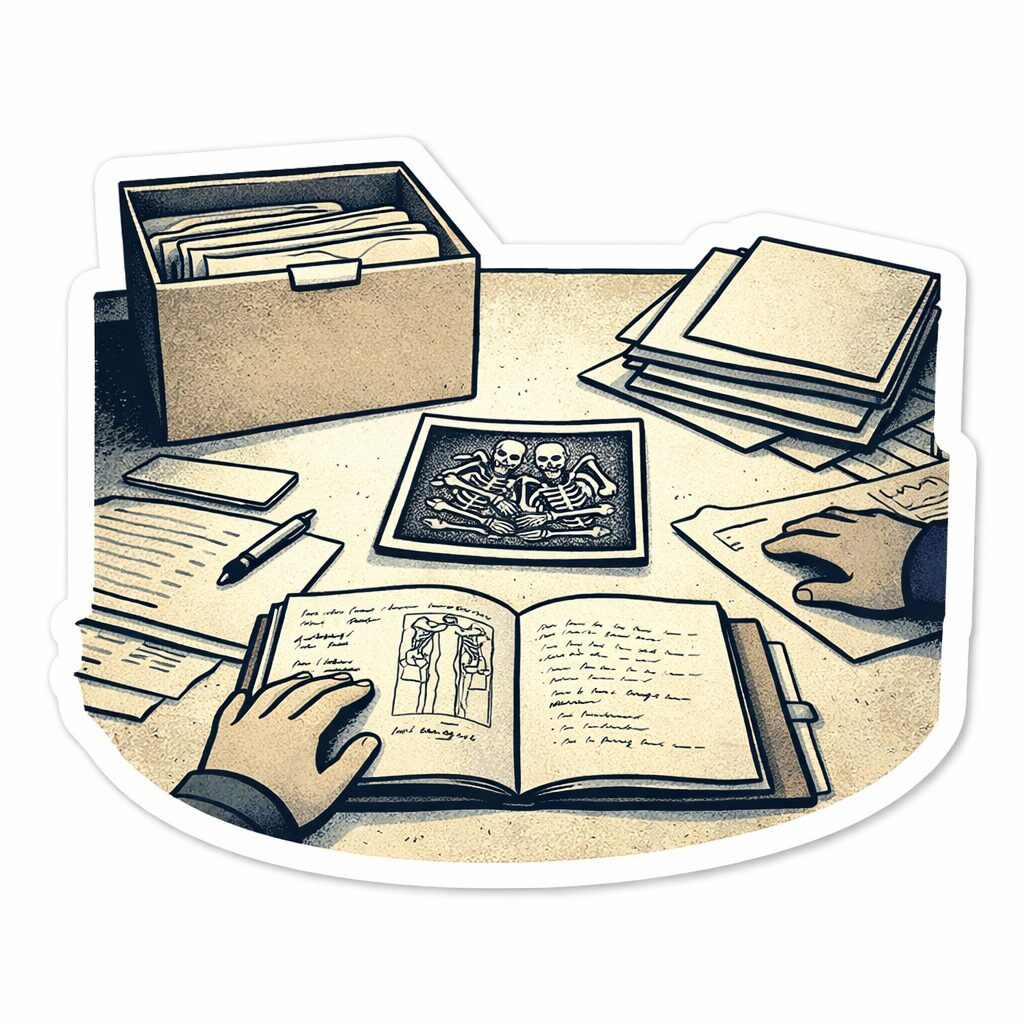
Later she found exhibition drafts in the second box. One version of the display text had called them embracing lovers. Another changed it to young couple. A third cut both and said only two individuals buried face to face. Beside the first version, someone had written in sharp pencil: Too romantic. Not defensible.
“Yours?” Mina asked.
Luca didn’t bother pretending otherwise. “Mine.”
When visitors kept asking for the ending
By late afternoon, the rain returned and blurred the office window. Mina kept working through the papers while the museum moved around them in muffled sounds: distant steps, a door opening and shutting, the low hum of systems that kept temperature and light under control.
“What do people always ask?” she said after a while.
Luca did not look up from the forms in front of him. “How they died.”
“That first?”
“That first.”
“Before who buried them like this. Before why. Before whether the placement itself matters.”
“Yes.”
“Why?”
He stacked one paper on another. “Because a cause of death gives people the false comfort of closure.”
Mina looked down at the notes again. Unknown cause. No visible trauma. Weapons that were not evidence of murder. Young bodies. Careful placement. Her whole profession loved a neat line between image and meaning. The lovers of valdaro offered almost none.
“Unknown is hard to publish,” she said.
“Unknown is hard to live with.”
That landed harder than she expected. She thought of Daniel again, of all the years they had spent arranging their future like furniture in a house they never signed for. She had always told herself she needed more certainty before choosing. A better contract. More money. Less risk. A calmer season. Unknown had seemed like a temporary inconvenience, when in fact it had been the permanent condition of every honest life.
At six, the museum closed. Luca locked the archive room and walked with her into the courtyard. The rain had deepened the brick to rust. Water gathered in the uneven stone like small dark mirrors.
“Did you get what you needed?” he asked.
“Not what I expected.”
“That is often better.”
At the gate, she surprised herself. “Have dinner with me.”
His expression altered only slightly. “Is this research?”
“It would be useful if it were.”
“And true?”
“Partly.”
He considered. “There’s a trattoria near Via Verdi. Seven-thirty.”
lovers of valdaro after closing time
The trattoria had yellow walls, a shelf of dusty bottles, and the tired warmth of places that did not need to charm anyone because the food already did the work. Luca was there first. Without the badge, he looked less official and more human in a way Mina did not fully trust.
They ordered tortelli di zucca and a wine neither of them pretended to understand. For a while they spoke around safe subjects: crowded weekends at the museum, editors who confused vagueness with sophistication, how Mantua changed when tourists left and the evening settled back into the city’s actual body.
Then Luca asked, “Why Mantua now?”
It was direct enough that she respected him for it and disliked him a little too.
“Because someone I used to live with wrote it in a notebook.”
“That is either sentimental or tactical.”
“Unhelpfully, both.”
He waited, not pushing, simply refusing to save her with a subject change. Mina told him about Daniel then. Not everything. Enough. Three years together. A photographer. A good man. No scandal. Only a long erosion caused by delay.
“We kept postponing the things that would have made us real,” she said.
“And then?”
“He stopped mistaking postponement for care.”
Luca lowered his glass. “That sounds expensive.”
“It was.”
He did not offer comfort. She was grateful. Comfort from strangers often felt like vanity. Instead he said, “People think romance is proved by intensity. More often it is proved by timing.”
She looked at him. “Do you always speak in verdicts after one glass of wine?”
“Only when the company makes me reckless.”
The line should have felt polished. It did not. It felt almost reluctant, which made it more dangerous.
When they left the trattoria, Mantua had thinned into quiet streets and damp light. At the corner where they parted, Luca said, “Come back tomorrow. There’s one photograph you didn’t see.”
She should have said goodnight and gone to her room. Instead she stood there another second too long, long enough to understand that some forms of attraction announced themselves not as heat but as the unsettling wish to stay.
The note that changed its meaning
Back in the pensione, Mina opened the notebook again. Daniel’s handwriting appeared in fragments over the last years of their life: train times, grocery lists, an address in Turin, a sentence from an argument neither of them had won. On the final page, darker than the rest, Go to Mantua.
Near midnight, her phone lit up.
A message from Daniel.
It wasn’t for the article.
She stared at the screen until another arrived.
I thought if you went there you might understand what I could never explain without sounding dramatic.
That was so like him that it made her chest tighten. Daniel had always been better with images than conclusions. He could show a thing from the right distance and assume that was enough. Sometimes it had been. Sometimes it had not.
Mina typed three answers and erased them all. Finally she wrote, I’m trying.
He did not respond.
She slept badly, waking once before dawn with the feeling that the city itself was waiting for a decision she had not yet been asked to make.
The next morning, Luca was already in the archive room, a single photograph laid aside from the rest.
“You’re punctual,” she said.
“I distrust people who arrive late for the dead.”
He passed her the print.
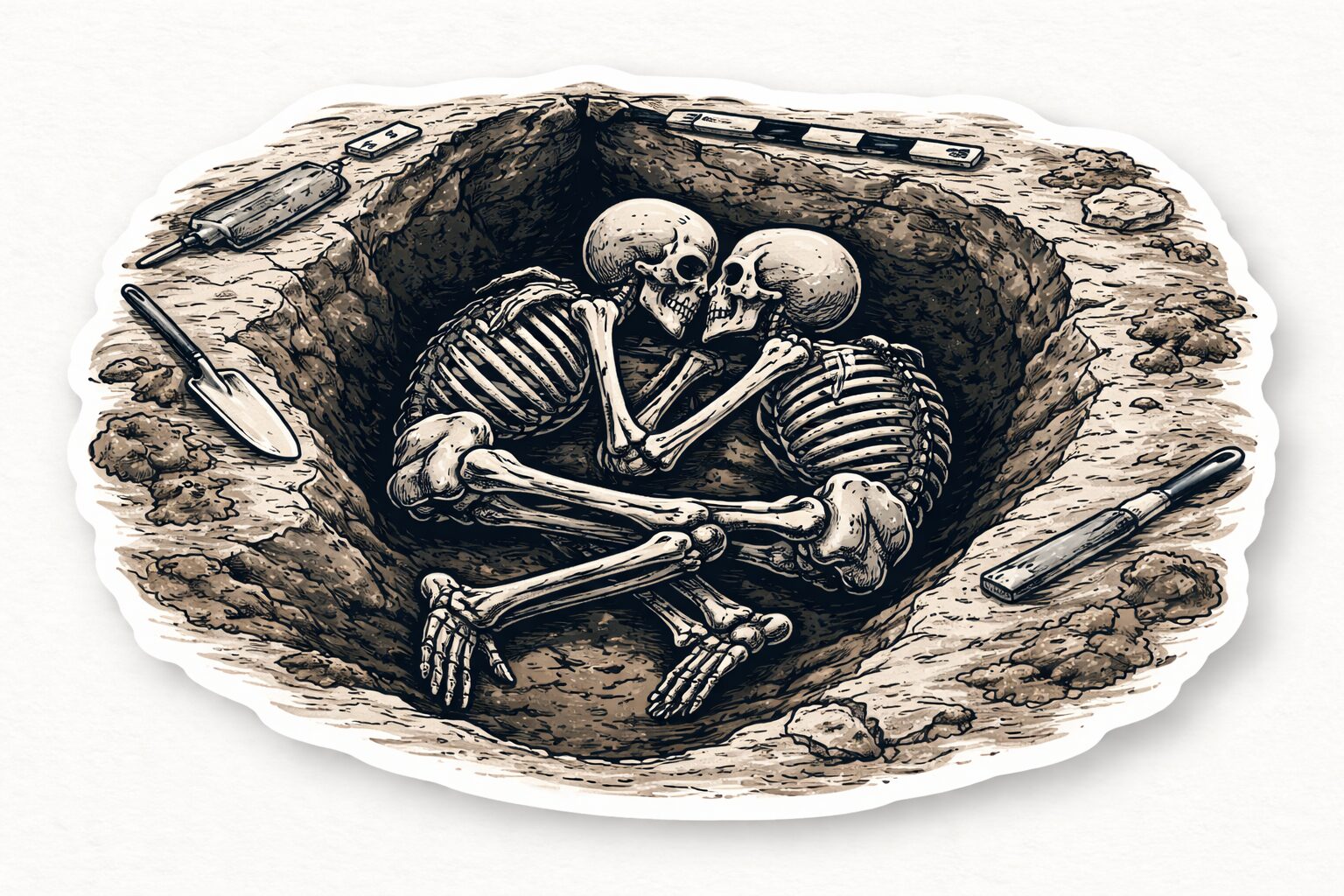
It showed the lovers of valdaro still in the ground before lifting, their outlines cradled by earth. In the museum case upstairs, the display gave them a clean finality. Here, they looked exposed to error.
“This is better,” Mina said.
“It is truer to the risk.”
The place where evidence holds and fails
He sat on the edge of the table while she studied the print. “Every journalist wants the dramatic angle,” he said. “Forbidden love. Double death. Sacrifice. Something with a villain. Almost nobody wants the harder version.”
“Which is?”
“That two people can be given extraordinary care and still leave almost nothing behind that satisfies our hunger for explanation.”
Mina looked up. “That doesn’t make a neat article.”
“No.”
“It makes a better story.”
He watched her for a moment and then said, “Are you writing an article?”
The question sharpened the room. Until then she had been able to live in the useful blur between assignment and impulse. Now she had to hear the difference aloud.
“I don’t know anymore.”
“That is a beginning.”
“Or a professional mistake.”
“Often the same thing.”
Later, in the gallery, they listened to visitors. A woman insisted the pair had to be husband and wife. Her friend said, “Or lovers.” A man nearby declared, “Maybe they were brother and sister.” Someone else repeated the old newspaper nonsense about Romeo and Juliet of prehistory, and Luca closed his eyes for half a second with visible pain.
“You hate that one,” Mina said.
“I would arrest it if I could.”
The woman who had said husband and wife turned and asked them directly, “Do they know for sure it was a man and a woman?”
Luca answered with care. “That was the original assessment. Young, around eighteen to twenty. But old bones do not always obey modern certainty as politely as people would like.”
The woman nodded, dissatisfied. Mina loved him a little then for choosing accuracy over ease while knowing ease would have pleased everyone more.
lovers of valdaro and the old habit of delay
That afternoon, the editor in Milan finally called.
Mina stepped out into the courtyard to answer. Rain had not returned, but the air held that damp waiting quality that made stone seem older.
“Where are you?” he asked.
“Mantua.”
“I know that. Are you sending the proposal tonight?”
She looked across the courtyard toward the museum windows. Somewhere behind them were the lovers of valdaro, the archive boxes, the photograph, Luca moving through rooms designed to keep fragile arrangements from losing their shape. “I don’t think I am,” she said.
Silence. Then, “Don’t become precious.”
“It’s not that.”
“What is it?”
She had no tidy answer he would respect. “The piece you want isn’t the piece that’s there.”
He laughed once, but without humor. “There is always a piece there. Our job is to write it.”
That had once sounded to Mina like professional wisdom. Today it sounded like theft.
“If I send what you want,” she said, “I’ll be lying in an elegant tone.”
“Then lie better.”
She closed her eyes. The irreversible moment came not with thunder or insight but with the flatness of her own next sentence. “No.”
The line went quiet again. When he spoke, he sounded tired, not angry. “Then don’t expect me to hold the slot.”
“I know.”
She ended the call and stood still long enough to feel the cost land properly. Rent. Work. Reputation. None of those were abstractions. Turning away from the commission did not make her brave. It made her poorer.
When she went back inside, Luca saw her face and asked no questions until she nodded once. Only then did he say, “You chose.”
“Yes.”
“How bad?”
“Financially? Quite.”
He considered that. “Then it was probably real.”
The photograph lifted with the earth
In the late afternoon, Luca took her into a storage room where supports, casts, and padded transport materials were kept. Nothing there was beautiful. Foam, crates, labels, wheels. The practical machinery of preservation.
Mina liked it immediately.
“This is where the museum tells the truth,” she said.
“No,” Luca replied. “This is where it admits it has hands.”
He showed her one of the custom supports used during earlier study and transport. She did not touch it. The object itself was plain, but suddenly she could see the excavation not as a press image but as labor: people crouched over a grave, arguing softly, calculating weight, deciding that the arrangement of the lovers of valdaro was not decoration but evidence.
“What if they had separated them?” she asked.
“We would know different things,” he said. “And we would never recover what was lost by the act itself.”
The sentence opened something in her before she could defend against it. That had been the trouble with Daniel. She had spent years acting as if choices could be delayed without changing what remained available later. As if postponement preserved rather than altered. As if taking nothing apart was not, in its own way, a dismantling.
“I thought waiting was neutral,” she said quietly.
Luca leaned back against the shelf. “It rarely is.”
She looked at him then. “Did you learn that the hard way?”
“Yes.”
He gave it to her without embellishment. Eight years earlier there had been a woman. A fiancée. He had delayed the life she wanted because he thought more time would make him surer, more stable, more worthy of the version of himself he imagined she deserved. Instead time had become its own answer, and she had left.
“Do you miss her?” Mina asked.
He considered before speaking. “Not in the present tense. I miss the person I was when I thought delay counted as care.”
It was one of those sentences that seemed to settle directly into the bones.
The note that changed its meaning
That night Daniel finally answered the message she had sent.
I didn’t send you there for us, he wrote. I sent you there because you trust scenes more than conversations. I thought maybe that scene would tell you what I couldn’t.
For a moment she hated him for being right.
Then she hated herself more, because what she felt was not outrage. It was recognition.
She wrote back, You were asking for a life, not a mood.
The reply took a long time.
Yes.
Just that.
The simplicity of it changed the whole note in the notebook. Go to Mantua had not been a breadcrumb back to him. It had been an act of surrender. He had already known what she did not want to hear: that she might only understand the shape of a loss after seeing another arrangement the world had gone to great trouble to preserve.
The revelation altered the past without rescuing it. She had not missed a secret reunion. She had been sent to a mirror.
When she saw Luca the next morning, she told him. Not everything. Enough.
“And now?” he asked.
“Now I know he was saying goodbye more kindly than I deserved.”
Luca did not soften the truth. “Kindness and leaving are not opposites.”
She almost laughed, but it caught in her throat instead. The lovers of valdaro were in the next room, still held in their impossible closeness, while she was standing in Mantua beside a man she had known only three days and feeling her life re-sort itself around choices that suddenly looked less theoretical than they had in Milan.
lovers of valdaro beneath Sunday voices
Sunday brought thicker crowds.
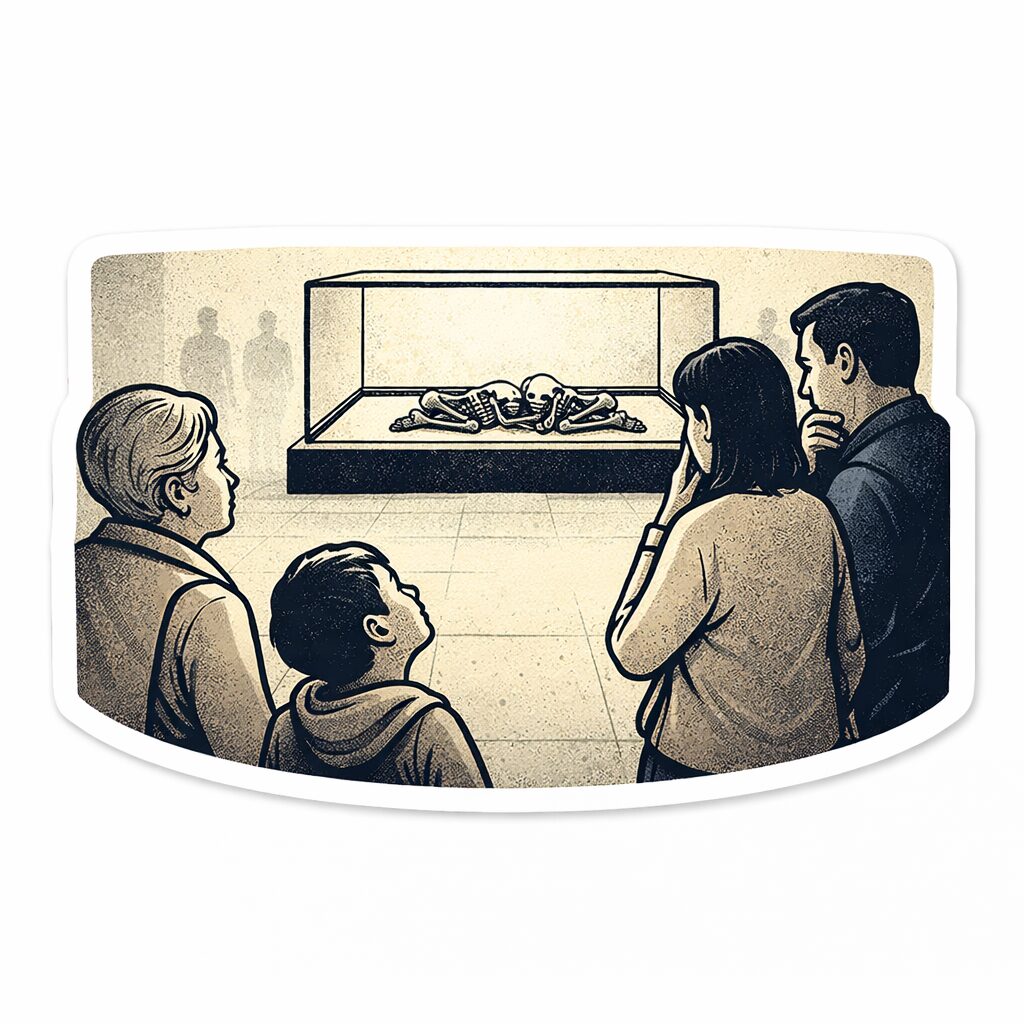
The museum filled with the murmur of couples, families, students, and tourists carrying umbrellas that dripped onto the stone floor near the entrance. Mina spent an hour in the gallery simply listening.
The lovers of valdaro made people reveal themselves. A teenage girl said, “That’s the most romantic thing I’ve ever seen.” Her brother replied, “It’s creepy.” An older woman whispered, “Imagine somebody wanting you close even after death.” Her husband muttered, “Imagine the archaeologists trying not to break them.”
That last remark pleased Mina because it held both halves at once: feeling and labor.
A little girl asked her grandmother, “Were they really in love?”
The grandmother looked at the case for a long moment and said, “Someone loved them enough to place them gently.”
Mina glanced at Luca across the room. He had heard it too. He gave the slightest tilt of his head, neither endorsing nor correcting. Just allowing.
That afternoon, he unlocked the office and handed her a small envelope. Inside was a reproduction print of the excavation photograph, no larger than a postcard. The pair lay in earth, still surrounded by the cut edges of the grave.
“You’re not supposed to do this often,” she said.
“I’m not doing it often.”
She held the envelope more carefully than the object required. What she wanted was not the official museum image, polished and already translated for public longing. She wanted this rougher one, the version where the earth still showed, where preservation still looked uncertain.
“Thank you,” she said.
“It’s not a romantic souvenir.”
“No?”
“It’s a reminder that keeping a fragile thing intact takes work.”