Letting the Quantum Radar Run Straight
The second demonstration went ahead at eleven the next morning. Marcus got there two hours early. He didn’t need to sabotage anything. In front of Whitfield, the moment she arrived, he did what he and Priya had already done privately the night before — disconnected the telemetry relay board from the display, in full view, and told her exactly what it was, where he’d found it, and how long it had likely been feeding false coordinates into a system that was supposed to be reading light.
Then he reconnected the real system — the idler photon, the correlation logic, the honest four-kilometre range he’d actually built and calibrated. He told her its real limits, including exactly how it would behave behind a ridge, and asked her to run the test with no fallback at all, and to watch it go honestly silent the moment the drone lost line of sight — because that silence, this time, was worth more than another clean lie.
The Nine Seconds That Mattered
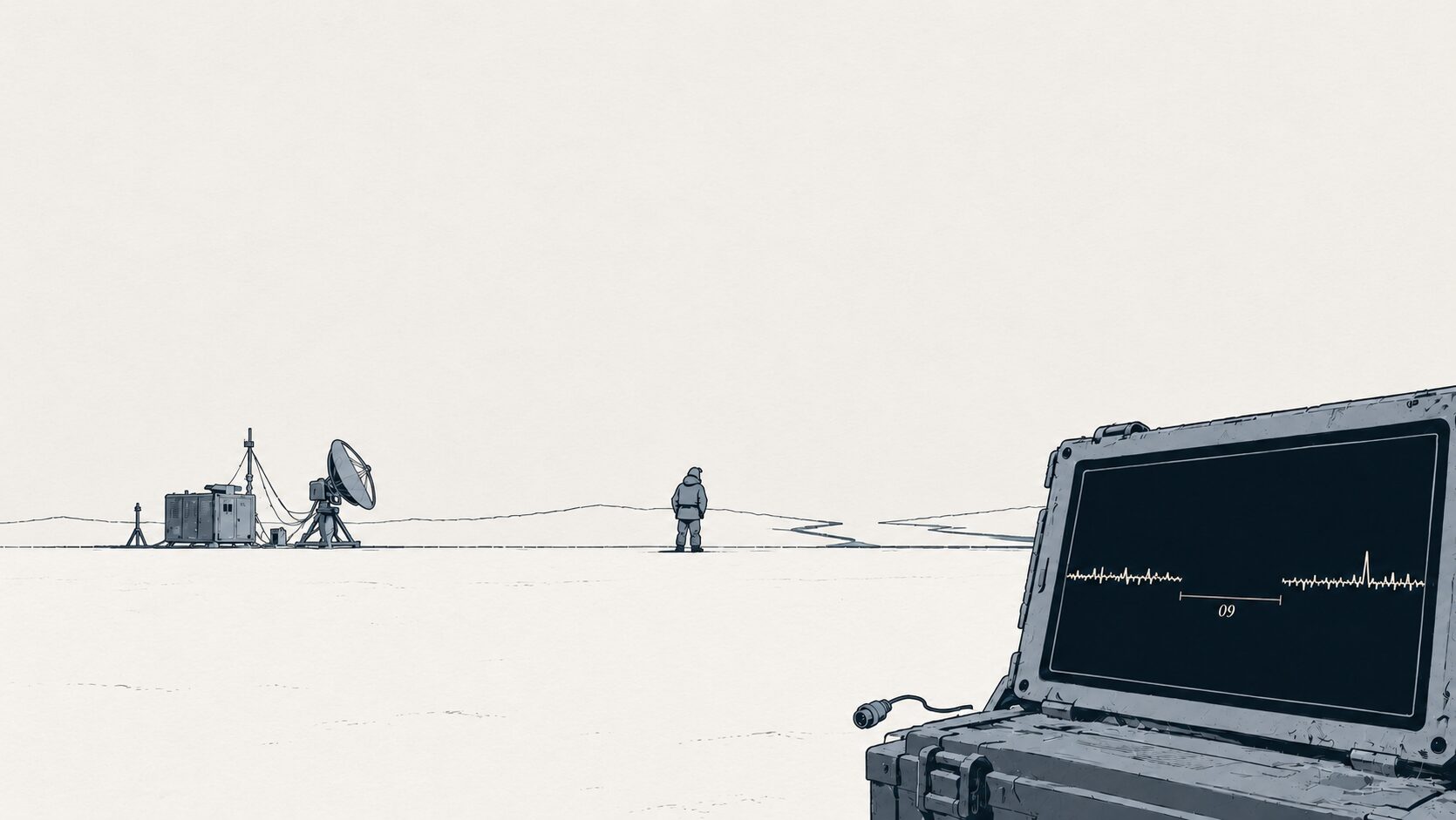
The drone flew its four kilometres. The real system tracked it cleanly through open sky, then, exactly as physics required, went dark for the nine seconds the drone spent behind the ridge, and came back the instant it cleared the rise.
Whitfield watched all nine seconds without moving. Marcus understood, watching her watch it, that the silence was the most convincing thing the quantum radar had done all week. A fraud never goes quiet at the right moment. A real detector always does.
What the Fraud Cost the Room
Renata walked in four minutes into the second demonstration and understood immediately — the disconnected relay board on the console told her everything before anyone said a word. She didn’t argue in front of Whitfield. There was nothing left to argue.
Near the door, Petrov had already started composing, in his head by the look of him, whatever a company says when a fraud collapses in front of the one officer with the power to end every future contract along with this one.
Whitfield asked two more questions before she left. Whether the false coordinates had ever reached a previous procurement board, and whether anyone besides Renata and Petrov had known. Marcus could answer the first one clean: Petawawa was his own test, on his own equipment, and nobody had touched the display pipeline back then. Whatever this was, it hadn’t happened before Cambridge Bay. As far as he could tell, the answer to the second was no — the deception had stayed narrow, contained to two people who’d decided, somewhere in a room he’d never been part of, that an honest four-kilometre result wasn’t a big enough number to put in front of a colonel with a contract to sign. That didn’t make it a smaller fraud. If anything, it made it easier to see clearly. A single clean lie is often easier to hold than a tangled one.
The room emptied slowly after that, the way a room does after something breaks that can’t go back to how it was. Whitfield left first. Then the officers. Then Petrov. Until it was just Marcus, Priya, and the console, in a hut with no demonstration left to run.
The Quantum Radar Nobody Turned Off
They should have shut it down. Everyone else had already driven back into town to make the calls that would end careers. There was no real reason to keep the cryostat cold, or the laser firing, or the idler photon sitting patient in its box, waiting for a twin nobody official was watching for anymore. But shutting it down felt like one more small dishonesty on a day that had already used up its quota, so Marcus left it running — honest version, relay still dark on the console — while he and Priya packed the crates in silence.
Something With No Name Attached to It
Priya saw it first, about an hour later — a single clean correlation spike rising out of the noise, on a screen nobody was demonstrating to anyone anymore. It had the exact signature of a genuine detection. Low altitude. Distant. Moving slowly out over the open lead in the sea ice, well beyond the last point the drone had ever flown, in a straight, unbroken line of sight the system had no trouble reaching. The drone’s telemetry transmitter was packed away in its case, in the truck, powered off. It could not possibly have sent anything at all.
“That’s not the drone,” Priya said. “The drone’s in the truck.”
“I know.”
What the Quantum Radar Still Can’t Explain
They stood over the console for a long time without talking. The trace matched every honest criterion Marcus had spent eleven months building into the system — nothing to spoof, because there was no relay board left connected, no telemetry to fake, nothing feeding the display but light itself, going out cold and true into the Arctic dark and coming back changed by something that hadn’t asked anyone’s permission to be seen.
Marcus didn’t reach for the shutdown switch. He sat down, pulled his notebook over, and started writing the numbers exactly as they arrived, one honest correlation at a time.
“Do we call someone?” Priya asked, watching the trace hold, fade, then return.
“Not yet.” He kept writing. “Whoever we call is going to want a story. Right now all I’ve got is a number on a screen. I’d rather hand them ten pages of real numbers than one good guess.”
She didn’t argue. She pulled a second chair up to the console and started logging timestamps of her own, so the record would carry two sets of handwriting instead of one. Outside, the wind found the same gap it always found in the siding — the sound Marcus had first heard in the airport terminal, the sound he suspected he’d hear on every flight out of this place for the rest of his life. Past the frost creeping up the window, the sea ice ran flat and grey into the dark, all the way to the open lead. Somewhere out past it, something that had never asked to be found was still there, waiting to be looked at properly.
Artifact Note: The Cambridge Bay quantum radar escapes the story as a small field-model artifact, carrying the nine-second break that revealed what the demonstration had tried to hide.