The Quantum Radar’s Second Cable
He didn’t say anything in the moment. Whitfield watched the screen with the stillness of someone quietly revising an opinion. The demonstration ended with applause from everyone but Marcus, and, he suspected, Priya.
That night, behind the hut, Priya showed him a cable neither of them had run. It came off the display processor, but not from the photon detector array — it came from a small receiver bolted low on the rack, tucked under a panel that had no reason to be there. It was pulling in the drone’s flight-test telemetry — the channel that streamed its GPS-derived position back to the ground crew for safety, the kind any station with the right receiver could pick up.
“It’s not correlating anything,” Priya said, her voice gone very flat. “It’s drawing a dot wherever the telemetry says the drone is, and dressing the dot up to look like a detection.”
Testing It the Hard Way
They checked it twice more, quietly. Marcus pulled the fiber optic cable clean out of the idler detector — physically disconnected the one thing that could produce a real quantum radar detection — and the trace kept updating anyway. Smooth. Confident. Tracking a drone the actual system had no way to see.
Then they asked the operator to keep the drone behind the ridge for a full minute instead of eleven seconds. The trace held there too, exactly as long as the telemetry kept transmitting, and not a second longer.
“Every flight,” Marcus said. “The whole time. They fed it live coordinates the whole time.”
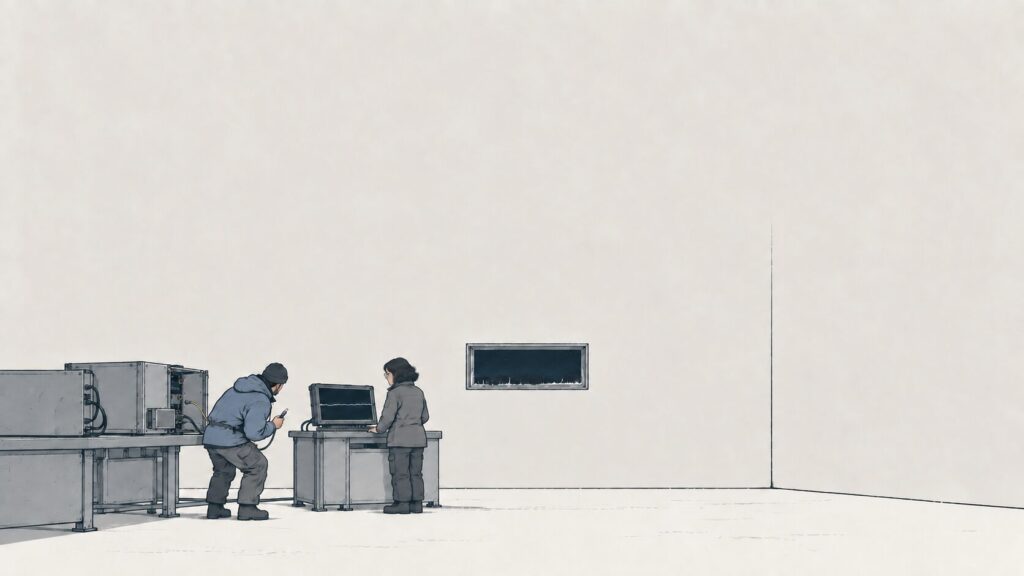
He pulled the flight logs to check. Every takeoff matched a spike in the false trace down to the second — too clean to be anything but borrowed. A real detection has some noise in it. Small dropouts. A little jitter. This had none of that at all.
“How long has it been running like this?” Priya asked.
“Long enough that somebody trusted it,” Marcus said. “That’s what I can’t get past. I ran Petawawa myself. Those four kilometres were real, every photon of them. Somebody just decided a real four wasn’t a big enough number to put in a prospectus.”
What the Company Was Really Selling
He stood there with the loose cable in his hand, thinking about the eleven months in Waterloo, the whole night he’d stayed up fixing the cryostat, the arguments he’d already lost about the eighty-kilometre figure. None of it had made it onto that screen.
The photons had gone out and come back, or hadn’t, exactly as physics required. Somewhere between the detector and the display, someone had swapped in an easier truth, because the real one wasn’t finished yet and the contract couldn’t wait for it.
“We tell Whitfield,” Priya said.
“Tomorrow. Renata first — I want to hear her say it to my face before anyone else does. Then Whitfield, whatever she says.”
Renata’s Version of the Math
He found Renata in the mess hall before sunrise, before anyone else was up, hoping one honest conversation without an audience might give her a real chance to explain something he already understood too well to be talked out of.
“The telemetry feed is a fallback,” she said. Not a denial — a framing. “The system works, Marcus. You’ve seen it work at Petawawa, at close range. We’re not lying about the physics. We’re insuring one demonstration, on one day, against bad luck, because losing this contract costs us the next three years of the real research.”
“You fed a colonel a false detection and called it quantum radar.”
“I protected something I believe in from weather and a deadline neither of us picked.” She said it like she’d rehearsed it, because she probably had. “Walk in tomorrow and tell her the truth about what the physics can already do — fine. Don’t hand her a fraud story that kills this company before the physics has a chance to catch up to what we promised.”
She nodded toward the whiteboard behind her — funding milestones, a line marking the date the Waterloo lab ran out of money if this didn’t close. “Eighty kilometres was never a lie about today. It’s a forecast, eighteen months out, if the funding holds. You know how much of the real programme is riding on this one signature. I didn’t create that pressure. I’m just standing closest to it.”
“Then give her the honest four kilometres,” Marcus said. “Let eighty be the forecast you’re asking her to fund. Not a number you stole.”
She didn’t answer that. For a moment she looked less like a chief executive and more like someone doing arithmetic that refused to come out even, no matter how many times she ran it.
The Longest Night at Cambridge Bay
He didn’t sleep, not because he was undecided but because he understood exactly what the decision would cost. Exposing the fraud meant losing the contract, probably the company, certainly his own job.
It also meant likely burying the honest four-kilometre system — the real one, the one he’d actually built — under the same scandal as the fake one. Dana would be looking for a new supervisor by spring, halfway through a degree, for reasons she’d probably never fully understand.
There was a version of tomorrow where he said nothing. Where the contract closed, and the company kept funding real research under the cover of a demonstration only he and Priya knew had been staged. He turned that version over for a long time in the dark. He couldn’t make himself keep it.