Why Quantum Radar Needs the Cold
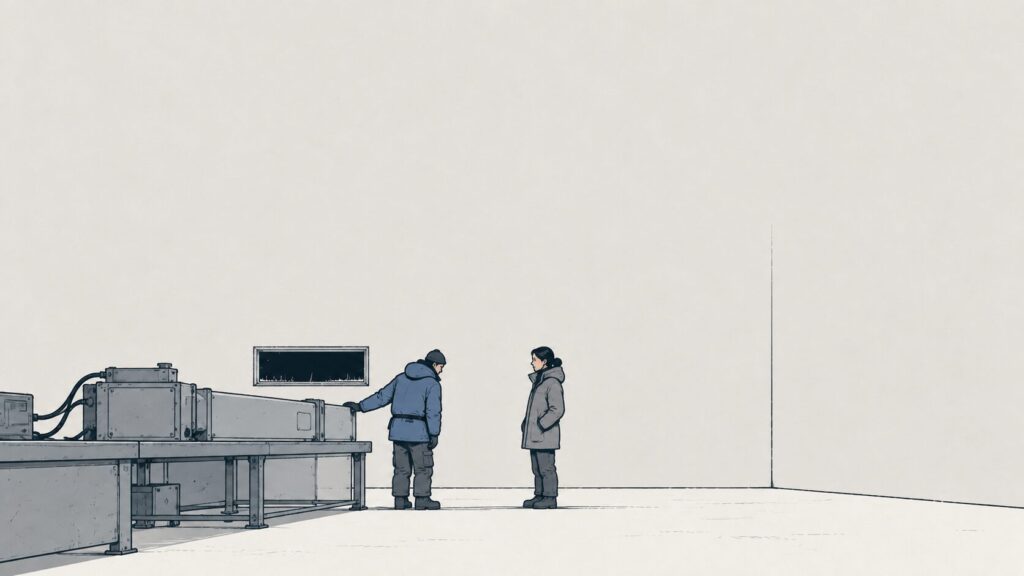
She asked, before she left, why the cryostat mattered so much. He didn’t explain it. He just walked her through what happened when it drifted.
Heat doesn’t sever the link between two photons directly. It drowns it. Every degree above spec adds thermal noise into the detectors and the source itself, and thermal noise looks — statistically — uncomfortably close to the faint correlation the system is built to find. A system running warm doesn’t announce that it’s broken. It just gets steadily worse at telling a real weak return apart from noise that happens to resemble one, until eventually it can’t.
“So right now,” Priya said, “if we ran it—”
“Right now it couldn’t tell you a real detection from noise that looked like one. That’s the whole danger of it.” He shut the housing. “Which is why this gets fixed tonight. Not tomorrow morning.”
He didn’t say the rest out loud — that a colonel who already doubted the eighty-kilometre number needed exactly one clean look at a working screen to decide the whole thing wasn’t worth funding.
A Long Night Fixing What Shouldn’t Have Broken
He worked until two in the morning. By the time Renata found him, the cryostat was back inside spec, and she wanted to know, flatly, whether the quantum radar would perform tomorrow.
He gave her the honest answer. If the drone came within range, and the air stayed cold and clear, the system would produce something real. That “if” was carrying more weight than either of them wanted it to.
“Four kilometres, low altitude, the same radar-absorbent coating we tested in Petawawa,” she said.
“At four kilometres, in good conditions, with the cryostat behaving — I’d give it a real shot. Not a guarantee.”
“Make it a guarantee.”
There was no anger in how she said it. That should have worried him more than anger would have — a request phrased like it had already been decided, whether he agreed or not. At the time, he only heard exhaustion, hers and his own, and let it go. That was the last night he could honestly say nobody had warned him.
Instead of sleeping, he went back to the hut and pointed the idler detector at a scrap of foil he’d rigged on a tripod thirty metres out. Nothing dramatic — just a small, steady target, catching a stray photon now and then. He logged twenty minutes of quiet, unglamorous counts climbing exactly where the physics said they should. It wasn’t proof of anything the company needed. It was proof of something he needed: that left alone, without anyone’s ambition attached to it, the machine still told the truth.
What Quantum Radar Cannot See Through
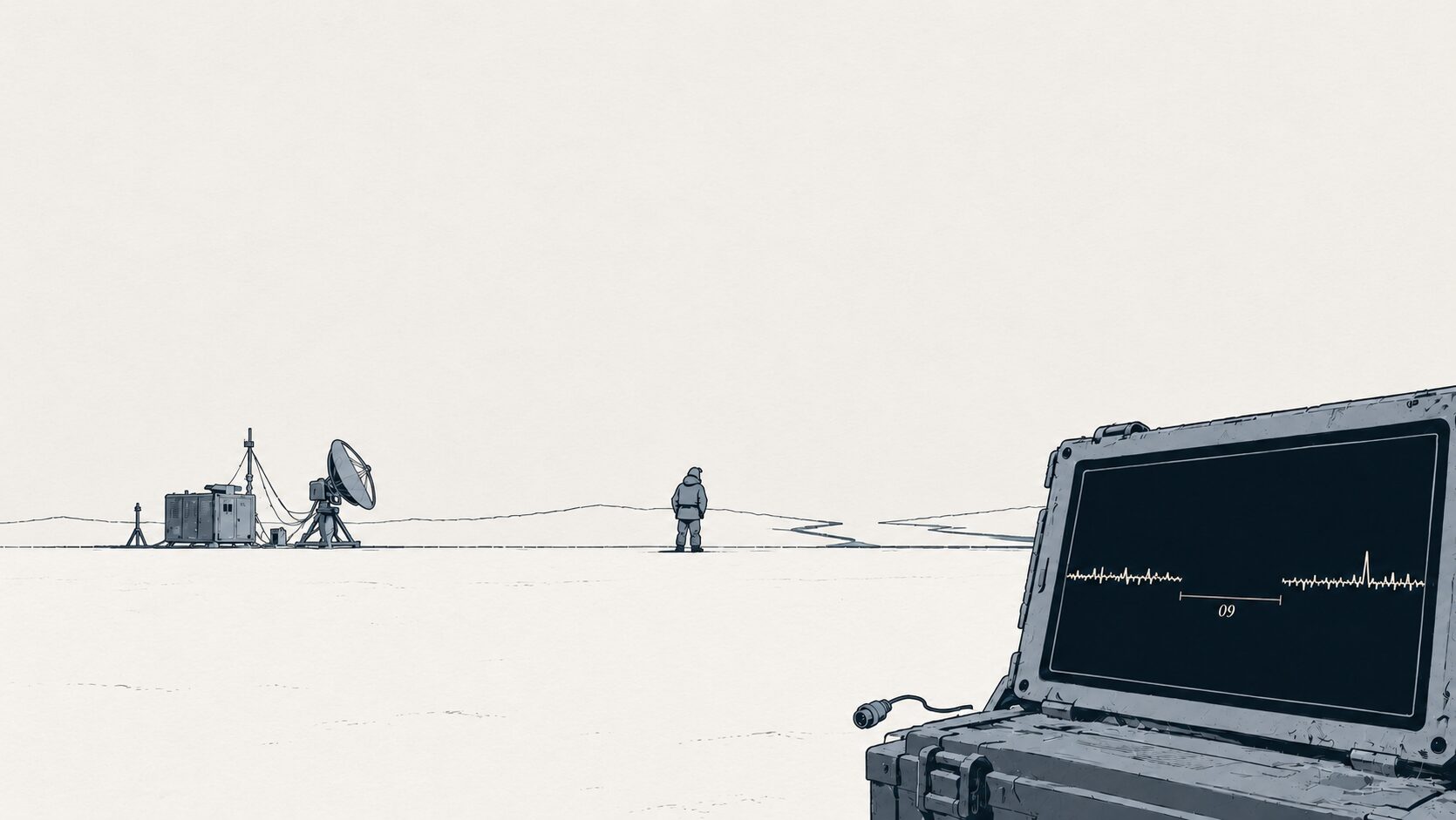
The next afternoon, out on the frozen bay, with the research station’s antenna farm behind them and the sky the flat white of a day that never quite decided to be daylight, they ran the real demonstration. Whitfield stood with two other officers, watching two screens side by side. On the left, the conventional radar, sweeping cleanly and seeing nothing — blind to the small shape climbing away from its ground crew, four kilometres out. On the right, the quantum radar display, waiting to prove there was a working eye next to the blind one.
Marcus knew exactly what the honest version of that eye could and couldn’t do. Light needs a clear path. It can’t bend around a hill any more than a flashlight beam can. If the drone dropped behind the low ridge to the north, even briefly, there’d be nothing for the signal photons to bounce off, and the screen should go quiet — not because anything failed, but because that’s what an honest system does when it can’t see.
It didn’t go quiet. The drone dipped behind the ridge for eleven seconds — Marcus counted them without meaning to — and the trace on the screen held perfectly steady the entire time. An unbroken line, through a stretch of sky the system had no physical way of seeing into.